


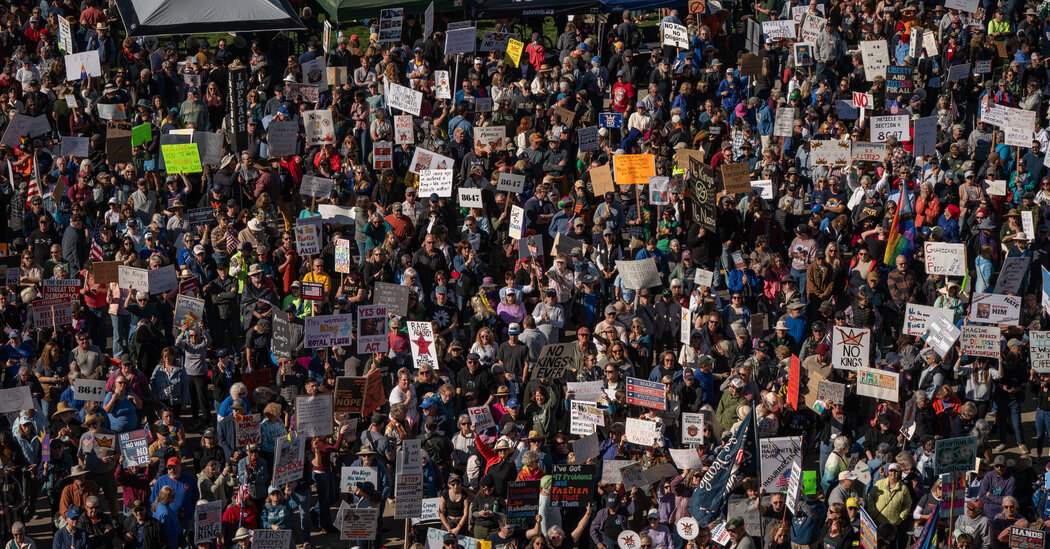
Thousands of demonstrations against the Trump administration unfolded across the country on Saturday, the third round in a nationwide series of loosely coordinated “No Kings” rallies.
The day of protest, the first since October, came as the midterm election season takes shape, and as Democrats work to capitalize politically on the unpopular war with Iran.
Exactly a month earlier, President Trump ordered the first U.S. strikes against Iran, setting off a conflict that has sent gasoline prices soaring and rattled Republicans.
The war was a central animating force in the Saturday rallies, which were attended by roughly eight million people, according to “No Kings” organizers, though their estimates in some cities were higher than those of local public safety officials. But the fighting in the Middle East was hardly the only issue on the minds of frustrated Democrats.
Here are five takeaways.
The war seemed to galvanize younger voters.
Many protesters said that the war had brought them out on Saturday. And at least in some places, the conflict appeared to be motivating younger people.
One large rally was held across the street from the University of Iowa, where the youth outreach group Voters of Tomorrow signed students up to join its organizing efforts.
Katy Gates, 22, an organizer, said the crowd was “a lot younger, more diverse and more energetic” than those at previous “No Kings” demonstrations. She attributed the change, in part, to the war.
“Our generation has grown up with this idea of endless war in the Middle East,” Ms. Gates said. “And the idea of getting into yet another is something that people are rightfully really angry about.”
Among those at the protest was Zach Wahls, 34, a state lawmaker running in Iowa’s competitive Democratic primary race for Senate. “I have not yet met somebody who is interested in another endless war in the Middle East,” he said.
Trump’s immigration crackdown remains a focus.
Even with the war in Iran dominating the national conversation, opposition to Mr. Trump’s immigration crackdown and Immigration and Customs Enforcement remained a rallying cry on Saturday.
The sprawling, flagship “No Kings” protest was held in Minnesota, where two U.S. citizens were killed by federal agents this winter as part of unrest over the Trump administration’s immigration operation there. (The administration last month ended its surge of federal agents in Minnesota, responding to mounting public criticism.)
Gov. Tim Walz of Minnesota and Senator Bernie Sanders, the progressive Vermont independent, spoke at the protest, which was held at the State Capitol building in St. Paul. Bruce Springsteen sang a song about the two citizens who died.
“This is still America,” Mr. Springsteen said. “And this reactionary nightmare and these invasions of American cities will not stand.”
In Minnesota, there were also loud chants of “end this war” and plenty of signs objecting to the conflict.
Dana R. Fisher, a professor at American University who studies civic engagement and surveyed protesters in Washington, said the share who described war and peace as their main motivator jumped drastically on Saturday compared with previous protests. But it was comparable to the share who cited concern about the administration’s handling of immigration, she said.
Dueling protests unfolded near Mar-a-Lago.
Thousands of protesters gathered on a grassy public space by a Target about a 15-minute drive from Mr. Trump’s Mar-a-Lago estate in Palm Beach County, Fla., participants said. One demonstrator carried a sign that said “Grab ’em by the midterms,” playing on the vulgar, caught-on-tape comment Mr. Trump made about women in 2005.
The crowd included Emily Gregory, a Democrat and first-time candidate who won an upset victory this past week in a Florida state legislative race to represent the area.
After prevailing in a district that Mr. Trump carried by 11 percentage points in 2024, she was greeted like a celebrity on Saturday.
“There were people that were asking us if that was really her,” said Lacy Larson, 47, an organizer.
The rally’s atmosphere was mostly celebratory, and a D.J. played music by Mr. Springsteen, Bob Marley and Tracy Chapman. “Some fine protest jams,” Ms. Gregory said in an interview.
But counterprotesters gathered to stand up for the county’s most famous resident. They unfurled a large pro-Trump flag, and the two sides chanted at each other.
The White House itself had mocked the nationwide protests. Abigail Jackson, a spokeswoman, said on Thursday that “the only people who care about these Trump derangement therapy sessions are the reporters who are paid to cover them.”
Midterm candidates came out in force.
From sunny Southern California to the unseasonably frigid northern reaches of New England, Democratic candidates in the midterm elections took to the streets to vent with voters about the Trump administration.
Gov. Janet Mills of Maine, a Democrat who is running for Senate in one of this year’s most-watched races, attended three “No Kings” protests in and around Portland, the state’s largest city and a Democratic stronghold. Her Democratic rival, Graham Platner, an oyster farmer running as a political outsider, spoke at a protest in Aroostook County, the state’s northernmost county, where Mr. Trump won by 26 points in 2024.
Ms. Mills and Mr. Platner are battling for the chance to take on Senator Susan Collins, a Republican seen as one of her party’s most vulnerable incumbents.
In Michigan, Mallory McMorrow, a state lawmaker who is in another closely watched Democratic primary for Senate, attended a rally in the Detroit suburbs. One of her leading rivals, Representative Haley Stevens, joined one in downtown Detroit.
And Senator Ed Markey of Massachusetts, who is seeking to fend off a Democratic primary challenge from Representative Seth Moulton, joined protests in Boston and its suburbs. Mr. Moulton attended a rally near Boston.
Some Democrats seen as potential 2028 presidential contenders got in on the action, too. Pete Buttigieg, the former transportation secretary and 2020 presidential candidate, attended a rally in Traverse City, Mich., where he lives. Senator Cory Booker of New Jersey, who also ran in 2020, joined a protest in St. Louis. (He was in the city as part of a book tour.)
Democrats found fresh fuel for their ‘No Kings’ slogan.
Two days before the protests, the Treasury Department said that it would begin printing dollars with Mr. Trump’s signature on them, a first for a sitting U.S. president.
The move continued a trend for Mr. Trump, whose allies have sought to put his name on the John F. Kennedy Center for the Performing Arts and the U.S. Institute of Peace, among other institutions and landmarks. The efforts have enraged many of his critics, who cast him as an aspiring monarch.
In a nod to the protests, Senator Kirsten Gillibrand of New York, the chair of Senate Democrats’ campaign arm, said on Saturday that she planned to introduce a bill to bar presidents from putting their name, likeness or signature on federal property or money.
“In America,” Ms. Gillibrand said in a statement, “we do not bow to kings.”
Wesley Parnell contributed reporting from New York, and Sheila M. Eldred from Minneapolis.

