


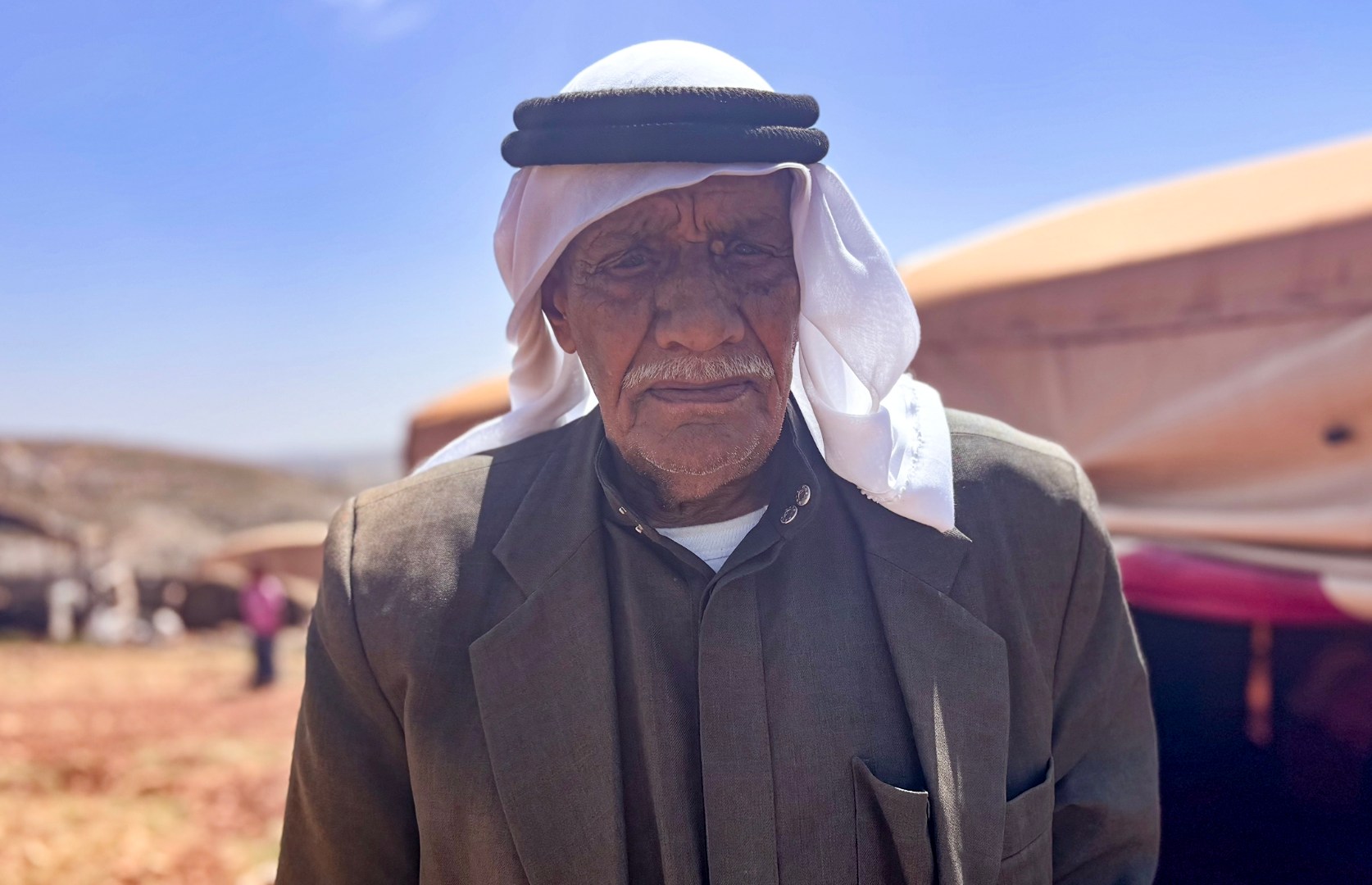
Rammun, occupied West Bank – Fresh off the seventh forced displacement of his central West Bank Bedouin community since 1948, Abu Najjeh was not in a contemplative mood leading up to Nakba Day. He said he was in a rush, too busy reacting to the crises of the day – the continuing “third Nakba”, as he called it.
“This is not a proper place to live – that’s why I’m in a hurry … waiting for a car to take me,” said Abu Najjeh, the mukhtar, or leader, of the former Bedouin community of Ein Samiya, speaking from a recently erected tent in the outskirts of Rammun before rushing to find his sons amid unfolding violence in Jiljilyya.
Recommended Stories
list of 3 itemsend of list
Just that morning, Jewish settlers had stolen hundreds of sheep and two tractors from a member of his extended family in Jiljilyya, to the north of Rammun, as well as shooting and killing 16-year-old Yousef Kaabneh – also from Abu Najjeh’s Kaabneh clan.
Like the community of Ein Samiya, Yousef and his family had been forcibly displaced from Wadi as-Seeq in 2023, one of dozens of Palestinian Bedouin communities emptied since October 7, 2023. Already ascendant, the Israeli far right has used the Hamas-led attack on Israel, along with the cover of Israel’s genocidal war on Gaza, to ramp up attacks on Palestinians in the West Bank and seize more land.
Yousef’s family had relocated to Jiljilyya, hoping to finally be safe from settler attacks in an area under Palestinian Authority (PA) administration and where Israeli civilians are prohibited from entering under Israeli law.
One of Abu Najjeh’s own sons had also fled to Jiljilyya two months earlier, thinking the same. But on Wednesday morning, dozens of settlers rampaged through Jiljilyya, Sinjil and Abwein, all in Area A. The armed settlers opened fire on residents, shooting Yousef dead. The killing took place two days before Nakba Day, May 15, when Palestinians mark the forced expulsion of 750,000 Palestinians from their homes during the Nakba – the Arabic word for catastrophe, used by Palestinians to refer to the ethnic cleansing that took place during the formation of Israel on historical Palestine.
And now, a few hundred metres away from where they recently moved to near Rammun, is another illegal settler outpost.
“Where is there to go?” Abu Najjeh wondered.

A history of family expulsions
It is a question that has haunted the Kaabneh family for eight decades.
Before 1948, the Kaabneh were Bedouins of the larger Jahalin clan living freely in the Bir al-Saba area in the Naqab Desert. They were pastoral people who grazed their flocks of livestock across the vast open ranges.
But in 1948, they were expelled from their homes by Zionist paramilitary and later military forces during the Nakba.
Pushed north to the West Bank, controlled by Jordan from 1948 to 1967, they drifted through Masafer Yatta and towards Ramallah, searching for land wide enough to sustain a herding community. In 1967, the Israelis once again forced them out, this time after they captured the West Bank in a war.
“They gave us 24 hours – they expelled us towards al-Muarrajat – no water, in September,” recalled Abu Najjeh. Throughout the 1970s, various Israeli military orders pushed them around different areas in the southern West Bank, and towards Ramallah, he explained. “Since 1967,” he said, “we haven’t rested a single day.”
Around 1980, they finally found what started to feel like home. In the hills east of Ramallah, at a place called Ein Samiya – named for the nearby spring – the community put down roots, remaining there for more than 40 years. The flocks grew to thousands, and the children had a school. “The feeling was one of ease,” Abu Najjeh said, the only moment where the urgency dropped from his voice. “The livestock could graze all the way to the spring at al-Auja, drink, and come back to us. It was a blessed life.”
Starting in the 1990s, the community faced periodic demolitions of their tent homes from Israeli authorities, who almost never grant building permits for Palestinians in Area C of the West Bank, which is under full Israeli administrative control. With help from humanitarian organisations like Action Against Hunger, they were able to weather such demolitions.
But when the settlers came, it was different.
Beginning around 2019, a settler outpost appeared nearby. What started as harassment in the grazing lands moved inside the community’s residential area by 2021. Soon enough, settlers blocked the community from accessing the spring. They placed spikes on the road to Ein Samiya, and they photographed the families’ flocks as a precursor to confiscation.
Due to settler thefts, poisonings and restriction of land access forcing people to sell their sheep, the flock collapsed from 2,500 to fewer than 500. As violent attacks escalated alongside such livestock thefts, Ein Samiya became one of the first Bedouin communities to be forcibly displaced in May 2023, months before the October 7 attack on Israel, and Israel’s subsequent genocidal war on Gaza. It is a wave that has since accelerated dramatically, wiping out dozens more communities.
Abu Najjeh’s son called that 2023 violent displacement “another Nakba”.
But the new Nakba did not end there.

‘We didn’t expect them to come’
Most of the Ein Samiya relocated with Abu Najjeh to Khirbet Abu Falah in Area B, where the Palestinian Authority has administrative control, but shares security control with Israel. The farmland was not optimal for a herding lifestyle, but “we said this is an Area B area – we are allowed there, we felt secure,” Abu Najjeh recalled.
But by 2025, new illegal outposts had appeared in the immediate vicinity of Khirbet Abu Falah, and attacks resumed from the same group of settlers, who had followed them there.
Facing rising thefts of their sheep and attacks and invasions of their shelter, during Ramadan this year, “We had to leave again, expelled while we were fasting,” said Abu Najjeh. While they had managed to pack up much of their possessions from Ein Samiya, the settlers in Khirbet Abu Falah forced them to abandon much of their belongings.
Eight of Abu Najjeh’s married sons scattered elsewhere.
The mukhtar arrived at Rammun with one son and a handful of grandchildren.
‘I don’t know where to go’
On this hillside, there is no electricity, and water is trucked in at 250 shekels ($86) a tank. The strip sits among cultivated olive groves – and “to graze sheep on a neighbour’s farmland would be wrong,” Abu Najjeh said. The few animals that remain are no longer a livelihood, but an economic burden.
“I was forced here into an area that has absolutely nothing – nothing above, nothing below,” remarked Abu Najjeh.
As his phone rang with new alerts from Jiljilyya, Abu Najjeh grew more restless. “Small children, since the day the settlers appeared, they have been afraid,” said Abu Najjeh. “At night, they dream of settlers. During the day, they’re afraid. When they see a car, they say it’s a settler.”
And yet, even after moving to this tiny strip of unsuitable land, settlers established another outpost in the Rammun area within the past week, adding to an outpost built just across the narrow valley two years ago – within eyesight of where Abu Najjeh’s grandchildren sleep.
“I’m afraid every night, every moment,” said Abu Najjeh. “They are right there. A kilometre, half a kilometre, three hundred metres.”
“But I don’t know where to go. There is nowhere to go. That is the problem.”

‘We live on the land and die in it’
Once the settler groups succeed in clearing a community, settlers often move on as well – following wherever the displaced families resettle. And so 78 years after the original Nakba, Abu Najjeh is not so focused on the Nakbas of the past.
“The Nakba of 1948, the Nakba of 1967, the Nakba of 2023,” he said. “This is the third Nakba.”
He gestured towards the east. “From Ein al-Beida [in the north] all the way to Masafer Yatta [in the south] – they cleared the entire eastern face. No grazing land is left. No place to set down your caravan. None left.”
According to the UN’s Office for the Coordination of Humanitarian Affairs, since January 2023 and up to May 4, 2026, more than 5,900 people from 117 communities across the West Bank experienced full or partial displacement due to settler attacks and related access restrictions. Forty-five communities have been erased completely. About 2,000 have been driven from their homes in 2026 alone.
Tens of thousands of Palestinians have also been forced out of their homes by Israeli military attacks in the West Bank.
Settler attacks, as well as the Israeli military’s near-daily raids on Palestinian towns and villages in the West Bank, have killed at least 1,090 Palestinians since October 2023, according to the UN.
“We live on the land and die in it,” said Abu Najjeh, invoking a Bedouin saying. “But brother, we need people. A community of seven or 10 men who want to resist 60, 70 men – they can’t resist.”
With communities across the West Bank now under threat, humanitarian workers on the ground describe what is happening to the Kaabneh not as isolated settler violence, but as a systematic pattern.
“They want the world to starve,” said Abu Najjeh. “To make life impossible so that the world emigrates.”
Abruptly, Abu Najjeh stood on his feet. His sons were somewhere in Jiljilyya, amid rampaging settlers and soldiers. There was no more time for reflection – only the next crisis. “My people need me – I must go.”

