


Demand for mental health support is drastically on the rise in Australia.
For many it means a call to Lifeline, where for them it feels like the volunteer on the other end of the line is the only person willing to listen.
And while the purpose has not changed in the 40 years since the service started — the demand and the nature of the calls certainly have.
Lifeline WA is experiencing record demand, now receiving more than 160,000 calls for help each year. More and more people are reaching out for support with loneliness, domestic violence, anxiety and suicidal thoughts.
Help is especially sought by men, who account for about 75 per cent of suicide deaths in Australia.
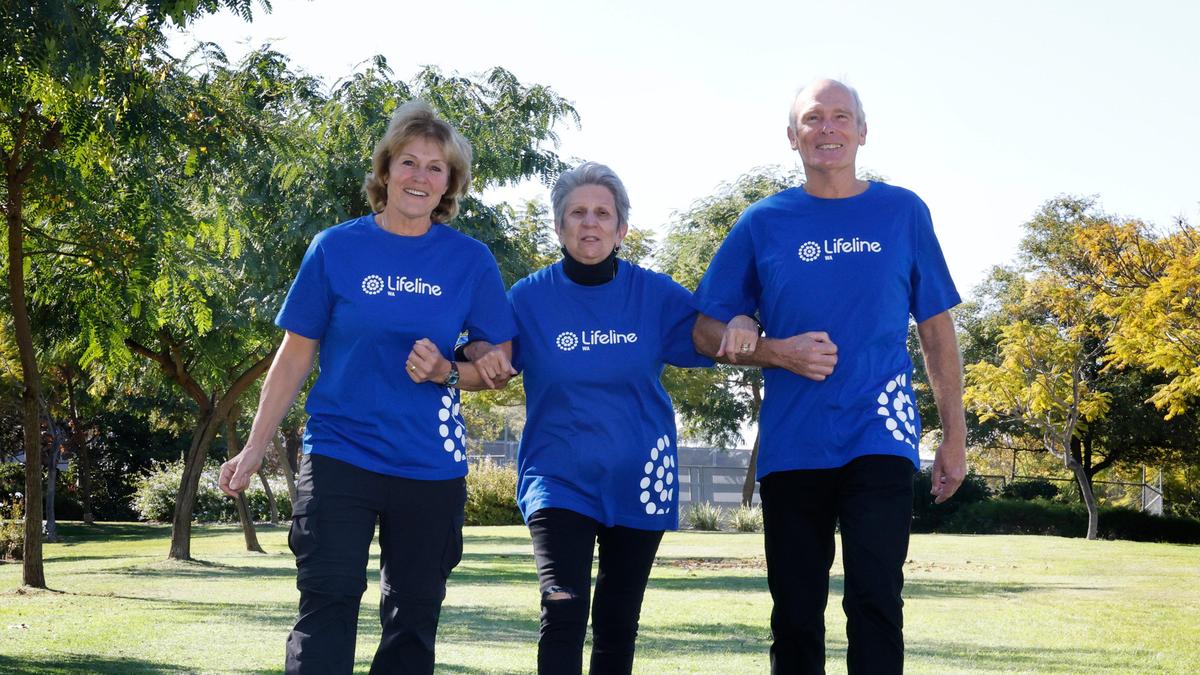
Concern around men’s mental health was what prompted volunteers like John Sivertsen to get involved.

“I’d been aware of the increasing suicide rates among young men for a long time, but didn’t know how to do anything practical about it,” he said.
“Lifeline felt like somewhere I could genuinely help — and sometimes it’s easier for another bloke to talk to a man.”
For the service in WA calls involving mental health account for about 43 per cent of topics mentioned. That is followed closely by family and relationship issues at 42 per cent, while loneliness makes up 17 per cent.
It reflects the changing nature of issues facing West Australians and the surge in psychological distress.
The statistics are alarming. Every day in Australia nine people die by suicide, seven of which are men. Yet, only 37 per cent of men and boys reach out for support when they need it.
Mr Sivertsen says anonymity plays a key role in breaking down barriers.
“A lot of men are reluctant to talk about their feelings. Sometimes anonymity is what helps them begin opening up. It can be easier to speak honestly when you know you’re not being judged,” he said.
Over four decades, Tina Baldwin has answered more than 33,000 calls — sitting with people through some of the most difficult moments of their lives.
Now, aged 76, she is one of Lifeline WA’s longest-serving volunteers.
But within those tens of thousands of calls, it’s one in particular that has stayed with her.

“One caller told me he couldn’t go on anymore and was planning to end his life. I simply encouraged him to keep talking. After a long conversation, he said: ‘What I was going to do, I’m not going to do now. I’m going to keep speaking with someone instead.’ That has always stayed with me,” Ms Baldwin said.
She is well aware that the need for services like Lifeline has never been greater, but the operation now is a far cry from the organisation’s humble beginnings.
In 1986, before mobile phones or the internet, support often came down to a handful of people answering calls behind the scenes of Radio 6PR’s Nightline, where host Graham Mabury noticed vulnerable callers reaching out on air.
“Sometimes people would ring the station to try and talk,” Mr Mabury said. “Other stations would use them as fodder for entertainment. We were determined to keep them off air, respect their dignity and provide real support.”
At the time, there were few alternatives.

“People called us because they didn’t know where to turn and, quite honestly, there was almost nowhere to turn,” he said.
In those early days, support was improvised. Counsellors initially handled calls, but when they stepped away, a small group of volunteers continued the work—quietly forming what would become Lifeline WA.
“While I was on air, they were taking calls off air. That was the beginning of Lifeline,” Mr Mabury said.
“Everything was done over telephones and public phone boxes.

“I remember taking a call from a young woman fleeing domestic violence from a phone box late at night. We had to send my PA to find her and help her to safety.
“There was very little we could do beyond being the ambulance at the bottom of the cliff. To see what Lifeline has become is absolutely gobsmacking.”
And while the service has gone from strength to strength, the organisation knows it has to prepare for even greater demand.
CEO Lorna MacGregor says call volumes are expected to exceed 200,000 a year by 2029, requiring a significant expansion of its volunteer base.
Data shows many calls involve overlapping problems rather than a single crisis, with “other” issues making up about six per cent of crisis-call topics.
“We currently have 450 crisis support volunteers, but we know demand is growing,” she said.
“We’ll need around 600 highly trained volunteers ready to support the WA community.”
Despite the scale of the service today, she says its core remains unchanged.
“I remember someone with lived experience once saying the reason they called Lifeline was because they knew the person answering the phone was doing so because they cared — not because they were paid. That compassion is at the centre of everything we do,” Ms MacGregor said.
Lifeline: 13 11 14

