


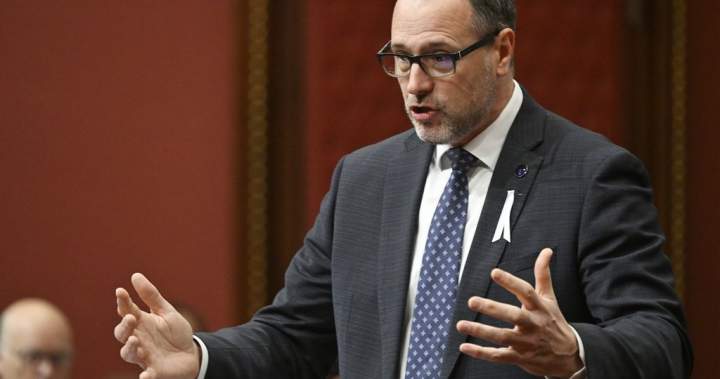
Quebec’s government has introduced new legislation to expand the province’s French language charter to adult education and vocational training, prompting concern and criticism from English-language institutions and opposition parties.

The proposed law, known as Bill 8, was tabled by French Language Minister Jean-François Roberge. It would apply key provisions of the Charter of the French Language, also known as Bill 101, to adult education and trade programs.
Under the bill, students who do not hold eligibility certificates allowing them to attend English-language primary and secondary schools — and, more recently, English CEGEPs — would be required to pursue adult education in French.

Roberge said the government’s objective is to strengthen the use of French in Quebec, not to harm English-language school boards.
“We have a plan and we will achieve our goal — to reverse the decline of the French language,” Roberge said.
But the proposal is generating unease among students and administrators in the English system.

Get daily National news
Get daily Canada news delivered to your inbox so you’ll never miss the day’s top stories.
At an adult education centre in Montreal’s Saint-Léonard district, some students say they feel targeted by the changes. Norman Kawodo, who moved to Quebec from Uganda six years ago, said she was surprised by the approach.
“I come from a country where there are multiple languages and nobody is forced to learn the other language,” she said. “People learn freely.”
English school boards warn the new rules could drive students away from training programs at a time when skilled workers are in high demand.
Quebec English School Boards Association President, Joe Ortona, said many students could abandon their studies rather than switch languages.

“You’re going to have a bunch of students who came here willing to learn a trade dropping out and not entering the workforce where they’re desperately needed,” he told Global News.
Government figures suggest the bill would make roughly three-quarters of students currently enrolled in English-language adult education ineligible to continue in that system.
Ortona accused the government of ignoring the concerns of English school boards. “I don’t think he thinks about the English school boards at all,” he said.
Education Minister Sonia Lebel defended the proposal, saying it is primarily aimed at newcomers.
“When you come to Quebec, you have to live and work and prosper in French,” she said, adding the government wants to encourage immigrants to learn the language through their studies.
The legislation would not take effect for two years, meaning current students would not be affected.
Still, critics say the government has not adequately consulted stakeholders.
“There has been zero consultation on this,” Ortona said.
The Quebec Liberals are calling for formal hearings on the bill. Liberal MNA André Fortin suggested the timing of the proposal is calculated, as there is limited time remaining before the end of the current parliamentary session.
“It tells me (they) want to campaign on it. That’s it,” Fortin said.
Questions also remain about whether the French-language system has the capacity to absorb an estimated 27,000 additional students who could be redirected under the new rules.
The proposal is expected to face debate in the National Assembly.


