


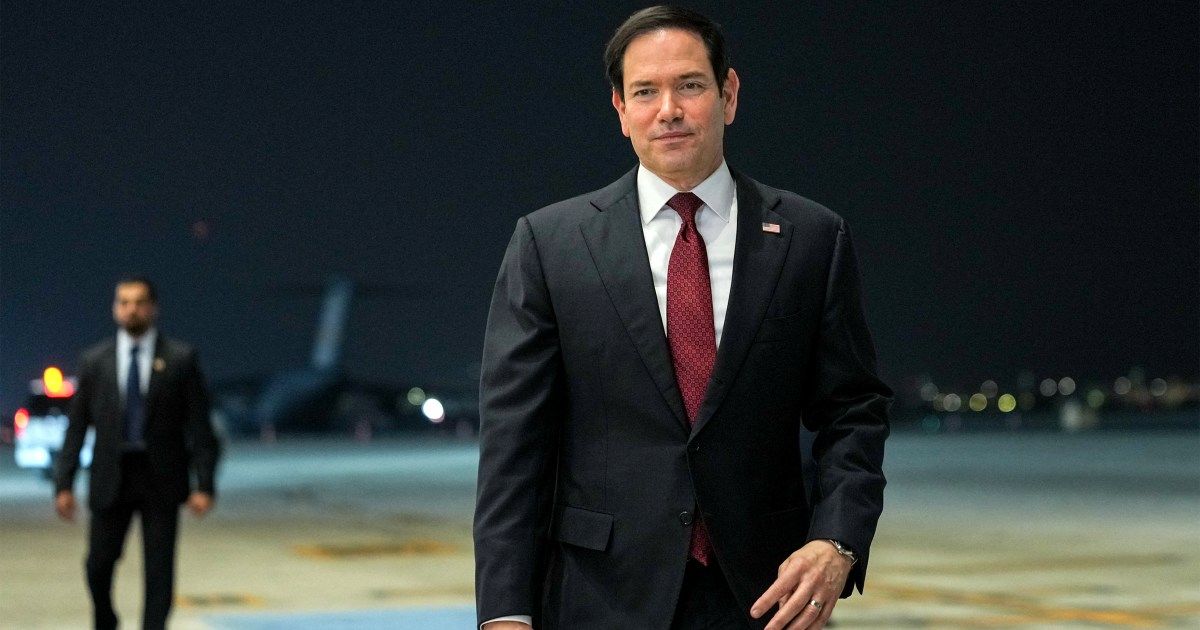
US Secretary of State Marco Rubio has said Iran will not be permitted to charge tolls or fees for vessels transiting the Strait of Hormuz under any final agreement with Washington, exposing one of the biggest points of friction in negotiations aimed at ending months of conflict across the Middle East.
The dispute comes after Iran announced it would waive planned transit fees through the strait that crosses through its territorial waters for 60 days while talks with the United States continue in Switzerland, suggesting charges could be introduced once the negotiating period expires.
Recommended Stories
list of 4 itemsend of list
Washington and Tehran signed a preliminary agreement in Switzerland this week to halt hostilities and launched a 60-day diplomatic process focused on sanctions relief, Iran’s nuclear programme and the future administration of the Strait of Hormuz.
Pakistan, which helped mediate the talks alongside Qatar, has said negotiations to end the four-month US-Israel war on Iran are expected to resume early next week, likely on Tuesday.
The future of Hormuz has already emerged as a key sticking point after Iran effectively closed the waterway during the war, severely disrupting maritime traffic through one of the world’s most important energy chokepoints and causing the price of oil to soar.
In peacetime, one-fifth of the world’s oil and natural gas supplies are shipped for export by Gulf producers through the waterway.
In April, the US imposed a corresponding naval blockade on Iranian naval ports in a bid to stem Iranian oil exports.
While a number of ships have crossed through the strait since the US-Iran agreement was signed last week, uncertainty remains over whether Tehran intends to impose permanent fees or service charges on shipping operators using the route. Here’s what we know – and what else is happening in the Strait of Hormuz this week.

What are the US and Iran saying?
On Friday, Iran’s Persian Gulf Strait Authority (PGSA) said planned fees for ships using the waterway would be suspended during the 60-day negotiation period established under the memorandum of understanding (MoU) signed with the US.
Earlier this week, Iran and Oman said in a joint statement that they would study the future administration of the trade route as well as possible charges for services provided there, while maintaining their sovereignty claims over territorial waters bordering the strait.
Speaking at the start of a regional tour in the United Arab Emirates, Rubio rejected the idea of transit fees. “It’s an international waterway. No country is allowed to charge tolls or fees on an international waterway,” he said, adding that he believed “all the countries in this region would agree”.
Iran’s chief negotiator, Mohammad Bagher Ghalibaf, has signalled that Tehran views the post-war arrangement as fundamentally different from the status quo that existed before the conflict, however. Experts also say that Iran will not give up control of the strait, which has proved to be its greatest point of leverage in the conflict with the US.
“Hormuz will never return” to its prewar status, Ghalibaf said, despite both sides agreeing on Monday to establish “communication mechanisms” aimed at keeping the waterway open.
What does international law say?
International law protects the right of transit through strategic waterways such as the Strait of Hormuz, preventing coastal states from imposing explicit tolls simply for passage through international shipping lanes, even when they are passing solely through territorial waters.
However, countries can charge for specific services, including inspections, navigation assistance, security measures and certain insurance-related requirements, insurance experts say.
Examples include fees associated with transit through the Suez Canal and Panama Canal, as well as some services provided in Turkiye’s Bosporus and Dardanelles straits.
Mohammad Reza Farzanegan, an economist at Germany’s Philipps-Universitat Marburg, told Al Jazeera last month that Iran, like Turkiye, could justify a negotiated mechanism for transit fees or service-based contributions through natural straits as payment for maintaining a safe passageway, reducing environmental risks and providing predictability in a waterway that supports global energy, food and technology supply chains.
A key difference, however, is that while those waterways pass through the territory of a single state in each case, the Strait of Hormuz passes through the territorial waters of both Iran and Oman, while also connecting to waters used by the United Arab Emirates and other Gulf states.
“This sort of arrangement is unprecedented, and there would not be such an outcome, unless there is a complete coordination between the GCC [Gulf Cooperation Council] countries and Iran, with the approval of major international powers, such as China and the United States,” Nader Habibi, an Iranian American economist, told Al Jazeera.
How many ships are getting through the strait now?
Ship movements through the Strait of Hormuz remain well below prewar levels, when between 120 and 140 ships transited the passage each day, including tankers carrying about 20 million barrels of oil from the Gulf.
As the strait begins to open up, Oman says it is working with the United Nations’ International Maritime Organization (IMO) on temporary arrangements to facilitate safe transit through the strait, launching an operation to evacuate more than 11,000 sailors stranded in the area after the conflict left hundreds of vessels trapped for months.
Traffic through the strait has also been held back by ongoing concerns about the possible presence of sea mines in the central shipping channels used by international vessels before the war.
The Joint Maritime Information Center (JMIC), which includes representatives from the US and other maritime partners, has warned ships to avoid the area “due to the existence of mines”.
Other countries, including Japan, are currently weighing up whether to send ships to help with efforts to remove mines from the strait.
While Iran has never confirmed the presence of mines in the strait, when it first issued a map of the waterway for vessels it had approved for transit while the conflict was ongoing, it ordered ships to pass close to its coast to avoid possible mines. Ships had previously passed much closer to the coast of Oman.
The graphic below illustrates how much shipping through the strait dropped off as a result of the US-Israel war on Iran.

Could the dispute over strait fees derail a peace deal?
Mostafa Khoshcheshm, a professor at the University of Applied Sciences in Tehran, told Al Jazeera that Iran is unlikely to abandon plans to introduce long-term service fees in the strait.
“According to the MoU, Iran is not going to charge service fees for 60 days, but afterwards, Iran is definitely going to do that,” Khoshcheshm told Al Jazeera.
He said many Iranians were already unhappy that Tehran had agreed to suspend fees for the duration of the negotiating period.
“The money is not the real core of the issue,” he said. “The point here is how to impose your new protocols in the region. This is highly important for the Iranians.”
Cyrus Schayegh, professor of international history and politics at the Geneva Graduate Institute, told Al Jazeera the success of any new administrative arrangement would depend heavily on regional support.
“I think this is a very big question, and the biggest question is whether they will be able to sell it to the Emirates,” Schayegh told Al Jazeera.
“I think the Emirates will need to be involved in a really substantive way for any sort of new authority to actually work.”
More broadly, he said, the future of Hormuz forms part of a wider debate over Gulf security architecture following the war.
“It is only one piece of a much larger puzzle,” Schayegh said, adding that several regional states now accept that Iran has strengthened its deterrence capabilities following the conflict.
What other issues remain unresolved?
Hormuz is far from the only serious obstacle to a peace deal.
Questions also remain over the future of Iran’s nuclear programme, with Kazem Gharibabadi, Iran’s deputy foreign minister for legal and international affairs, saying that access for international inspectors to nuclear facilities damaged during the war would only be addressed as part of a final agreement with Washington.
His comments came after US President Donald Trump claimed Iran had agreed to “the highest level” of nuclear inspections.
Iranian officials insist no commitments were made in Switzerland regarding Tehran’s nuclear programme and say they did not meet representatives of the International Atomic Energy Agency (IAEA), including Director-General Rafael Grossi.
Regional security remains another major source of disagreement, with Israeli Defence Minister Israel Katz insisting Israeli forces will not withdraw from southern Lebanon “even if there is an American demand” to do so.
Meanwhile, Ghalibaf has identified the withdrawal of foreign military forces from the Middle East as one of Tehran’s strategic objectives in the negotiations.
The future of Iran’s frozen assets also remains a sticking point, with Trump indicating Washington is reluctant to release large sums of Iranian funds directly, arguing that money could ultimately benefit the Islamic Revolutionary Guard Corps (IRGC).
Instead, he has suggested a mechanism under which some funds would be used to purchase US goods.
“Food is desperately needed in Iran, and we will be purchasing it for them exclusively from the United States,” Trump said. Iran has not confirmed plans to do this.

