


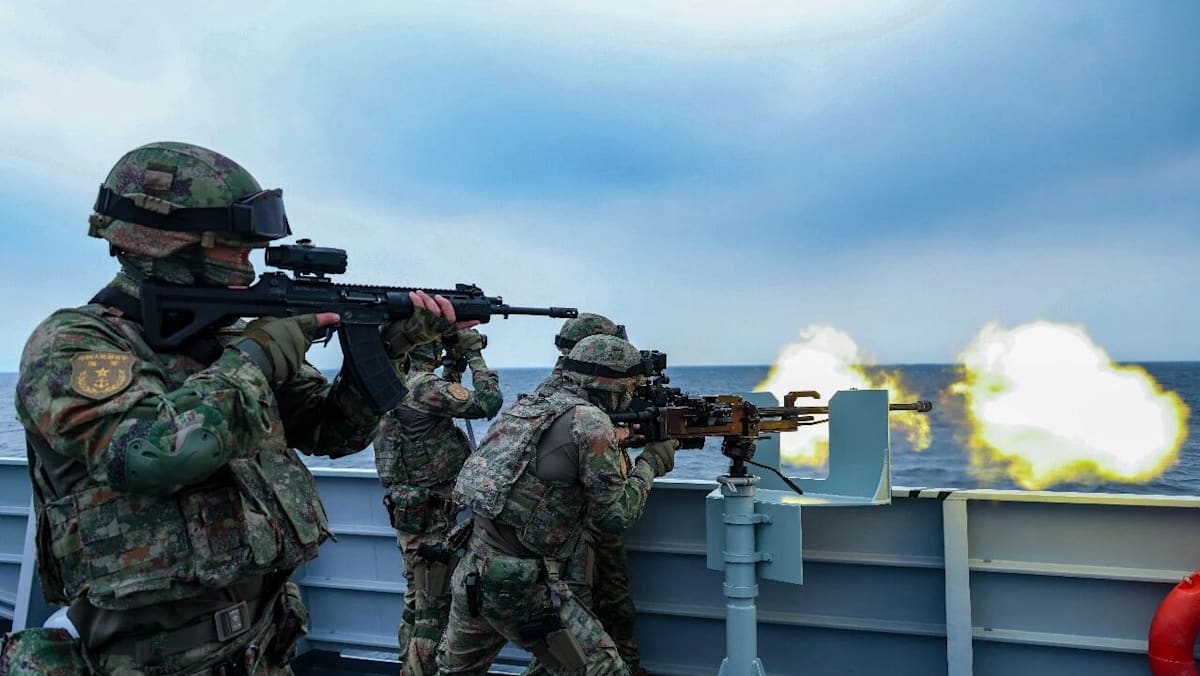
For Japan, the signalling comes clearest through both military activity and geography, analysts said.
Brand said bomber patrols and repeated transits through nearby waterways – maritime and aerial actions – kept “a two-front problem in front of Japan”, adding another layer to the pressure Tokyo would have to account for in any regional crisis.
Beyond those immediate audiences, Hao said, the wider region receives a dual message – that China is demonstrating resolve in the security sphere, while maintaining engagement through trade, diplomacy and regional mechanisms.
FROM SIGNALS TO A SUSTAINED POSTURE
The coming months may offer a better indication of whether the recent activity marks the beginning of a more enduring pattern, said analysts.
For Johns Hopkins University’s Kardon, one of the clearest indicators will be whether China can sustain coast guard operations east of Taiwan.
“If there is a CCG task group on station continuously in the coming months, this will be a good indication of more assertive law enforcement actions to come in those sensitive waters, which may precipitate a crisis with Taiwan, Japan, or the Philippines,” he said.
Further submarine-launched ballistic missile tests into the Pacific, or other conspicuous submarine and missile activity, would also be closely watched, Kardon added.
Such developments “should be interpreted in Washington as a signal of Beijing’s willingness to escalate beyond the region in the event of American intervention in a Taiwan contingency”, he said.
Highlighting similar indicators, Brand said the key question was whether the current pattern hardened into doctrine or faded with the summer exercise season.
“One test is a signal. A cadence is a doctrine,” he said.
At the same time, the evolution of China’s military presence may not only be measured on the surface.

