


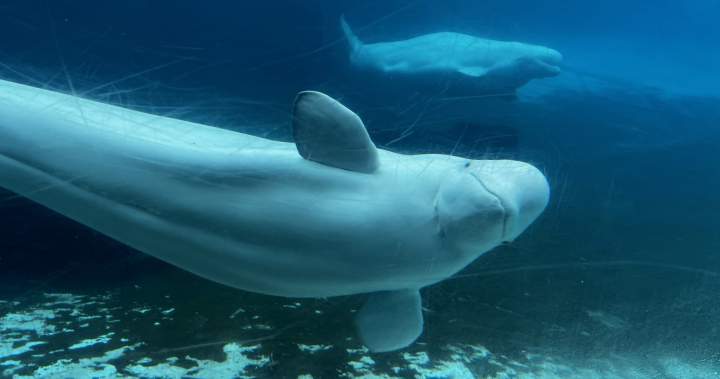
Six beluga whales have started their journey to the U.S., with Marineland beginning the relocation process.

It’s part of a deal struck with an international group of marine parks, with U.S. authorities approving the “emergency rescue” earlier this month.
“Today marks a significant milestone,” Marineland said in a statement to Global News.
Relocating the marine mammals of this size is a “complex” undertaking, according to the park’s statement, which required months of planning and cross-border coordination.
Phil Demers, a former Marineland trainer-turned outspoken critic of the park, said the journey is a “historical moment.”
“These will be the first of the last of those animals,” Demers told Global News. “The list of animals that have survived Marineland up until recently had almost no names on it, and now there’s a long list including bears, including bison … the dolphins will ultimately and the belugas will be entirely removed and that will be the end of Marineland.”
Niagara police were assisting with traffic control in support of the transportation of the mammals, the service confirmed in an email to Global News.
A copy of the plan laying out the complex movement of the whales was obtained by The Canadian Press last month.
It states the move will involve a number of staff from Marineland and the American aquariums, specialized containers to hold each whale, transport trucks and a police escort.
Demers acknowledged there is an element of stress and risk for the animals, but he said they are in the hands of professionals, adding he’s done similar transfers multiple times before.

Get daily National news
Get daily Canada news delivered to your inbox so you’ll never miss the day’s top stories.
The whales are expected to be moved from Marineland and transported to Shedd Aquarium in Chicago and SeaWorld in San Antonio.

Marineland has been trying to ship its 30 beluga whales and four dolphins for several months, attempting to transport them to China last year before the federal fisheries minister blocked the move.
As a result, it struck a deal with the consortium of marine parks. Last month, the Canadian government endorsed the rescue plan led by the international team, according to Johnny Ford, a spokesperson for Shedd Aquarium.
The plan would see the remaining whales divided between four U.S. aquariums, including Shedd, SeaWorld in San Antonio and San Diego, and Georgia Aquarium in Atlanta. Some whales would also be sent to the Oceanografic Valencia in Spain, Europe’s largest aquarium.
In a statement Monday, Fisheries Minister Joanne Thompson said the consortium would provide details as the rescue operation proceeds.
“The first wave of the rescue mission at Marineland is underway,” she wrote. “I would like to extend my thanks and appreciation to the consortium, the veterinarians on site, and all organizations leading the work to ensure they are transported safely.”
While getting the whales out of Marineland is a benefit, animal welfare group Animal Justice says it would be better if they were heading to a seaside sanctuary.
“We’ve always known that there’s not enough space at sanctuaries for all of these belugas, there’s 30 of them, so we acknowledge that probably going to U.S. facilities is the least worst option for many of these animals,” said Kaitlyn Mitchell, the group’s director of legal advocacy. “But again, it’s disappointing that, first of all, no one is actually focusing on the sanctuary as an option.”
The fate of the belugas has been in question since the park shut its doors in 2024 following the death of the attraction’s last surviving owner.
Marineland had also threatened euthanasia of the whales if the federal government didn’t enact emergency funds for the continued care of the whales. The aquarium said it could no longer afford to keep the animals alive.
In April, a federal government source with direct knowledge on the matter told Global News that funding in the range of an eight-figure number was ready to provide assistance.
Further financial details have yet to be released.
Ford said the Department of Fisheries and Oceans (DFO) concluded moving the belugas to the five accredited aquariums is “in the best interest of the animals’ wellbeing.”
A spokesperson for Thompson’s office told Global News last month permits had been issued under the Convention on Internatoinal Trade in Endangered Species of Wild Fauna and Flora, otherwise known as CITES permits. The office said final animal health checks are required before final authorizations under the Fisheries Act will be granted.
But Mitchell said the whole situation could have been avoided.
“It could have been avoided by Marineland being held to account for its treatment of animals over the years,” she said. “It would have been avoided by provincial officials stepping in and improving the health of these animals and it could have been avoided by the federal government letting Canadians know what is going on.”
—with files from Global News’ Rachel Morgan and The Canadian Press
© 2026 Global News, a division of Corus Entertainment Inc.

