


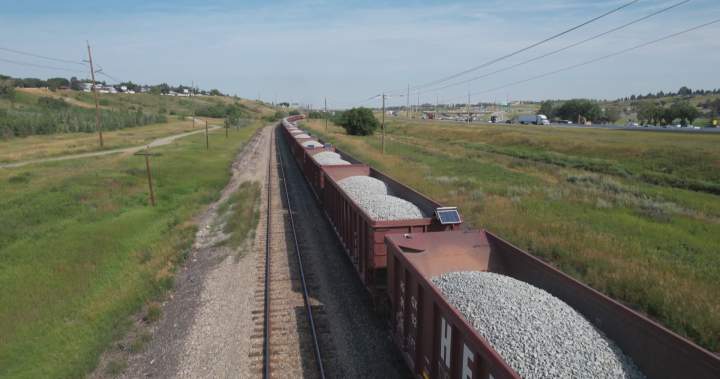
The City of Calgary and Rockyview County have signed on to an agreement that’s set to accelerate work around Prairie Economic Gateway, a multi-billion dollar logistics hub slated for the city’s southeast limits.

The memorandum of understanding announced Tuesday is between the two municipalities and the Canada Infrastructure Bank (CIB), and is set to “speed up the transition from engineering design to construction activities” near the proposed site.
Dubbed an “inland port,” Prairie Economic Gateway is set to be built on 1,300 acres along 114 Avenue S.E. as part of a regionally-approved collaboration between the city and Rockyview County.
Once complete, it would be one of the largest trade, logistics and manufacturing hubs in Canada, anchored by the Canadian Pacific Kansas City (CPKC) rail network.
Oyin Shyllon, the city’s project manager for Prairie Economic Gateway, said the agreement with the Canada Infrastructure Bank is “very significant” in advancing the project from a vision to reality.
“It’s about progression,” he told Global News. “This is about moving from regional potential into coordinated action.”
Shyllon said the deal also signals momentum and confidence in Calgary’s economic future in the region.
According to a press release issued Tuesday, the deal establishes a framework for the organizations involved to assess the commercial, technical, and financial feasibility of the public off-site infrastructure needed to enable future development.

Get daily National news
Get daily Canada news delivered to your inbox so you’ll never miss the day’s top stories.
“The Canada Infrastructure Bank’s expertise is second-to-none from an investor lense,” said Rockyview County’s manager of intergovernmental services and economic development, Ben Manshanden.
“I characterize it as the gold standard of due diligence that would allow all parties the comfort they would need to proceed.”
The move follows an earlier MOU signed by the same parties in early 2025, the city said, which explored the Canada Infrastructure Bank’s potential participation in the project.
“This agreement with the Canada Infrastructure Bank is an important step toward finalizing the infrastructure investments needed to unlock new trade, logistics and industrial development, create jobs and strengthen Calgary’s competitiveness,” Calgary Mayor Jeromy Farkas said in a statement.
That infrastructure is expected to be built between this year and 2031, including water, wastewater, stormwater, road improvements and emergency response planning.
The initial projects listed by the City of Calgary show plans for a stormwater trunk to be completed by 2028, and a 10.6-km-long feeder main scheduled to be operational by 2029. The timing around road improvements for 114 Avenue and Glenmore Trail are listed as still to be confirmed.
Those off-site projects will come with a cost that’s expected to be at least partly covered by municipal taxpayers. However, how significant those investments will be isn’t expected until November, when city council will debate the upcoming four-year budget.
According to project officials, there will be a return on the public investment, with city estimates projecting the Prairie Economic Gateway will generate over $7 billion in economic activity and create more than 30,000 jobs across the Calgary region over the next 10 to 12 years.
“Every dollar is going to generate at least $8.90, or roughly nine dollars of private investment. It is the catalyst, it’s what gets things going,” Shyllon said. “Without the major road network, without the underlying water infrastructure, those developments can’t happen.”
News of the memorandum of understanding was welcomed by the Calgary Chamber of Commerce Tuesday, with expectations the logistics hub will help improve “bottlenecks” in the supply chain.
Ruhee Ismail-Teja with the Calgary Chamber said supply chain issues have impacted nearly 40 per cent of the chamber’s member businesses, with one in six surveyed saying those issues have prevented growth.
“Supply chains, we initially thought closer to the pandemic were going to be a shorter-term trend in terms of the level of issues and acuteness of those, and they’ve proven to be a much more persistent challenge,” she said.
“Now, having a real plan to address the structural issues really helps move us forward.”
Project officials hope to have the first phase of the project ready for business operations by 2031, with shovels in the ground on enabling infrastructure sometime next year.
The buildout of further phases of Prairie Economic Gateway would be based on market demand and uptake, the city said.
A deal structure and statutory plan for the project were approved by both councils from Rockyview County and the City of Calgary in February 2025.
© 2026 Global News, a division of Corus Entertainment Inc.

