


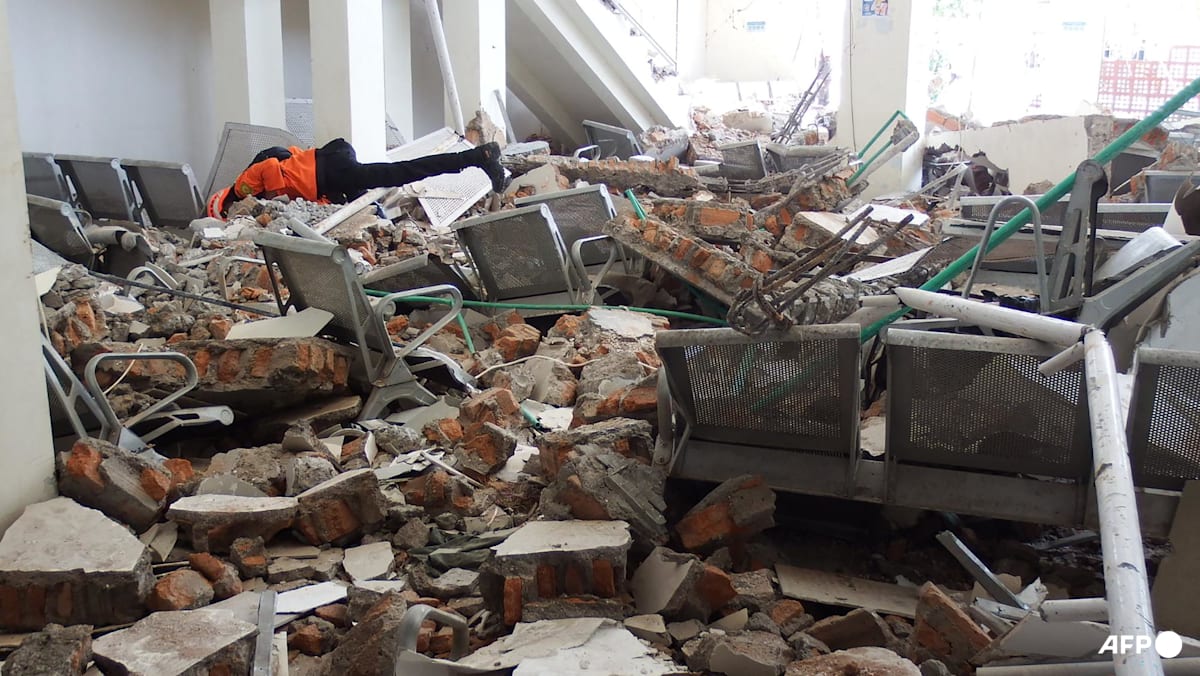
Rescue official Fathur told AFP the focus had shifted to locating victims who may be buried under rubble, but rescue efforts were complicated by landslides cutting off roads.
Residents in Nagekeo, an area close to the epicentre, raced for higher ground as the sea retreated early Saturday – a possible sign of an approaching tsunami, AFP journalists witnessed.
A tsunami warning was lifted, but authorities urged people not to return to damaged buildings for fear that aftershocks could bring them down.
Hundreds remained outside hours later as dozens of aftershocks shook Flores, the strongest measured at a magnitude of 6.1.
Waves of up to 1.6m were measured in some coastal regions of the island, according to Indonesia’s BMKG geological agency.
FLEEING IN PANIC
Yulian said she had dragged her stove outside and was cooking there, fearing further tremors.
She said she saw patients being treated under emergency tents outside a nearby hospital.
Nagekeo resident Yohanes Babo, 56, said he was at a market when the earth started shaking in the early morning hours.
“The shaking was strong. Thankfully, we were already outside the house,” he told AFP.
“People were panicking, running here and there. We’re evacuating for the time being … and trying to get to the hills,” he said.
The epicentre of the shallow quake was located just off the north coast of Flores island, US and Indonesian authorities said.
The extent of the damage is still being assessed. The area is largely rural with few high-rise buildings.
Long queues of people were seen evacuating on foot, by motorbike and car, some piled into the back of pickup trucks, after the initial tsunami warning issued by Indonesia’s Meteorology, Climatology, and Geophysics Agency.

