


UNCLEAR WHETHER JOINT COMMUNIQUE CAN BE AGREED
China’s massive export push has pressured economies across the globe, especially as the United States has imposed high tariffs on Chinese goods and outright bans on some products, such as Chinese vehicles.
With chronically weak domestic demand, China has doubled down on exports of electric vehicles, semiconductors and other goods, and its total exports rose 23.9 per cent in July year-on-year, prompting growing calls in Europe for tougher curbs on Chinese imports.
“We do know that Chinese currency is hugely undervalued, that China is supporting, very actively subsidising its exports and this is a problem for Europe as well,” Polish Finance Minister Andrzej Domanski told Reuters late on Monday.
China’s goods trade surplus with the European Union hit €360.6 billion (US$418 billion) last year, a 15 per cent increase on 2024, and has expanded further this year as Chinese firms have sold more to the EU and imported less.
European Economy Commissioner Valdis Dombrovskis agreed that China is a major source of economic imbalances, but said the US and Europe both also had roles to play in evening things out.
In more direct comments, German Finance Minister Lars Klingbeil noted that the US- and Israeli-led Iran war, together with ongoing US tariff disputes, were also major causes of uncertainty holding back the global economy.
“Uncertainty is poison for economic growth,” he said. “The tariff conflicts being pursued by the US, such as the current dispute with Canada, destroy trust.”
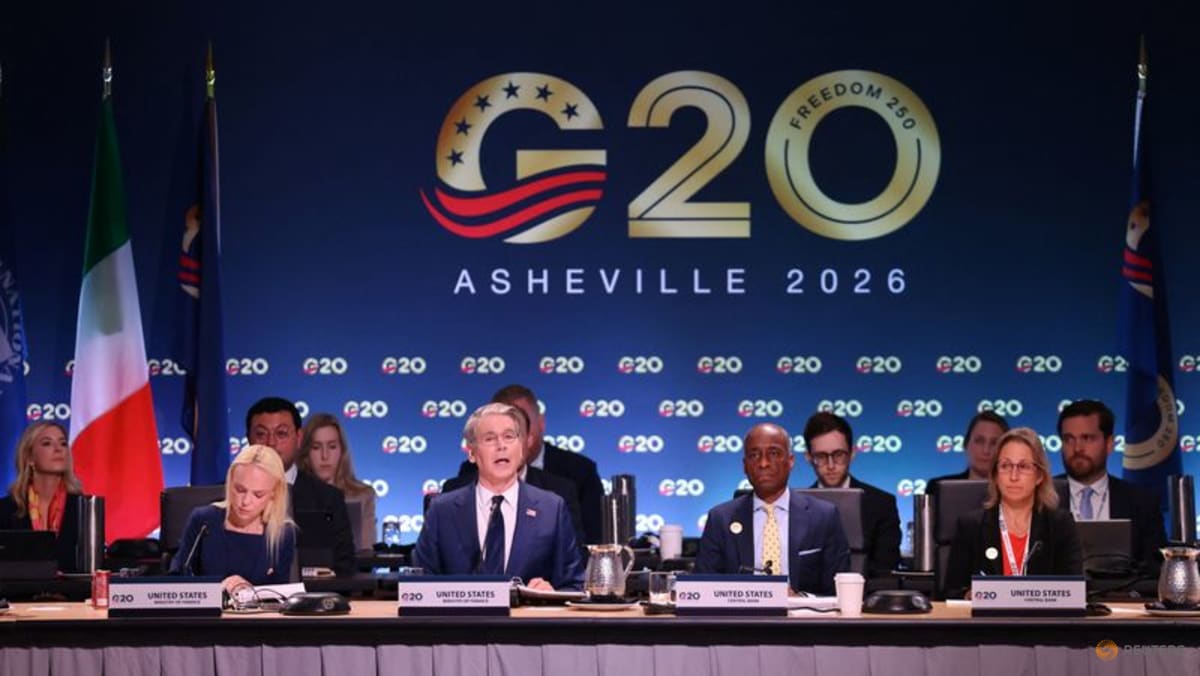
It remains unclear whether the US will be able to bring the diverse forum together to agree on a joint communique on how to reduce global imbalances.
G20 member China has shown little interest in longstanding calls for it to reduce industrial subsidies and rebalance its economy, while its yuan currency remains significantly undervalued by most measures.
Beijing has also exploited its dominance in the processing of critical minerals by placing export restrictions on rare earths in April 2025, a response to US President Donald Trump’s tariffs that has also hit non-US companies.
Japanese Finance Minister Satsuki Katayama, speaking at a news briefing on Monday evening after the first day of talks, said she had told her G20 counterparts that arbitrary export restrictions on critical minerals were harming the global economy and should be withdrawn.
Officials said the section on global imbalances in the planned joint communique was proving particularly difficult, with China opposed to any singling out of “non-market economies” or firm words on critical mineral supply curbs.
European countries were also keen to include strong language critical of Russia’s war against Ukraine. They were dismayed by the fact their Russian counterpart was present at the forum for the first time since Russia invaded Ukraine in 2022.
A sell-off in global bond markets deepened on Tuesday, with Japan’s 10-year bond yield hitting 3 per cent for the first time since 1996 – the latest manifestation of investor concern about energy-driven inflation, potential monetary tightening and worsening fiscal conditions.
Treasury officials said Bessent had called for sound monetary policy to anchor inflation expectations and avoid excessive currency volatility during his meeting on Sunday with Bank of Japan Governor Kazuo Ueda.
“I have information that the market doesn’t have, and it’s my belief that the Japanese government and the BOJ will do the things that will lead to a stronger yen,” Bessent told CNBC in an interview
The remarks, which underline Bessent’s recent calls for the BOJ to raise interest rates, were seen as an attempt to bolster the case for Ueda to argue for a hike at his bank’s policy meeting on Sep 17-18.

