


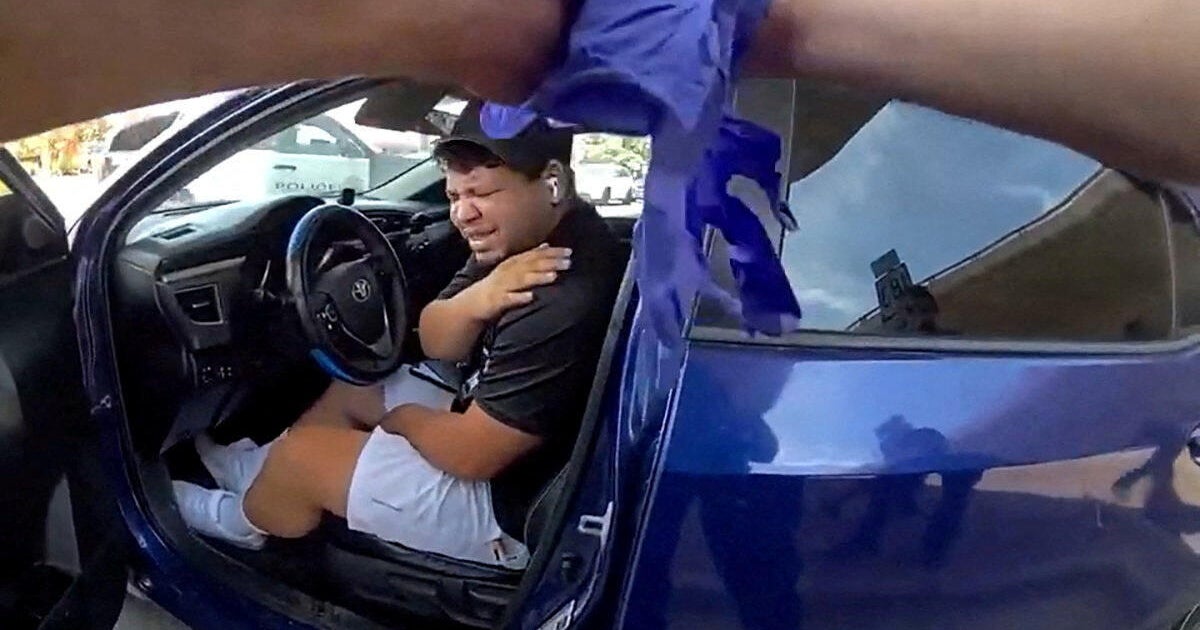
Austin — A Venezuelan delivery driver who was shot in his car by a federal immigration agent in Texas will remain in custody on charges that he assaulted an officer while trying to evade arrest, a federal judge ruled Wednesday.
Judge Dustin Howell said the case against Wilber Rafael Garces Perez, 28, should proceed after prosecutors presented body-worn camera footage of the encounter in Austin, in which Garces Perez allegedly struck a U.S. Immigration and Customs Enforcement officer with his driver’s side mirror.
Garces Perez is charged with one count of assaulting, resisting and impeding a federal officer and faces up to 20 years in prison if convicted.
His case has sparked widespread outrage across the Texas capital city and brought renewed criticism from Democrats of President Trump’s aggressive crackdown on immigration.
Howell said he denied Garces Perez bond on the basis that he could be a flight risk to Venezuela, where he has a child.His attorneys have filed a lawsuit seeking to prevent his removal from the U.S.
How the hearing played out
With a bullet still lodged in his back, Garces Perez appeared in court in a wheelchair. His attorneys said he still urgently needs medical care, 10 days after being shot. He also wore a sling on his arm and needed help putting on a headset to listen to a translation of the proceedings.
The bullet lodged close to Garces Perez’s spine. He is being held at an ICE detention facility in Texas. His attorney and Democratic lawmakers have said he is in intense pain and needs surgery.
Austin Police / Handout via Reuters 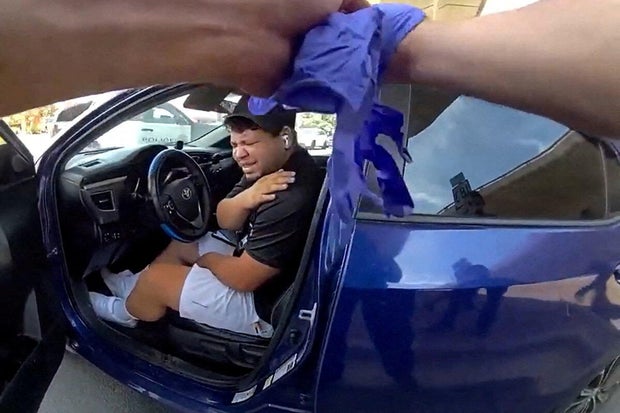
The defense called the charges against Garces Perez “retaliation” and argued that the camera footage was inconclusive because it didn’t fully capture the moment when he allegedly tried to flee.
The hearing also included testimony from Homeland Security Investigations Special Agent Rick Bazan, who signed the criminal complaint charging Garces Perez with assault. The defense argued that Bazan, whose agency is the investigative arm of ICE, couldn’t confirm whether the ICE agent was actually hit by the car mirror since no federal investigators interviewed the agent directly. Bazan also couldn’t explain why the officer allegedly struck by the mirror wasn’t wearing a body-worn camera.
Footage provided Wednesday in court shows officers pulling Garces Perez over Sept. 20 in Austin, where he was making deliveries for DoorDash.
The video showed Garces Perez giving officers his driver’s license through a crack in his window and then asking in Spanish if he can park his car so that a relative could come retrieve it. The officer demanded Garces Perez get out of the car multiple times, to which he asked if he could park his own car so a family member could come retrieve it. After a back and forth, Garces Perez abruptly and rapidly drives off.
Prosecutors presented a video from cameras at a nearby business showing the ensuing high-speed chase through residential streets. The shooting itself wasn’t captured on the footage shared in court.
The federal officer who shot Garces Perez wasn’t wearing a body-worn camera. The immigration officer who did have a camera was driving in a separate car and turned the camera off during the pursuit.
Garces Perez said he was struck by a law enforcement SUV and spun around before he was shot. Federal officers told investigators, however, that Garces Perez attempted to strike an officer with his car at the end of the chase before the unidentified officer fired his weapon.
The accusations against Garces Perez recall previous claims made by immigration agents similarly accusing drivers of weaponizing their vehicles after other high-profile shootings. In a handful of cases, the allegations have been undermined or walked back after the release of body-worn camera footage, drawing renewed scrutiny about the Department of Homeland Security’s reliance on vehicular stops to execute arrests.
Kate Lincoln-Goldfinch, one of Garces Perez’s immigration attorneys, accused ICE of denying him medical treatment for his bullet wound.
“ICE’s conduct has been so egregious that physicians, nurses, medical ethicists and health advocates have come together to demand his release,” she said outside court after the hearing.
Garces Perez entered the U.S. in 2024 using CBP One, a program begun under President Biden that allowed migrants to schedule appointments with U.S. authorities to be considered for asylum. President Trump ended the program on his first day back in office.
Garces Perez was an asylum seeker and had a valid work permit, according to his lawyer. She said a judge later issued a deportation order after Garces Perez missed an immigration court hearing because the notice had been sent to a former address.

