


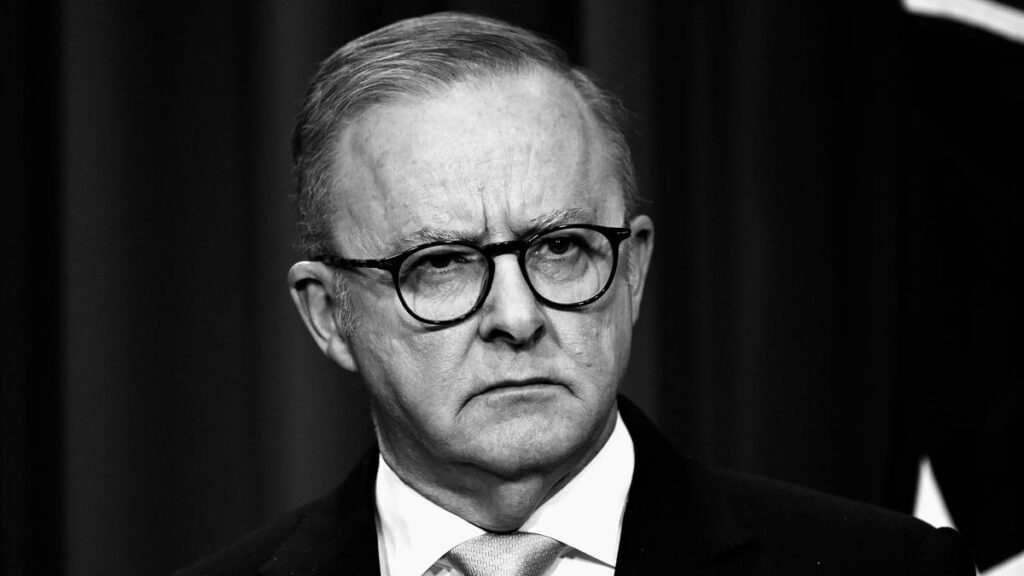
The Prime Minister says Australia will have “private” discussions with the United States about whether to contribute military personnel to an international coalition to reopen the Strait of Hormuz.
A US State Department cable has detailed how the Trump administration is seeking participation from other countries to restore freedom of navigation in the critical waterway “post conflict”.
The April 28 document reveals US Secretary of State Marco Rubio has approved the creation of the Maritime Freedom Construct (MFC), which is described as a joint initiative by his Department and the Pentagon.
“The MFC constitutes a critical first step in the establishment of a post-conflict maritime security architecture for the Middle East. This framework is essential to ensuring long-term energy security, protecting critical maritime infrastructure, and maintaining navigational rights and freedoms in vital sea lanes,” the cable said.
The component of the initiative led by the State Department would serve as the diplomatic hub between partner countries and the shipping industry, while the Pentagon component operating out of CENTCOM headquarters in Florida would coordinate real-time maritime traffic and communicate directly with vessels transiting the Strait, the cable said.
On Thursday, Foreign Minister Penny Wong confirmed Australia was involved in diplomatic discussions with the United Kingdom, France and the United States on “options” to reopen the Strait.
Asked about the proposed coalition on Friday, Anthony Albanese said his government would “have those discussions privately” but added that “we’ll engage in anything that can assist”.
Pressed on whether he was open to Australian military personnel joining the US-led effort, the Prime Minister responded: “there hasn’t been that determination”, but his government would “discuss those things respectfully”.
“What we want to see, though, is for a de-escalation. We want to see peace in the region, because that is in the interest of not just having an impact, of reducing the human impact of this conflict, it’s also about the economic impact that the world is suffering from.”


The diplomatic communication first reported by the Wall Street Journal says US embassies should deliver the request orally to partner nations by May 1, but not to Russia, China, Belarus, Cuba and “other US adversaries”.
Participation could be in the form of diplomacy, information sharing, sanctions enforcement, naval presence or other forms of support, the cable reportedly states.
“We welcome all levels of engagement and do not expect your country to shift naval assets and resources away from existing regional maritime constructs and organizations,” the cable said.
“The MFC is distinct from the President’s Maximum Pressure campaign and from ongoing negotiations.”
Last month the Defence Chief declared Australia could “absolutely” contribute to a coalition mission to reopen the Strait of Hormuz, should the Albanese Government decide to do so.
“I am very confident we could deploy a ship into that environment if the Government was to make a decision to do so. I have no hesitation in our ability to work in a Strait of Hormuz type role,” Admiral David Johnston told reporters in early April.
Australia has already deployed an E-7A Wedgetail surveillance plane to the Middle East in a “purely defensive” capacity following a request from the United Arab Emirates.