


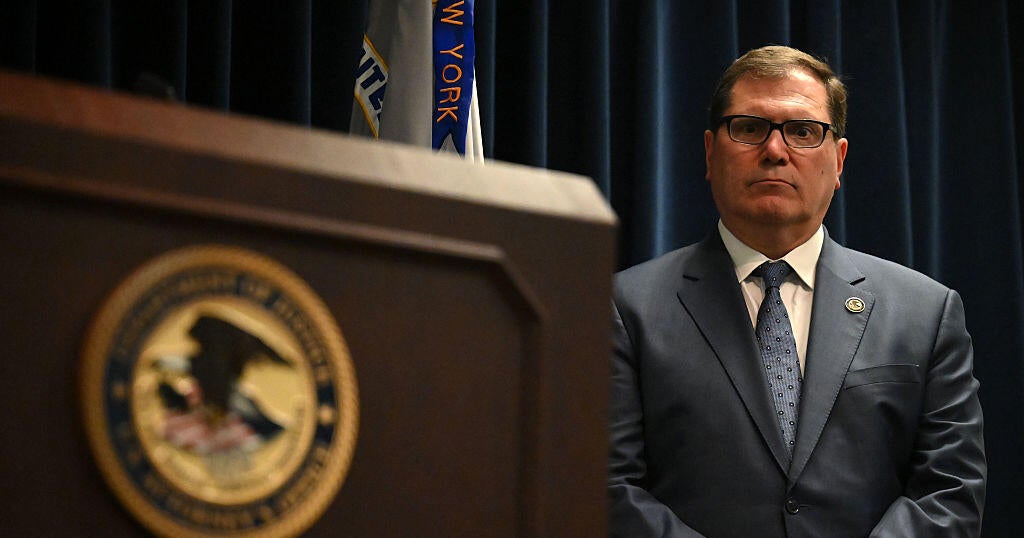
Washington — A federal appeals court on Friday said the top federal prosecutor in the Northern District of New York was unlawfully serving in his role when he subpoenaed New York Attorney General Letitia James as part of two investigations into her last year.
A Justice Department spokesperson quickly said the Trump administration intends to appeal the ruling directly to the Supreme Court, setting up a showdown over the Trump administration’s repeated attempts across the country to make an end-run around federal law to keep their choice of prosecutors in office without Senate confirmation.
In a 2-1 decision, the U.S. Court of Appeals for the 2nd Circuit ruled against John Sarcone, who has been leading the U.S. Attorney’s Office in Albany for more than a year.
The two judges in the majority said Sarcone’s appointment in 2025 did not conform with a federal law known as the Federal Vacancies Reform Act, meaning he was not lawfully serving as the acting U.S. attorney when he secured the subpoenas targeting James.
“Text, structure, and history all point the same way,” Judge Guido Calabresi wrote. “We hold that only the First Assistant in place when a vacancy arises may become the acting officer under [the Vacancies Act]. Sarcone was not.”
Judge Michael Park dissented.
Mr. Trump and his administration have attempted to use two different laws to install their preferred picks to lead U.S. attorney’s offices around the country without Senate confirmation. Both were invoked to keep Sarcone as the top federal prosecutor in Albany.
Will Waldron/Albany Times Union via Getty Images 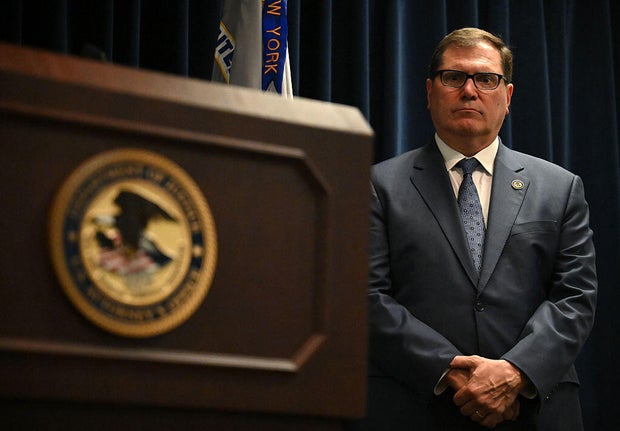

The first allows the attorney general to appoint an interim U.S. attorney, who can serve for a maximum of 120 days. Once that clock runs out, the judges serving in the district may either extend the person’s tenure, or appoint a new person to serve until the Senate confirms a replacement.
The second approach, under the Federal Vacancies Reform Act, allows the deputy to the vacant office to be elevated into the leadership position and serve for 210 days in an acting capacity. It also lays out two other categories of federal officials who can move into a position covered by the law.
Sarcone, a former campaign attorney for President Trump, was initially appointed to serve as the interim U.S. attorney in the Northern District of New York, which includes Albany, last year. When his 120-day term ran out, judges in the district declined to retain him. Instead, then-Attorney General Pam Bondi appointed him as a special attorney and named him first assistant U.S. attorney in the office. The Justice Department said Sarcone was tapped for the deputy role so he could then be elevated to acting U.S. attorney for 210 days.
But the appeals court said that the FVRA only allows a deputy who is already in place when a U.S. attorney position opens up to be elevated to the acting role. Because Sarcone was named first assistant months after the U.S. attorney position became vacant, he was not lawfully serving as the acting U.S. attorney when he secured the subpoenas targeting James, the majority ruled.
James was subpoenaed in August 2025 as part of probes into her office’s handling of investigations into the National Rifle Association and Mr. Trump. After the subpoenas were issued, she sued to quash them, arguing that Sarcone was unlawfully appointed.
The Justice Department argued that the “special attorney” title given to Sarcone gave him subpoena power and said he had been lawfully serving as acting U.S. attorney.
In January, a U.S. district judge in the Northern District of New York found that Sarcone was “not lawfully serving as Acting U.S. Attorney” and ruled that “any of his past or future acts taken in that capacity are void or voidable as they would rest on authority Mr. Sarcone does not lawfully have.”
About a month later, a panel of judges in New York appointed a new top federal prosecutor after Sarcone was disqualified. But within hours, the Justice Department announced it had fired the judges’ new hire, allowing Sarcone to effectively lead the office as the appeal played out.
Calabresi, who authored the opinion for the appeals court’s majority on Friday, said that the government’s reading of the vacancies law “rewards evasion and penalizes compliance.”
Reading the law to “encompass First Assistants who are designated after the vacancy arises would turn the FVRA’s common-sense framework on its head,” he said. “Under that reading, the President could install virtually anyone as the acting officer simply by naming that person First Assistant, regardless of whether they possessed any of the qualifications Congress required for the Executive to depart from the default.”
The president has used his novel, multi-step mechanism to keep certain interim U.S. attorneys in place after the 120-day clock runs out in Nevada, New Jersey, California and Virginia. The efforts have been challenged in court.
In New Jersey, the White House and Justice Department attempted multiple times to keep another of Mr. Trump’s lawyers, Alina Habba, as top federal prosecutor there. In December, Habba announced she was stepping down from her post after a federal appeals court ruled that she was unlawfully appointed to her role. Bondi criticized the ruling, saying it made it “untenable” for Habba “to effectively run her office.”
The president’s attempt to install Lindsey Halligan, his former personal lawyer and a White House aide, to lead the U.S. Attorney’s Office in eastern Virginia also led a judge to toss out indictments against former FBI Director James Comey and New York Attorney General Letitia James. The Justice Department is appealing that decision, in which a judge ruled Halligan was unlawfully appointed interim U.S. attorney.
Earlier this month, an appeals court panel in the 9th U.S. Circuit Court of Appeals ruled that Sigal Chattah, Mr. Trump’s pick for U.S. attorney in Nevada, was also serving unlawfully in her role after she remained in the job after the 120-day limit. The day before her term was set to expire, Chattah resigned and Bondi appointed her first assistant U.S. attorney and said she had the power to remain as acting U.S. attorney.
Mr. Trump’s selection for U.S. attorney in Los Angeles, Bill Essayli, was also found to have been serving unlawfully in his role for months, disqualifying him from supervising some criminal cases.
Chattah and Essayli, like Sarcone, have remained in their roles for now under the first assistant U.S. attorney title.