


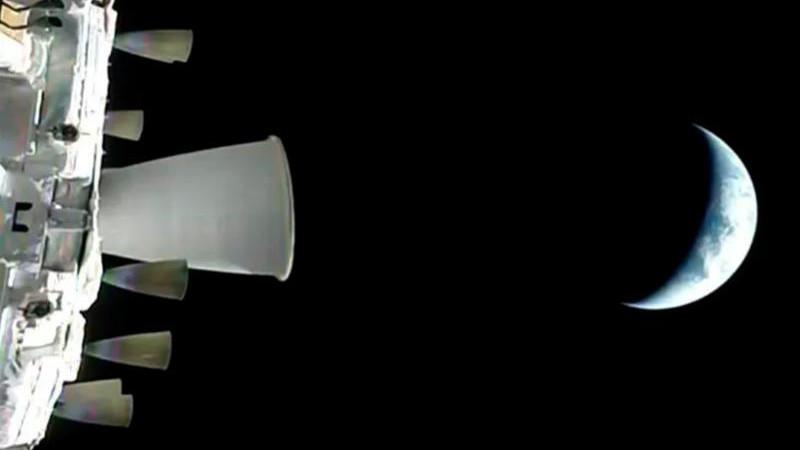
The NASA Artemis II mission started to leave Earth’s orbit on Thursday, a critical milestone of the flight. Astronauts are officially headed to the moon for the first time since 1972.
At 7.49pm Eastern time (Friday, 10.49am AEDT), the Orion spacecraft fired its main engine for 5 minutes and 50 seconds, accelerating with 6,000 pounds of thrust and committing the crew of three NASA astronauts and one Canadian crew member on a path that would take them around the moon four days from now without landing.
Reid Wiseman, Victor Glover, Christina Koch and Jeremy Hansen spent the first day of the mission in an orbit of Earth that goes to a higher altitude than astronauts usually travel when they are circling the planet. As they orbited, they tested systems on the Orion spacecraft to ensure the vehicle’s safety, the primary purpose of this mission.
Once NASA mission controllers on Earth were confident that the spacecraft is performing as needed, Orion got the command to fire its engines taking it in the direction of the moon Thursday evening.
The decision came about a day after the launch on Wednesday of the gigantic orange-and-white rocket that vaulted the astronauts into space.
The journey of the crew is now fully underway, with eight full additional days to go before it concludes with a splashdown in the Pacific Ocean.


Here’s what to know going into Day 2 of the mission:
— Moonshot: The main event of Day 2 was a maneuver called a trans-lunar injection burn, which pushed Orion away from Earth orbit and onto a path toward the moon. Earlier Thursday, the mission team on the ground decided to perform the burn.
— How to Tune In: NASA is streaming the mission on YouTube, X, its website and other online platforms.
— A Busy Day 1: The second stage of NASA’s Space Launch System with the Orion capsule separated from the core stage of the rocket about eight minutes after launch Wednesday.
A series of engine burns of the second stage moved the capsule into a safe Earth orbit where the crew has been assessing systems onboard.
They reported troubles with the toilet, which thankfully were resolved hours later. After Orion separated from the rocket’s second stage late in the evening, Glover manually steered Orion through several simulations of docking maneuvers that are to be used for future lunar landing missions.
This article originally appeared in The New York Times.
© 2026 The New York Times Company