


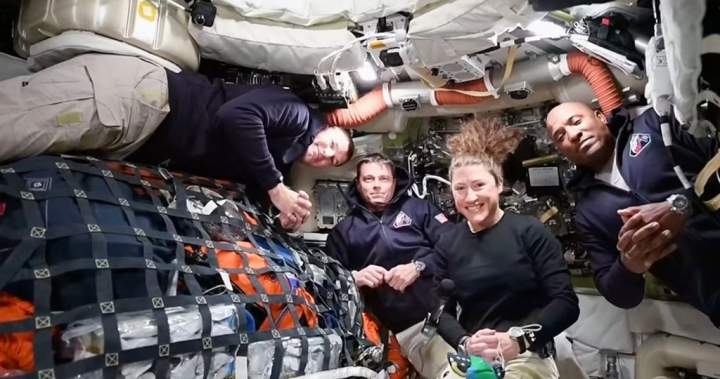
Jermey Hansen and the rest of the Artemis II crew aboard the Orion spacecraft are “focusing on getting it all done right” ahead of re-entry Friday night, Chris Hadfield says.


Hadfield, a decorated Canadian astronaut who served as commander of the International Space Station, told Global News Friday that he has communicated with Hansen through email ahead of the crew’s return to Earth.
NASA said the four-person crew are set to splash down around 8 p.m. in the Pacific Ocean, off the coast of San Diego, Calif., travelling at 38,000 kilometres an hour.
The astronauts looped around the moon this week in a six-hour lunar flyby that took them farther into space than any humans before.
Hansen is the first non-American to leave Earth’s orbit, while Hadfield was the first Canadian to perform extravehicular activity in space.
Here is what Hadfield told Global News on Friday. It has been edited for length and clarity.
Q: What does this mission mean to you and how historic is this moment as the Artemis II returns?
A: I’ll take the second question first. It’s really historic. Nobody has ever left Earth orbit except Americans. No other country, no Soviet astronaut or Russian or Chinese astronaut has ever done it. The very first country after the United States to have someone leave Earth is Canada. And everybody should take pride in that and recognize what Jeremy Hansen has done on behalf of us all. But how I’m feeling about it, just really keenly interested and excited. So proud of how well Jeremy and his crew has done, what Canada has done to get us here, what it means for the future, and now all eyes and held breath turn towards their re-entry tonight.


Get breaking National news
Get breaking Canada news delivered to your inbox as it happens so you won’t miss a trending story.
Q: What will they be feeling during that fireball phase of re-entry and how has their training really prepared them for this?
A: Yeah, I was emailing back and forth with Jeremy. Pretty amazing to email with someone who’s on the way back from the moon. They’re so proud of the ship and the team and how this vehicle has done. And Jeremy just says, ‘I’m going to miss this, this is a great experience.’ But what they’re focusing on now is getting it all done right. First, they need to perfectly line up their vehicle to enter the atmosphere at exactly the right angle. If they come in a little too shallow, they’ll skip out and then that’ll make a real mess later on. If they come in a little too steep, it’ll burn them up, so they have to aim it just right. They’ll be watching that. They’ve got to jettison the service module, the life support system on the back, and then they need to expose the pristine belly of their capsule to the Earth’s atmosphere — it’s been protected from little meteoroids up until now — and then fly it down through the atmosphere. Hopefully, the computer will properly steer it as they fly down through and dissipate all that energy, and then get down to where they’re slow enough, they can pop little drogue shoots and then the three big parachutes and come down like a monstrous thistle down into the Pacific off the coast of California. It’s going to be an amazing half-hour ride.
Q: What do you think this crew will carry with them from this journey?
A: You know, the way it works is your emotions get sort of trapped in lag behind you because there’s so much amazing new stimulation. So unbelievably different things in your life and you just can’t keep up. You can’t see fast enough. You can hardly even feel fast enough for what those four people have been through. And they’ve been doing their best to share it but even they admit it, they’re just fumbling for enough vocabulary to let people know how this feels and how it actually looks. They’ll have taken tens of thousands of pictures, but they now have the rest of their lives in order to sort out what this means to them as a person and then how to share it with their family and their friends and the rest of the world and let people see where we are in history as a species. As we transitioned from exploring the moon, done by the Apollo astronauts to now to this very first flight of starting to settle on the moon, much as we did Antarctica a hundred years ago, and somehow Jeremy and his three crewmates need to get all that square in their heads immediately when they land and then with a lot of time to reflect later on.
Q: How are you feeling on this day as you await your friends to return home?
A: Well, I mean, Jeremy used to be a combat fighter pilot flying F-18s. I was a test pilot as well. Dangerous professions, but they’re part of society and there’s no guaranteed outcome. So what you do is you study it like crazy, you change who you are, you develop a huge, deep skillset for things to go wrong. But eventually somebody needs, if you want to, talk about the edge of the envelope and expanding the envelope. Someone has to test where the edges of the envelope are. That’s what Jeremy and his crew are doing. They are pushing the edge of the envelope. No human beings have ever flown this spaceship back down into the atmosphere before. We think we’ve done our math right. We did an unpiloted test, but it didn’t go perfectly, but we’re confident this is going to work today. But until someone is willing to risk really everything to go and test it, the rest of us won’t really know. So it’s extremely serious. And the crew takes it seriously. Everybody in all the space agencies is watching keenly and we’ll know whether we are right or wrong here after they’re safely back into the water of the Pacific. And I’m confident they’ll be OK, but there’s no guarantees on the edge of exploration.
© 2026 Global News, a division of Corus Entertainment Inc.