


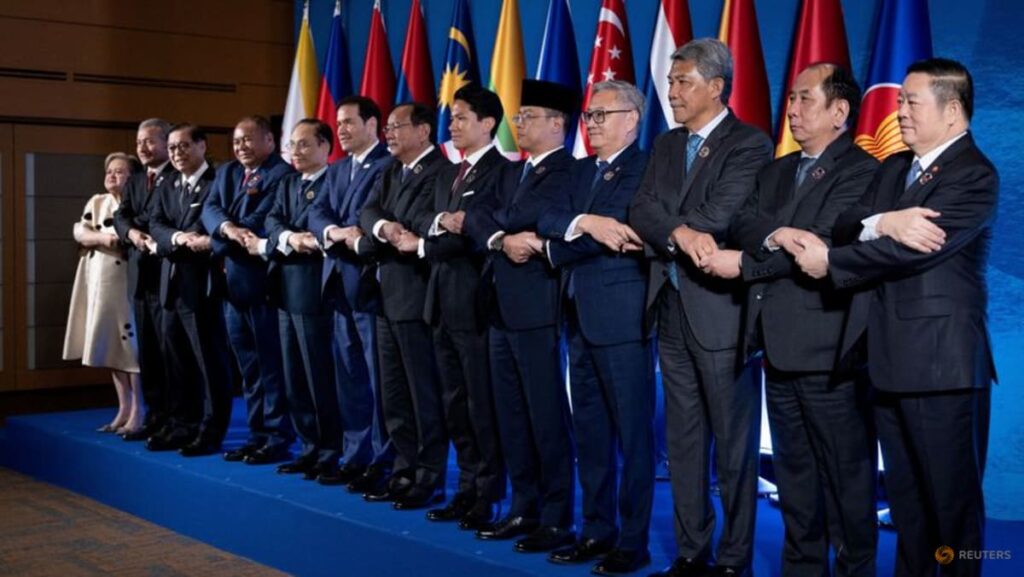
MANILA: ASEAN foreign ministers hailed “significant progress” in negotiations on the long-awaited Code of Conduct (COC) for the South China Sea, saying they hoped to conclude talks by the end of this year.
The 59th Association of Southeast Asian Nations (ASEAN) Foreign Ministers’ Meeting wrapped up in Manila on Friday (Jul 24) as renewed tensions flared in the contested waterway, with the Philippines and China trading accusations over separate confrontations near Second Thomas Shoal and Scarborough Shoal.
In a joint communiqué issued on Thursday (Jul 23), ASEAN ministers reaffirmed the importance of maintaining peace, stability and freedom of navigation in the South China Sea.
They said they were “pleased with the sustained positive momentum” in the ongoing negotiations and welcomed the “significant progress achieved so far”.
“We looked forward to continued efforts in endeavouring to conclude the negotiation of an effective and substantive COC that is in accordance with international law, including the 1982 UNCLOS (United Nations Convention on the Law of the Sea), within this year,” the document read.
Philippine Foreign Affairs Secretary Maria Theresa Lazaro, whose country holds the ASEAN chairmanship this year, said the latest incidents will be part of continued discussions on the code.
She added that the pace of negotiations – which has intensified this year – reflected the shared determination of ASEAN member states and China to conclude the agreement.
“This seems to be the focus of many of the countries, and I can see some political will from all the countries involved,” she told reporters on the sidelines of the meeting.
However, analysts cautioned that recent flare ups reveal a gap between diplomatic progress and continued tensions at sea.
“These Code of Conduct negotiations have gone on for decades now and have been quite thorny,” said Mr Andreyka Natalegawa, an associate fellow at Washington-based research institute Center for Strategic and International Studies’ (CSIS) Southeast Asia Program.
“Look at the political realities of what we’re seeing in the waters of the South China Sea – it feels as though a conclusion to the Code of Conduct negotiations seems quite challenging,” he told CNA’s Asia First.