


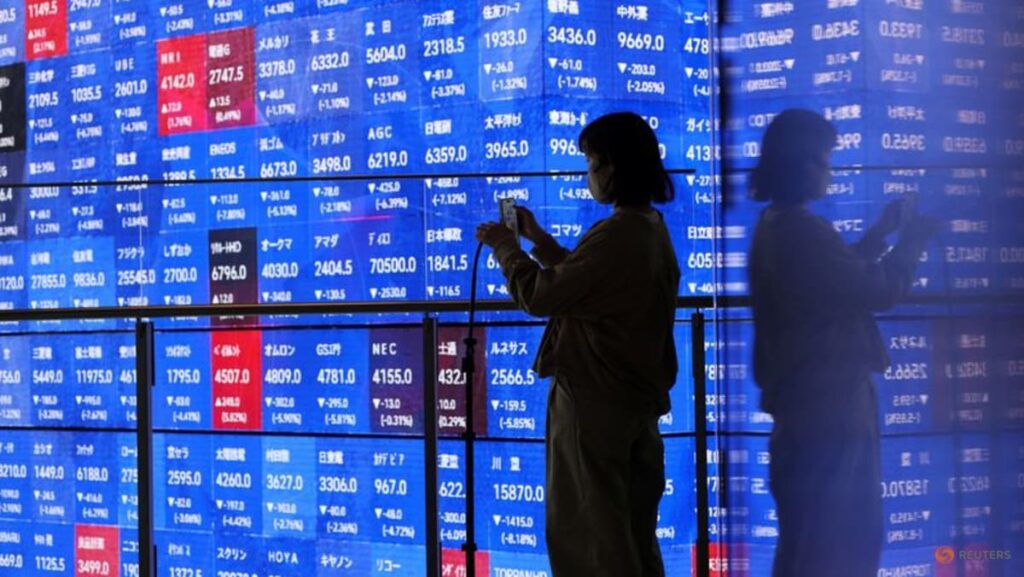
SYDNEY: Asian stocks gained on Tuesday (Oct 6) after a tech-fuelled rally lifted the Nasdaq to a record close, with lower oil prices offering further support even as longer-dated Treasury yields hovered near multi-decade highs.
The euro languished near 17-month lows after briefly touching US$1.116 overnight, pressured by mounting fiscal concerns in France as investors dumped government bonds after an underwhelming budget. Political uncertainty also deepened after Spanish Prime Minister Pedro Sanchez called a snap election.
Brent crude edged 0.6 per cent higher to US$100.88 a barrel, after losing 1.9 per cent overnight as Gulf oil flows excluding Iran surged to over 81 per cent of pre-war levels last month and the Group of Seven nations pledged to boost supplies.
Most markets in Asia rose, with Japan’s Nikkei gaining 1.1 per cent and Hong Kong’s Hang Seng index up 0.7 per cent. MSCI’s broadest index of Asia-Pacific shares excluding Japan was flat and South Korean shares fell nearly 1 per cent after returning from a holiday.
European bourses are set for a higher open, with pan-region stock futures up 0.3 per cent. Nasdaq futures edged up 0.2 per cent and S&P 500 futures rose 0.1 per cent.
The Nasdaq reached a record close overnight, buoyed by softer-than-expected jobs data that dampened expectations for a rate hike from the Federal Reserve this month.
AI heavyweight Nvidia climbed 2.1 per cent, reaching a record-high close and boosting its market value to US$5.76 trillion.
“The rally in the market was tech-led once again, with the marginal easing of interest rate uncertainty along with a slight moderation in geopolitical risk allowing market participants to focus on the extraordinary earnings growth being delivered by AI names,” said Kyle Rodda, a senior analyst at Capital.com.
The third-quarter earnings season kicks off next week. Goldman Sachs estimated consensus forecasts point to a 27 per cent growth in S&P 500 earnings last quarter, with more than half that from companies benefiting from AI infrastructure spending.
Latin American markets also climbed, led by a rally in Brazilian stocks and the real currency, after right-wing Senator Flavio Bolsonaro outperformed poll predictions in the first round of the presidential election and advanced to a runoff against leftist incumbent Luiz Inacio Lula da Silva.
BOND ROUT PERSISTS
The relentless climb in Treasury yields continued even as markets scaled back bets for an interest rate rise this month from the Fed to just 23 per cent from 71 per cent a week ago, after top policymakers stressed the need for more data before tightening again.
US 10- and 30-year Treasury yields hit fresh 24-year highs overnight, capping a steady climb since mid-August, driven by inflation and debt concerns. An ISM survey showed a measure of prices paid by service businesses for inputs jumped to the highest level in more than four years.
The 10-year Treasury yield was steady in Asia at 5.3154 per cent after climbing 3 basis points overnight to hit 5.3493 per cent, the highest since 2002, while 30-year yields held at 5.6749 per cent after having briefly reached 5.7029 per cent overnight.
The selloff in French bonds calmed a little, with the premium investors demand to hold French 10-year bonds over safer German debt narrowing to 137 basis points on Monday.
“We don’t think there’s a similar crisis happening as 15 years back with Greece and the European Union,” said Christian Nolting, global chief investment officer at Deutsche Bank Private Bank, adding that the European Central Bank now has some backstop mechanisms in place for episodes like this.
“Since they are available, I think the market won’t go too far. I’ve seen the spread, OATs-bunds has been widening substantially. But I don’t think we run into a real euro crisis.”
The euro nursed losses at US$1.1215 after falling as much as 0.8 per cent to US$1.116 overnight, its weakest point since May 2025. It traded at 177.27 yen after having fallen for seven sessions, around the lowest since November.
That kept the US dollar firm, with the dollar index at 102.2 after a weekly rise of 0.9 per cent.
Spot gold lost 0.4 per cent at US$4,121.75 an ounce.