


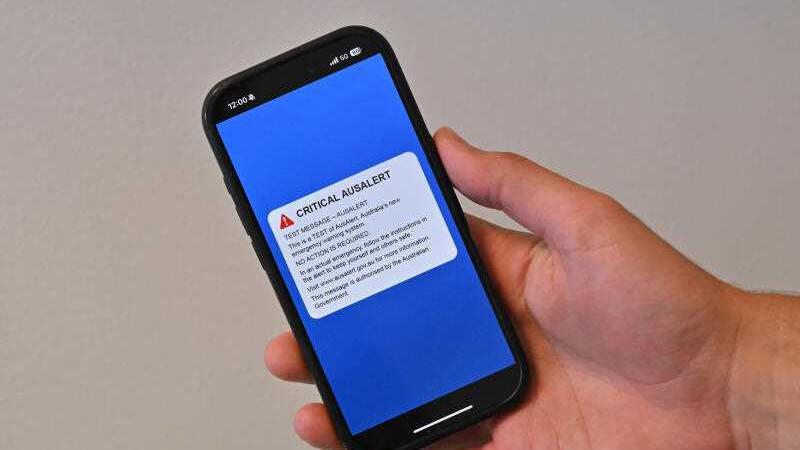
Millions of Australians will receive a loud emergency alert on their mobile phones next week as part of the first nationwide test of the Federal Government’s new AusAlert system.
The new warning technology is designed to deliver emergency alerts faster and to more people during disasters such as bushfires, floods, cyclones and other life-threatening emergencies.
Here is everything you need to know before the national test on Monday, 27 July.
What is AusAlert?
AusAlert is Australia’s new national emergency warning system, replacing the existing SMS-based Emergency Alert technology with a more modern cell broadcast system.
“It’s a modern, more capable system that will deliver emergency alerts to more people in a more timely manner than the existing text-based emergency alert system,” The Federal Minister for Emergency Management of Australia, Kristy McBain, said.


Cell broadcast technology is already used in more than 35 countries and is designed to deliver alerts almost instantly without relying on traditional text messages.
What will happen during Monday’s test?
At the scheduled time, compatible mobile devices across Australia will sound a loud emergency siren lasting about 10 seconds.
Rather than arriving as a text message, the alert will appear as a large notification directly on a phone’s home screen.
Ms McBain said the message will clearly state the alert is only a test and that no action is required.
“There will be a siren that sounds on the 27th for 10 seconds.”
“You’ll get a notification on your home screen. So it no longer will come through the text message app of your phone.”
“It will say on the 27th, ‘this is a test, we are testing AusAlert, you do not need to take any further action’.”
What time will Australians receive the test?
The national AusAlert test will be sent simultaneously across Australia on Monday, July 27.
- ACT: 2pm AEST
- New South Wales: 2pm AEST
- Queensland: 2pm AEST
- Victoria: 2pm AEST
- Tasmania: 2pm AEST
- South Australia (including Broken Hill): 1.30pm ACST
- Northern Territory: 1.30pm ACST
- Western Australia: 12pm AWST
- Christmas Island: 11am CXT
If the AusAlert test occurs while you are operating a vehicle, the alert may also play through your vehicle’s speakers using Apple CarPlay, Android Auto or Bluetooth and may interrupt navigation or media like music or podcasts. It is important that you do not read or respond to the alert while operating a vehicle, as mobile phone laws still apply.
Will my phone sound even if it’s on silent?
Yes.
Unlike ordinary notifications, AusAlert is classified as a critical alert, meaning it will sound even if your phone is on silent or set to Do Not Disturb.
However, phones that are switched off or placed in airplane mode before the alert is sent will not receive the notification.
Will the alert interrupt phone calls?
Government testing so far suggests the alert should not disconnect active phone calls.
However, officials say Monday’s nationwide test will provide valuable feedback about how different devices behave.
“In the testing that we have done, it didn’t hang up calls as far as I’m aware,” Minister for Emergency Services NSW, Jihad Dib said.
Australians will be encouraged to complete an online survey after the test to report how their phones responded.
Advice for people with hidden phones
Domestic and family violence advocates are urging victim-survivors who keep concealed phones as part of a safety plan to consider switching those devices off before Monday’s test.
Wesnet chief executive Karen Bentley said the audible warning could unintentionally reveal hidden devices.
“Our recommendation is that on Monday, if you do have a concealed or hidden phone, to support your safety, that you consider turning that device off, or switching it into airplane mode,” she said.
Ms Bentley said the device should remain off, or in airplane mode, for 24 hours after the test.
“But a phone switched off or on airplane mode will not receive the alert.”
Which devices are compatible?
The national test will be sent to compatible Apple and Android devices.
Current guidance indicates alerts will be received by:
- Apple devices running iOS 26.9 or later
- Android devices running Android 12 or later
Older devices may not receive the alert while the rollout continues.
Why is Australia changing the current emergency alert system?
The existing Emergency Alert system sends SMS messages through individual telecommunications providers, meaning alerts can sometimes be delayed during emergencies due to network congestion or if a person’s carrier has limited coverage.
Ms McBain said AusAlert overcomes those problems because it broadcasts directly through available mobile towers rather than relying on individual telco networks.
“In my part of the world, we really only have the service of one telco provider,” she said.
“We’re a high tourist area. That meant during the Black Summer bushfires, many people didn’t receive the emergency alert text message for several days because their telco wasn’t available to them.”
“The benefit of cell broadcast technology is that it is not telco reliant. If a tower is available, compatible devices will receive that alert. And there’s no issues with network congestion.”
Will AusAlert replace emergency texts immediately?
No.
Ms McBain said the current Emergency Alert system and the new AusAlert platform will operate alongside each other during this high-risk weather season.
“It’s another tool in the tool kit.”
Existing warning channels — including emergency websites, radio broadcasts, television, social media and emergency services — will continue to play a key role during disasters.
Can the system still work if phone towers fail?
Officials say AusAlert has been designed to be more resilient than the current system.
Rather than relying on a single telecommunications provider, the technology can use multiple towers to broadcast alerts to compatible devices.
Ms McBain said this significantly improves the chances of warnings reaching people during fast-moving emergencies.
“We use a triangle system. So it’s a much more resilient system in the fact it’s not reliant on one tower.”
The Federal Government is also exploring how future satellite capability could further improve coverage.
Are there still concerns about the rollout?
While the Federal Government says nine successful community trials have already been completed, some states say questions remain before AusAlert becomes the primary warning system.
Queensland has raised concerns about the transition period, particularly around the future of automated voice messages to landlines that many regional communities still rely on.
“We need to make sure Queenslanders aren’t put at risk,” Mr Dib explained.
“There are concerns around the gaps as we look to transition from the emergency alert system to AusAlert.”
Queensland said it supports the new technology but wants more answers before emergency agencies rely on it during the upcoming bushfire season.