


Australians who enjoy a meal of Italian pasta, French wine and Swiss chocolate will be able to save money once a new free trade deal with the European Union comes into effect.
And anyone eyeing off an electric BMW, Audi or Rolls Royce will also win through a reduction in the luxury car tax on EVs.
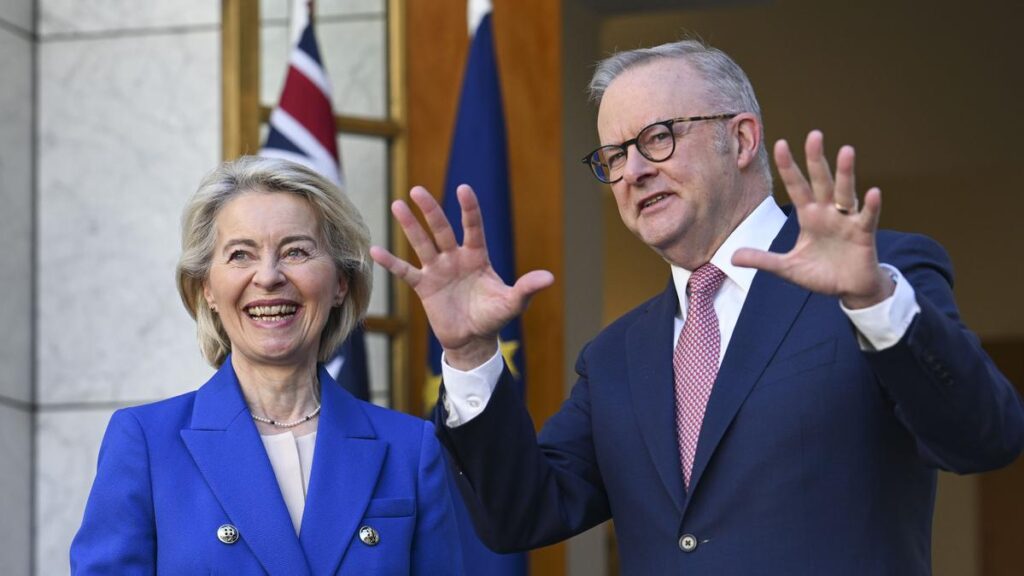
Prime Minister Anthony Albanese and European Commission President Ursula von der Leyen unveiled the landmark deal, eight years in the making and still up to 12 months from taking effect, at a joint appearance in Canberra on Tuesday.
It’s worth an estimated $10 billion a year to Australian producers, who will get greater access to the market of 450 million people, while slashing nearly all remaining tariffs on European imports Down Under.
WA exported about $4 billion worth of goods to the EU in 2025, notably mineral sands, silicon products and alumina, all of which will have tariffs scrapped.
It will also benefit from a new push to increase European investment in critical minerals projects.
But beef and sheep producers were up in arms over the fine detail of the deal, complaining that the Government hadn’t managed to secure as much access as they wanted.
Australia will be able to export 35,000 tonnes of beef and 30,851 tonnes of sheep meat a year, although these final levels won’t be reached for several years and are lower than the industry had demanded.
Sheep Producers Australia said the deal “falls well short of what was needed” for a premium market like WA.
Cattle Australia chair Garry Edwards was even more brutal in his assessment, saying our Government appeared to be “amateurs playing a game with professionals” and had agreed to “pathetic” and “trivial” volumes.
“Our Trade Minister (Don Farrell) has rolled over and sold Australia out. No deal was much better than this deal!” he said.
National Farmers Federation president Hamish McIntyre said there hadn’t been any meaningful gain from the version of the deal that Mr Farrell walked away from in 2023.
No meat imports into Australia currently have tariffs imposed, although biosecurity restrictions apply.
Both Mr Albanese and Ms Ursula von der Leyen described it as win-win and an important stabiliser in an increasingly uncertain world.
“Today we are telling an important story to a world that is deeply changing. A world where great powers are using tariffs as a leverage and supply chains as vulnerabilities to be exploited,” Ms von der Leyen said, taking aim at the US and China.
“What I have seen with a growing unpredictability and uncertainty worldwide is that countries are longing for stability and predictability, and this is what the European Union is offering.
“And therefore it was basically an open door on both sides where we started our negotiations knowing that we want a situation where a free trade agreement leads to a win-win situation for both sides.
“And this is what we are showing here: you can have a free trade agreement and both sides are winning.”
The beef sector had wanted to be allowed to send 50,000 tonnes, and sheep producers 67,000 tonnes — expectations that government insiders have repeatedly said during negotiations were unrealistic.
Mr Albanese said beef exports to Europe had already doubled to $18 billion since Labor took office, and under the new deal would increase from 4000 tonnes to 35,000 tonnes, while the access for sheep meat would rise five-fold.
“After eight years of negotiations – something that couldn’t be done by those opposite – we have today signed the Australia-EU Free Trade Agreement. It represents a very good deal for exporters, for Australian consumers and businesses gaining more access to European products here at home, at lower prices,” he said.
Business and resources groups broadly welcomed the agreement, which will also make it easier for Australians to work in Europe through the recognition of skills across countries.
Australia had wins on sticking points over the names of several products linked to specific European regions.
Prosecco makers will still be allowed to call their bubbly wine that when sold in Australia — Europe had wanted to ban its use, as has already happened with Champagne — but they’ll have to rename any exports after 10 years.
Australian Grape and Wine chief executive Lee McLean said while the result for prosecco exports was disappointing, overall the removal of tariffs on Australian wines was good news for the sector’s long-term competitiveness.
Australian parmesan cheese can retain that name, while existing makers of feta and gruyere can keep using the terms, but new producers won’t be allowed.