


CHINA SAYS ITS DATA-SHARING HAS BEEN ‘TIMELY’
No officials or experts have blamed either side for the natural disaster, which will cost an estimated tenth of Nepal’s annual economic output to recover from. Nepali officials say the priority is to deepen cooperation with China.
China’s foreign ministry did not respond to a request for comment on the May meeting or on Nepal’s request for additional information sharing.
At the meeting, the Chinese said they did not have the mandate to sign an agreement to meet Nepal’s requests, asking for further discussions, said Binod Parajuli, another Nepal government hydrologist.
Details of the meeting and Nepal’s demands for broader cooperation in monitoring the glaciers that threaten communities on both sides of the border have not previously been reported.
China’s embassy in Nepal said in a statement on X on Saturday (Aug 29) that Beijing and Kathmandu had kept in close contact on the issue and had made “substantial progress” at the meeting in May on promoting cross-border disaster information sharing.
NOT SIGNIFICANT FACTOR IN LATEST DISASTER
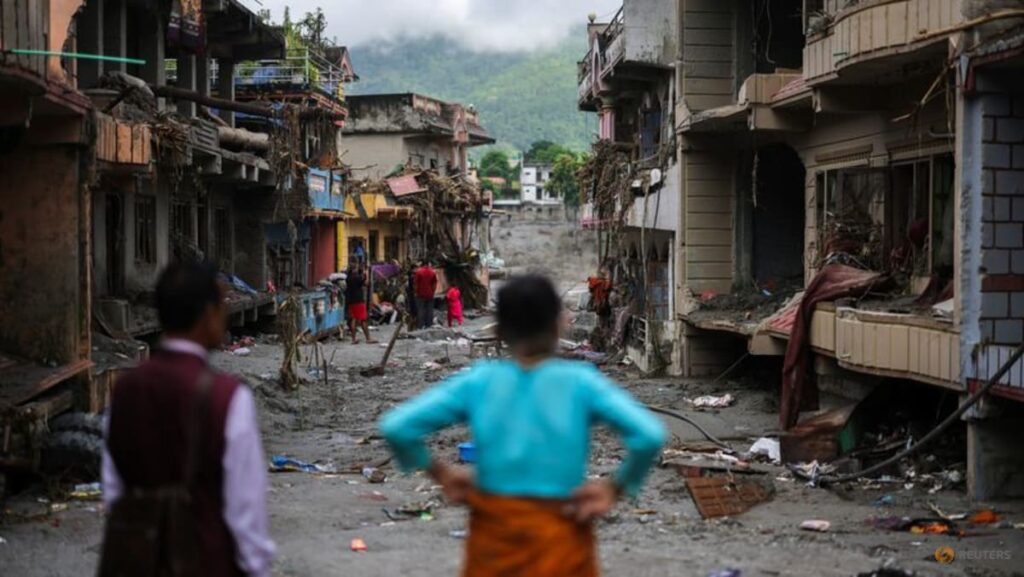
Nepal raised similar concerns last year, officials said, though experts and officials cautioned that what they describe as slow progress was not a significant factor in the latest disaster, in which a glacier collapse unleashed a catastrophic mudslide that has killed nearly 800 people in both countries and left more than 3,000 missing, by the latest count.
Rejecting criticism from some Nepali social media users that China had failed to provide adequate warning, the Chinese embassy said Chinese and international experts faced significant challenges monitoring hazards in the remote Himalayan region.
Chinese teams had shared important information with Nepal “in a timely manner”, it said.
At last year’s meeting, Nepal raised concerns about a flood in the same area, triggered by the sudden release of water from a glacial lake in Tibet that killed at least nine in Nepal and left more than a dozen missing.
“When the Chinese side sees a heavy precipitation forecast in the Tibet area, then they provide us that forecast and those observations,” Parajuli said. But “not for avalanche and water level, landslides, extreme events.”
China began sharing forecasts of heavy rain in Tibet over China’s WeChat messaging app and email a month ago, Parajuli said.
TIMELINE TO CALAMITY
Twelve days before the disaster, China’s World Meteorological Centre told Nepali officials in an email, seen by Reuters, that a monsoon depression was forecast for the area from August 14 to 19.
“Enhanced rainfall is likely across much of Nepal, and we wish to draw your attention to the potential for secondary and cascading hazards, including but not limited to landslides and flash floods,” China warned.
The Chinese embassy said China has been sharing information, including monitoring data on a lake formed by debris from last week’s calamity.
The discussions over data-sharing underline the complexity of monitoring, forecasting and providing early warning in a region where regional geopolitical rivals – including China and India – control remote mountainous areas holding vast quantities of ice and snow that loom over densely populated South Asian plains.
Wednesday’s catastrophe was sparked by the collapse of the glacier in a relatively unmonitored area, and a lack of bilateral cooperation was not a significant factor in Nepal’s response, according to environmental anthropologist Austin Lord, senior fellow at the Washington-based Stimson Center think tank.
“That’s not to forgive the fact that there isn’t really a well-articulated system. And there is very limited exchange between Nepal and China,” said Lord, who is part of a team supporting Nepal’s government on disaster and climate risk management.
“Chinese scientists have a much greater capacity, have much greater resources for monitoring than those on the Nepal side overall.”
The time that the torrent took to reach Nepal shows the value of early-warning systems, Parajuli said.