


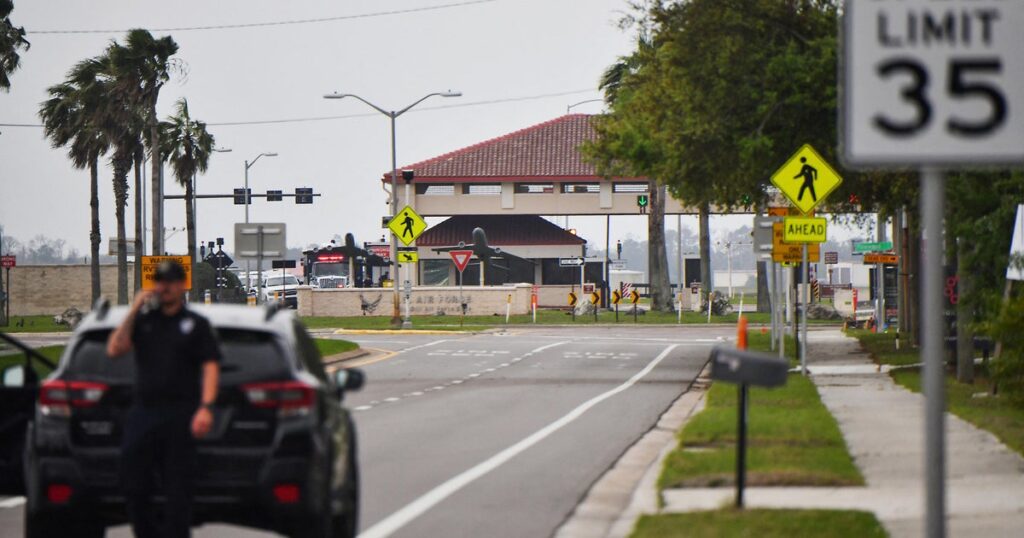
Washington — Two siblings have been charged after an improvised explosive device was left outside MacDill Air Force Base in Tampa, Florida, earlier this month, federal prosecutors announced Thursday.
Indictments were unsealed charging Alen Zheng and his sister, Ann Mary Zheng, in connection with the device, which was found at the base’s visitor center on March 16. FBI Director Kash Patel said Alen Zheng fled to China, where he remains, and Ann Mary Zheng is in custody for accessory and evidence tampering. She had her initial appearance before a judge on Thursday morning.
“This FBI, working with our partners, will continue pursuing all those responsible and ensure they are brought to justice, no matter where they are,” Patel wrote on social media.
Law enforcement in Tampa responded to a report of a suspicious package at MacDill’s visitor center near an entrance gate to the base on March 16, when the device was found by base security. Investigators with the FBI’s Tampa field office said last week that field screening of the package identified “possible energetic materials,” though final lab analysis hadn’t yet been completed.
U.S. Attorney Gregory Kehoe told reporters when announcing the charges against the siblings that the device did not detonate but “could’ve been potentially very deadly.” The motive is unknown, but Kehoe said “they obviously felt quite strongly about something or anything that the United States government was doing.”
Ann Mary Zheng faces one count of evidence tampering and one count of accessory after the fact for helping her brother flee and destroy evidence. Alen Zheng was charged with three counts: attempted damage of government property by explosion, unlawfully making a destructive device and possessing an unregistered destructive device.
MacDill Air Force Base is home to U.S. Central Command, U.S. Special Operations Command and the Air Force’s Air Mobility Command. Kehoe said the base houses “extremely, extremely important assets for the Department of War that are obviously involved in ongoing operations in the Middle East and elsewhere,” a reference to the war with Iran.
MacDill, he said, is crucial “to the safety of the United States” and the American people.
The device was planted outside MacDill’s visitor center on March 10, according to Kehoe. Minutes after it was left, a 911 call was placed reporting that there was a bomb on the base, though the caller did not provide a specific location, he said.
MacDill personnel searched the base but didn’t find the device in the immediate wake of the call. It was ultimately discovered in a secluded area at the visitor center, Kehoe said. On March 11, one day after the bomb was planted, Alen Zheng and Ann Mary Zheng purchased plane tickets to China and sold the vehicle that had been used to transport the device to the base visitor center, according to the U.S. attorney.
The siblings then left for China from Tampa on March 12, though Ann Mary Zheng returned to the U.S. on March 17, Kehoe said. Alen Zheng has not returned, he said.
During their probe, investigators tied Alen Zheng to the phone used to place the 911 call to emergency personnel about the bomb at MacDill on March 10 and received footage from Best Buy showing him buying the phone, according to prosecutors.
Law enforcement also obtained a search warrant for Alen Zheng’s home and found components consistent with the device, Kehoe said. His mother and sister also acknowledged to agents they knew he had planted the bomb at MacDill.