


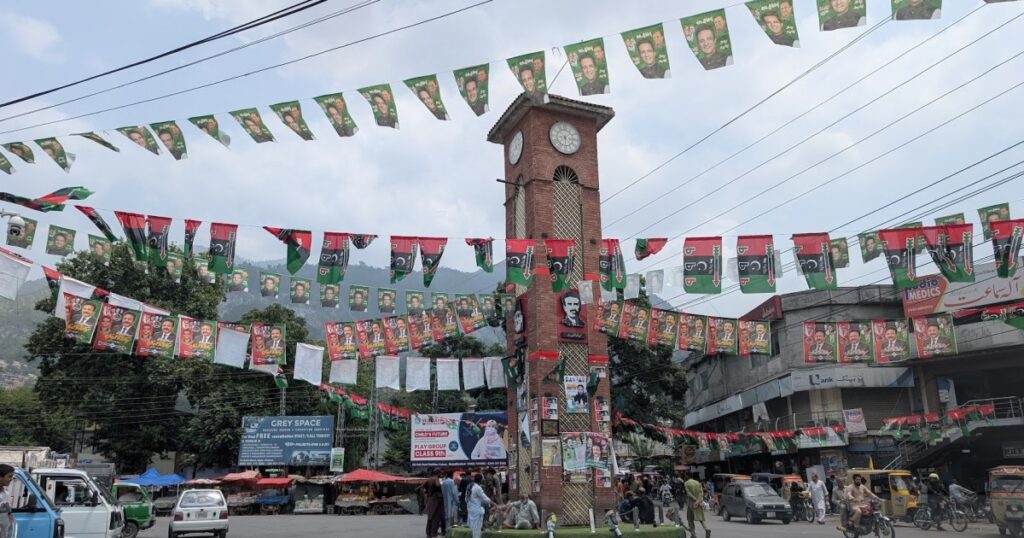
Muzaffarabad, Pakistan-administered Kashmir: The traffic crawled beneath densely strung election bunting.
Overhead hung the Pakistan Muslim League-Nawaz’s (PMLN) green tigers. Further down, Pakistan Peoples Party’s (PPP) red and black flags bearing the party’s arrow encircled the clock tower at Lal Chowk, a square near Muzaffarabad’s main market, built to honour the original Lal Chowk across the Line of Control in Indian-administered Kashmir’s Srinagar.
Recommended Stories
list of 4 itemsend of list
Muzaffarabad, the capital of Pakistan-administered Kashmir, does not look like a city in the grip of a crisis. It looks like a city preparing for an election.
Both are true.
Since early June, the territory has witnessed weeks of protests and sit-ins that have killed dozens. The protests are tied to elections for the region’s provincial legislature that were scheduled for July 27, but that on Monday were divided into voting now to be held on three separate days. Voting in the region’s Mirpur division will continue as planned on July 27. Elections in Poonch division, which has been the hotbed of protests, will now be held on August 10.
Voting in Muzaffarabad and for 12 other seats reserved for refugees from Indian-administered Kashmir who now live elsewhere in Pakistan will be held on August 2, the region’s Chief Election Commissioner Justice (retired) Ghulam Mustafa Mughal told Al Jazeera, citing security concerns arising from the unrest as the reason for the changed schedule.
It is those reserved seats for refugees that are at the heart of the agitation, with protesters demanding that they be scrapped, arguing that only those living in Pakistan-administered Kashmir should now be eligible to contest in elections to the regional legislature.
And it is in the backdrop of those tensions that the region is now readying to vote.
“I have never joined them, I never participated in their protest,” a 60-year-old driver, bespectacled and bearded, said of the Jammu Kashmir Joint Awami Action Committee (JKJAAC), commonly known as JAAC, the movement whose protests have dominated the politics of Pakistan-administered Kashmir, particularly Poonch division, in recent months.
“But my only reason to support them is that all the people in this movement are poor people, my sympathies are with them. They are the ones fighting and demanding for my rights,” the driver, who requested anonymity, told Al Jazeera, as he finished his lunch at a roadside hotel in Muzaffarabad on July 20.
When it came to the election, however, he was unequivocal: he would not vote.
“We should be part of the democratic process, but the person you want to vote for isn’t allowed on the ballot,” he said, referring to the JAAC, which was banned in June. “A vote is a responsibility, and it should only be given to those who deserve it. Right now the candidates on offer are all corrupt, and I will not be giving my vote.”
An election amid unrest
The Kashmir region, a scenic but disputed Himalayan territory, has been at the centre of multiple wars between Pakistan and India since both gained independence from British rule in 1947.


While both countries claim the region in full, they administer separate parts of it.
Home to more than four million people, Pakistan-administered Kashmir, locally known as Azad Jammu and Kashmir (AJK), has a semi-autonomous government with its own president, prime minister and Supreme Court.
The election was always going to be shaped by the latest crisis, JAAC’s fifth major mobilisation since the movement was founded in September 2023.
But Mughal, AJK’s chief election commissioner, said Poonch was the only division where, he said, “we have a bit of security-related concern”.
He is not the only official insisting the electoral process remains on track.
In Muzaffarabad, Deputy Commissioner Munir Qureshi pointed to bustling markets, heavy traffic and an active campaign trail as evidence that daily life continues largely uninterrupted.
“It is not our job to tell people to go and vote,” he said. “If they decide, for whatever reason, not to show up, it is their democratic right.”
The city, he added, has five constituencies and 890 polling stations, with additional security personnel requested ahead of polling day.
What neither official addressed directly, however, is the absent party hanging over the election.
The banned JAAC is absent from the ballot in any form. Some of its members who attempted to contest as independents had their nomination papers rejected.
The movement’s sit-ins have entered their second month across Rawalakot, Sudhnoti and other parts of Poonch division, closer to the Indian border, while its leadership has openly urged the public to boycott the vote.
How the region votes – or not – will tell whether the election carries legitimacy in the eyes of the people of AJK.
A movement outside the ballot box
The protests that have shaped this election began more than two years ago over prices.

![A large number of supporters present at the sit-in in Rawalakot in Poonch division last week [Courtesy Joint Awaami Action Committee]](https://www.aljazeera.com/wp-content/uploads/2026/07/IMG-20260719-WA0032-1784679834.jpg?w=770&resize=770%2C433&quality=80)
JAAC was formed in 2023 around 10 demands, including subsidised wheat, cheaper electricity, and a government commitment to curb the perks and pensions enjoyed by AJK officials and elected representatives.
The Pakistani government intervened in May 2024, agreeing to provide subsidies, while a charter of demands signed by the AJK government in October that year was intended to resolve most of the movement’s concerns.
By this June, however, JAAC’s focus had shifted to the 12 assembly seats reserved for Kashmiri refugees settled in Pakistan, which it wants abolished.
The group argues the seats give outsiders influence over AJK’s governance and budget, while residents themselves have no say over who occupies them.
On June 5, the AJK government declared JAAC a proscribed organisation under anti-terrorism legislation ahead of a planned June 9 protest, just weeks before the election.
Within days, police had arrested dozens of JAAC members and supporters, including the movement’s leader and public face, Shaukat Nawaz Mir.
What followed was the deadliest period of unrest AJK has witnessed in years.
The death toll remains disputed by JAAC and the authorities, but even conservative estimates place it at nearly 30 people since early June, including protesters and law enforcement personnel.
Access to Pakistan-administered Kashmir was also restricted, with entry into Poonch division almost entirely blocked for weeks, disrupting supplies of flour and other essential goods to a region dependent on routes from Muzaffarabad and Mirpur.
Banks remained closed for two weeks, leaving residents without access to cash. Mobile and fibre internet services have also remained suspended across almost the entire territory, with exceptions only for banks and a handful of government offices, including district administrations and the Election Commission.
And the Election Commission itself has become an institution whose role faces questions from the JAAC.
Sardar Amanullah, a JAAC member from Sudhnoti district in Poonch division, more than 155km (96 miles) south of Muzaffarabad, said he had submitted nomination papers as an independent candidate, only for them to be rejected.
“I don’t think these are free and fair elections,” he said. “When you cannot let people’s representation out there, the government keeps finding ways to reject our papers,” he told Al Jazeera.
Chief Election Commissioner Mughal offered a different account.
“There were only two or three people who submitted their nomination papers, who claim to be affiliated with JAAC, and their papers were rejected by the returning officer since their names were mentioned in FIRs and the Fourth Schedule,” he said, referring to police reports and Pakistan’s anti-terrorism watchlist.
Abid Shaheen, a JAAC core committee member from Bagh district, was more blunt. With the group now proscribed, he described the vote as “a selection, not an election”.
A dozen seats, one dispute
Of the AJK Legislative Assembly’s 45 general seats, 12 are reserved for Kashmiri refugees who settled in Pakistan after 1947: six linked to Jammu and six to the Kashmir Valley.

The arrangement dates back to legislation introduced in the 1960s and was later entrenched in AJK’s 1974 Interim Constitution.
In June, the AJK Supreme Court, ruling on a presidential reference, held that the seats could only be abolished through a formal constitutional amendment passed by the assembly, not through public protest.
AJK’s electorate has grown from just over 3.2 million in 2021 to more than 3.8 million this year, according to Election Commission figures.
Within that, the 12 refugee constituencies alone have expanded from about 405,000 voters to nearly 439,000. JAAC argues that the increase has further amplified the influence of seats that were never intended to carry such political weight.
Since AJK adopted its current parliamentary system in 1975, all 10 general elections have produced governments aligned with the party in power in Islamabad.
Zulfiqar Ali, a Muzaffarabad-based political analyst, argued that the seats themselves have rarely determined who governs AJK.
“Across all the governments AJK has had, these 12 seats have played no significant role in actually making or breaking a government,” he said. “That role has always belonged to native AJK politicians, or whichever party holds federal power in Islamabad.”
Islamabad, meanwhile, has shown little interest in rethinking the refugee seats.
Defence Minister Khawaja Asif told the National Assembly last month that abolishing the seats under pressure from street protests would amount to “sabotaging the electoral process”.
The campaign that resumed late
For the parties actually on the ballot, the crisis all but wiped out campaigning in June.
“Frankly speaking, the campaigning was dead due to the protests all June,” said Iftikhar Gillani, a PMLN candidate contesting from Muzaffarabad.
“The campaign only picked up in the last few days,” Gillani told Al Jazeera after meeting supporters at a polling station on July 20, where government officials were casting advance ballots.
Dressed in a white shalwar kameez and repeatedly wiping his face with a tissue on a severely humid Monday afternoon, Gillani argued that many Kashmiris distinguish between supporting JAAC and participating in the election, even if some committed supporters may stay away from the polls.
“People here are cognisant of the importance of the election and understand that they don’t have to mix their support for JAAC with their responsibility to participate in the polls,” he said. “But there is obviously no denying that there is a chunk of the population which fully believes in JAAC, and they might not cast their votes.”
A 28-year-old PMLN activist, who requested anonymity to speak candidly, said the internet shutdown had forced campaign workers to abandon social media in favour of door-to-door canvassing and loudspeakers mounted on vehicles to publicise the party’s manifesto.
But, he added, the election had also exposed social divisions unlike any he had witnessed before, fuelled by the JAAC-led protests.
“Families are divided over this,” he said. “Those who don’t support JAAC are being called supporters of our oppressors.”
The PPP, which currently governs Pakistan-administered Kashmir, has maintained the more visible street presence.
Its flags dominate Lal Chowk, and a Saturday night corner meeting near the square drew a crowd of supporters waving the party’s arrow banner close to midnight.
But Sardar Mukhtar, a PPP candidate in Muzaffarabad, acknowledged the changed mood.
“The campaign environment is not like previously. I personally feel that turnout might not be as strong as in the past,” he told Al Jazeera from his camp office, where party workers crowded in to catch a glimpse of the candidate.
The party’s clearest position has come from its chairman.
In a letter to JAAC’s negotiating committee last week, Bilawal Bhutto Zardari proposed establishing a Truth and Reconciliation Commission to “examine the present situation, establish the relevant facts, consider the grievances and positions of all sides”.
He also urged JAAC to suspend its protest once such a commission was agreed, while calling on the state to halt further action pending its findings.
Bilawal is scheduled to address a public rally in Muzaffarabad on July 24.
AJK’s Prime Minister Faisal Mumtaz Rathore, the PPP’s most senior leader in the territory, has been more measured on the campaign trail, telling reporters after the revised election schedule was announced only that “the current environment is not suitable for the state” and that “problems can only be solved through dialogue”.
In the region’s legislature, he has previously said that the JAAC bears “the primary responsibility for this situation,” while conceding that “we have not absolved ourselves of responsibility as a government”.
What the election can’t fix
For Ali, the Muzaffarabad-based political analyst, the real issue lies not in the vote itself but in everything that has unfolded over the past few years.

He pointed to commitments the government made to JAAC in October 2024 that remain unfulfilled, including promises to devolve development budgets to local councillors and eliminate the perks and privileges enjoyed by politicians.
“However, people will vote,” he told Al Jazeera. “Because the entire system is designed in a certain way, tying government jobs and small favours to elected representatives. So turnout will be fine, but it will not resolve people’s fury and anger.”
Ershad Mahmud, a Canada-based researcher and author of Poonch: Identity, Politics and Resistance, sees the problem differently, arguing that the election is diminished by who is missing from the ballot.
“PTI did win last time, and they have significant following, as well as JAAC,” he said, referring to Imran Khan-founded Pakistan Tehreek-e-Insaf, which ruled Pakistan from 2018 to 2022 before being ousted through a vote of no confidence.
PTI also formed the AJK government after the 2021 election, but since 2023 the territory has had four prime ministers.
Mahmud argued that with two major democratic forces absent from the contest, many voters will stay away as well.
“I don’t think this election will be seen as legitimate. The distance from Muzaffarabad to Islamabad is more than 120km [75 miles]. But the mental distance is now 1,000km [621 miles],” he told Al Jazeera.
An uncertain verdict
However, not everyone has reached the same conclusion.
Muhammad Ramzan, a property dealer from Mirpur division in the south of the territory, supported JAAC when its demands centred on subsidised wheat and lower electricity prices.
His support cooled once the movement shifted its focus to abolishing the 12 refugee seats, a campaign he considers disconnected from the concerns of residents and his own livelihood.
“Even I am curious,” he said. “Earlier they asked for roads or electricity or school, but now that they have changed their focus to 12 seats, I am flabbergasted why would they do that.”
He intends to vote, although he expects turnout to fall, with much of the boycott driven by younger voters aged between 18 and 35 who remain committed to JAAC.
“There are a lot of people like me,” he said, describing his gradual drift away from the movement.
But he remains doubtful that the election will resolve the crisis.
“I fear that things will go bad,” he said quietly.