


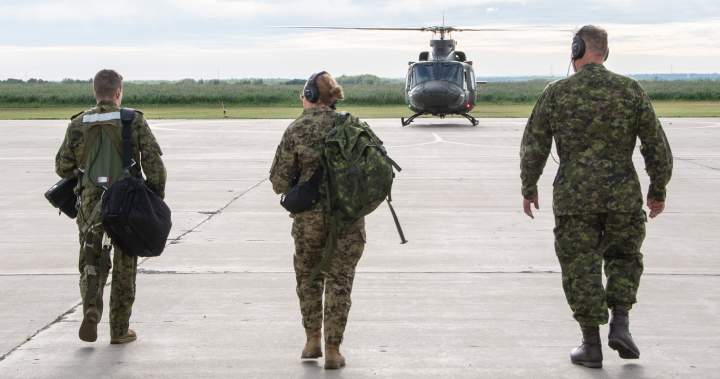
The Canadian Army is making one of the biggest structure changes in its history, shifting from four divisions based on geography to three that are built around specific purposes.


“Our structure, our equipment and the way we do business had to change,” said Maj.-Gen. Wade Rutland, commander of the new 1st Canadian Division, in an interview with Global News.
“This is not an exercise in restructuring the deck chairs,” he added in comments to The Canadian Press.
“We’re doing this in order to be more agile, more lethal, more relevant to defend Canada.”
CFB Edmonton held a signing ceremony and parade on Thursday to stand up the 1st Canadian Division, which will be headquartered in Edmonton and will serve as the main force responsible for deploying on large-scale combat operations and responding to crises.
“We’re designed to be the expeditionary war-fighting division — whether that’s overseas or in Canada.”
Before Thursday’s reorganization, the army had a structure where every type of unit in the west, Ontario, Quebec, and Atlantic regions were in geographical division, responsible for everything that happened within its area.
Rutland said that system worked during Canada’s peacekeeping years, the war in Afghanistan and the earlier years of Canada sending battalions of 500 to 1,000 troops to Latvia as part of NATO deterrence and defence measures across the Euro-Atlantic region.
But, the global threat environment has changed and he said the military recognized the army it had is not the army it needs.
Rutland said the world is returning to large-scale combat operations like Russia’s invasion of Ukraine, involving the deployment of hundreds of thousands of soldiers.
“You need to be able to put up what we called a fighting division — which means you can sense and shoot out to 100 kilometres, you can control multiple brigades in close combat, and you can sustain all that over hundreds of kilometres of lines communication,” Rutland said. “You also have to be able to integrate capabilities like cyber, space, air.”
At the same time, Canada faces perils both within and abroad.
Rutland gave examples like threats to Canada’s critical infrastructure and climate change — the latter which experts have said is fuelling more natural disasters like fires and floods, leading to more requests for military aid within provinces.


Get daily National news
Get daily Canada news delivered to your inbox so you’ll never miss the day’s top stories.
The military is also mindful of air and ballistic missile threats, he said, and of protecting Arctic sovereignty.
“We’re moving to a more functional, efficient structure in order to face the threats that are more prevalent today.”
The three new function-based divisions with their own specific mandates are now: 1st Canadian Division (the Manoeuvre Division, based in Edmonton), 2nd Canadian Division (the Defence of Canada Division, based in Montreal), and the Canadian Army Support Division, based in Kingston.
Headquartered at the Edmonton Garrison, the 1st Canadian Division will bring many capabilities together under one roof, such as tanks and other armour, artillery, light infantry, paratroopers and engineers.
“There’s going to be more people moving into Edmonton, more infrastructure,” Rutland said, explaining over the next few years, about 1,000 more soldiers will be based at CFB Edmonton.
“That also means 1,000 — sometimes — families, places to live, et cetera.
“It has a really high economic impact.”
Rutland said says it’s a big administrative change that required a lot of work over the past year.
“It’ll be phased over the coming years, but certainly Edmonton is a place that, for the Canadian Army, is going to grow.”
The base in Edmonton has a long history of leading the charge, the major general said.
“CFB Edmonton has been the launching pad for operations for decades, quite frankly, from Cold War units into launching troops into places like Bosnia, former Yugoslavia. First army troops that went into Afghanistan came from this base. First troops that were into Latvia came from this space.
“We like to think that we’re first out the door.”
Western Canada — Alberta in particular — has extensive training areas and established infrastructure that Rutland said is almost unmatched in the rest of NATO. More troops will also be headed to the province’s three other military bases.
“CFB Edmonton, CFB Wainwright, Cold Lake, Suffield — huge amount of land and infrastructure that the Canadian Armed Forces relies on right here in Alberta. So it’s not just Edmonton that’s gonna feel the effects of all this.”
The division is assuming command of the three regular Canadian Mechanized Brigade Groups in Edmonton, Petawawa, Ont., and Valcartier, Que.
The incoming brigades will remain in their current locations across Canada, but will now report to the Edmonton division headquarters.
Four new formations are now part of the 1st Canadian Division:
- 3rd Canadian Light Infantry Regiment: A reassignment of existing units, staffed with high‑readiness forces for rapid crisis and Arctic responses.
- 1st Canadian Artillery Brigade: Tasked with centralizing and coordinating the Division’s artillery in support in the deep fight, shaping the battlefield and setting the conditions for manoeuvre formations to fight and win
- 1st Canadian Sustainment Brigade: manage logistics depth in prolonged, high‑intensity operations
- 10th Signal Regiment: brings modern situational awareness and communications across all formations together under the 1st Canadian Division, connecting the headquarters, manoeuvre brigades, and supporting units into a single, coordinated fight
The military said the new arrangement retains the army’s coast‑to‑coast footprint while streamlining the chain of command structure. There will be new patch colours as part of the reorganization.
“For the 1st Division, we’re going back to what we call the ‘old red patch’ which we used in World War I and World War II,” Rutland said.
The 1st Canadian Division dates to 1915 and the First World War battles, including Vimy Ridge. For the past 16 years, the 1st Canadian Division was headquartered in Kingston, Ont.
The standing up of the 1st Canadian Division means the 3rd Canadian Division — which also traces its history to the First World War — is being retired to the supplementary Order of Battle, which happens when a regiment is powered down but continues to exist on paper in case it needs to be returned to duty.
With files from The Canadian Press
© 2026 Global News, a division of Corus Entertainment Inc.