


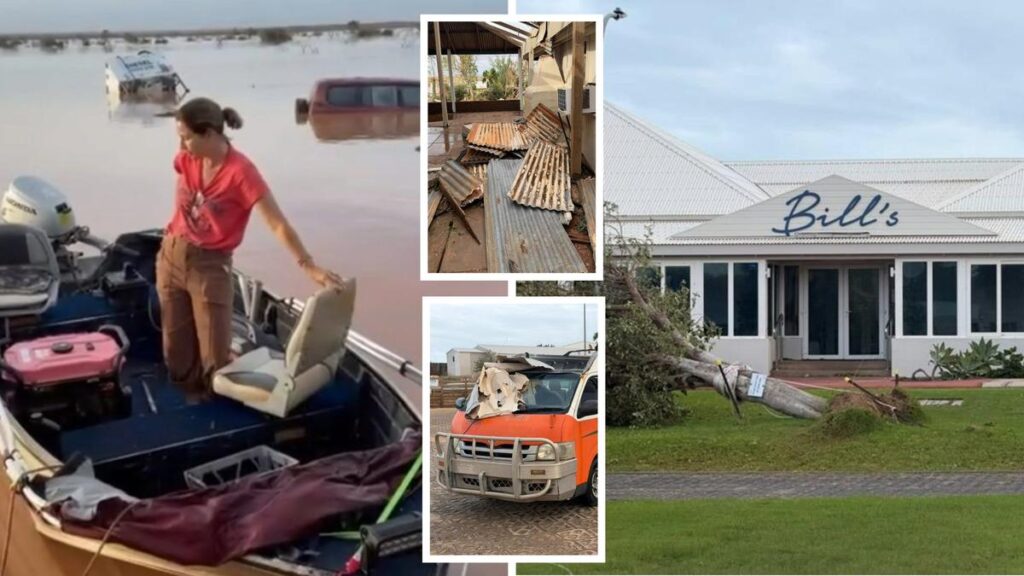
The monster cyclone that ripped through WA has dissipated, but the worst could be yet to come with tourism operators left facing the aftermath just days before peak season.
Easter weekend marks the start of tourism season for Ningaloo but cyclone damage has put a question mark on when tourists will return.
The category four cyclone, which reached winds of up to 260km/h, has left a trail of destruction including shutting off access roads to popular tourism spots and halting the Learmonth Airport until at least Monday due to significant roof damage to the terminal.
State Emergency Service teams were called out to 96 requests for assistance in the Pilbara — mainly in Exmouth — and a further 54 callouts in the Midwest Gascoyne region.
Ningaloo Lodge owner and Shire of Exmouth deputy president Jackie Brooks said she only had minimal damage to her accommodation but she could only do so much to get the community back on track since the town was shut off.
Her rooms are currently being used by State Emergency Service crews.
“Once we can get back up and going, the ones that are open will be able to take tourists,” she said.
“Unfortunately Warroora and Bullara Station were impacted as well, quite substantially, so from a tourism point of view, I really hope that the government will step up and support the stations and our town at this time because it is quite devastating.
“It is really devastating seeing the impact that we’ve had and obviously, with the roads closed and the airport not being able to bring people in, that’s going to affect a lot of our tourism operators here.”
She urged travellers to come and support small businesses once the town is reopened.
“We would like people to definitely come up and support our small businesses, because they are heavily reliant on it,” Ms Brooks said.
“This is supposed to be our peak time of the year, and all the businesses are going to be impacted substantially.
“It might look a bit different, but you’re still going to have that awesome experience out in the water with whale sharks and enjoy the Ningaloo Reef and what it has to offer.”
Exmouth charter boat operator Craig Kitson said there was no point putting his boats in the water as there was no tourists around.
“The airport is closed and the water is brown so I’m just waiting for all of that to clear up,” he said.
“All of us are just at the end of summer, where we don’t really get a lot of work so this is the kickstart to the year for most of us so this is obviously going to have an impact.
“I think the reef itself will clear up pretty quickly but it’s just a matter of the roads being open and people being in a position to get back to work.”


He said the fuel crisis was exacerbating his tourism concerns.
“We’ve already had cancellations just due to the price of fuel, so I suspect it’s going to be a lean year,” Mr Kitson said.
Tourist hotspot Bullara Station in Exmouth has been left in ruin after copping the worst of the cyclone.
The cattle farm posted an update on social media just days out from their tourist season beginning.
The heartbreaking images paint a grim picture for the long-term damage that Narelle has dealt to local businesses in WA’s north.
“Due to the severe impacts of cyclone Narelle, we are currently unable to open as we work through significant damage and loss,” the station post said.
“This has been a very challenging time for our team, and we truly appreciate your understanding and support while we focus on recovery.”
The outback station was expecting visitors to start flooding in from April 1 but staff are now dealing with draining the flooding out and repairing the extensive damage.


The concerns for tourism operators comes just a day after Tourism Council WA chief executive Evan Hall was confident the clean-up from Narelle would not impact the Easter break.
Wildlife were also caught in the crosshairs with BaluBlue founder Brinkley Davies saying hundreds of birds had died and a baby dolphin washed up alive but didn’t make it.
Exmouth IGA was able to open on Saturday, however, limits were in place in a bid to stop panic buying. Customers were limited to one basket of food each.
Local Jamie Brooks said she still expected panic buying among residents as they felt trapped with nowhere else to get groceries.
“There’s a one-basket-per-person rule, but when people are scared and trying to prepare without power and with water restrictions, one basket doesn’t feel like enough,” she said. “Everyone’s just trying to make sure they can get through the next few days.”
The Water Corporation was still urging residents in Exmouth and Onslow to limit their non-essential water use as they worked to get water restored to the towns.
Horizon Power teams also arrived in Exmouth on Saturday to start restoring electricity.
Burkett Road, a key road connecting the North West Coastal Highway to Exmouth, was expected to open on Saturday afternoon.
It is not yet known when roads into Exmouth from the south will be open.
Farmers in Carnarvon have been left to pick up the pieces and salvage what they can from their crops.
While they copped the slightly weaker, western side of the storm, the damage was still immense to farms near town.
Sweeter Banana Co-operative business manager Doriana Mangili said her banana farm had copped significant damage with reports of between 50 to 80 per cent of crops damaged.
Ms Mangili said the business was going through crops to see what could be saved but the impact was “utterly devastating”.
“Over the next couple of days, we’ll be trying to harvest what we can that’s fallen over that hasn’t been damaged, to try and get as much fruit off.
“We did pack everything as much as we could before the roads closed on Thursday to try and get as much fruit out as we could to keep the market going.


“This is our third extreme weather event this year, January we had a heat wave, February we had a cyclone now March we have a cyclone.
“We’re already at about 50 per cent of production capacity, we’re going to be looking at very, very low volume.”
The Mid West dodged a bullet, as Narelle rapidly weakened in strength and moved eastwards on Friday night.
The Bureau of Meteorology originally forecast the cyclone to move over Geraldton in the early hours of Saturday morning as a category one system.
However, as the city braced for impact, residents woke up fresh on Saturday morning with no cyclone damage.
The strongest wind gust recorded at Geraldton Airport was 56km/h, while only 1.6mm of rain was recorded.
The after effects of Narelle were still being felt on Saturday with Mandurah copping more than 100mm of rain.
This led to more than 120 requests for assistance to SES in the Perth metropolitan due to water ingress and flooding.