


“VERY, VERY DIFFICULT”
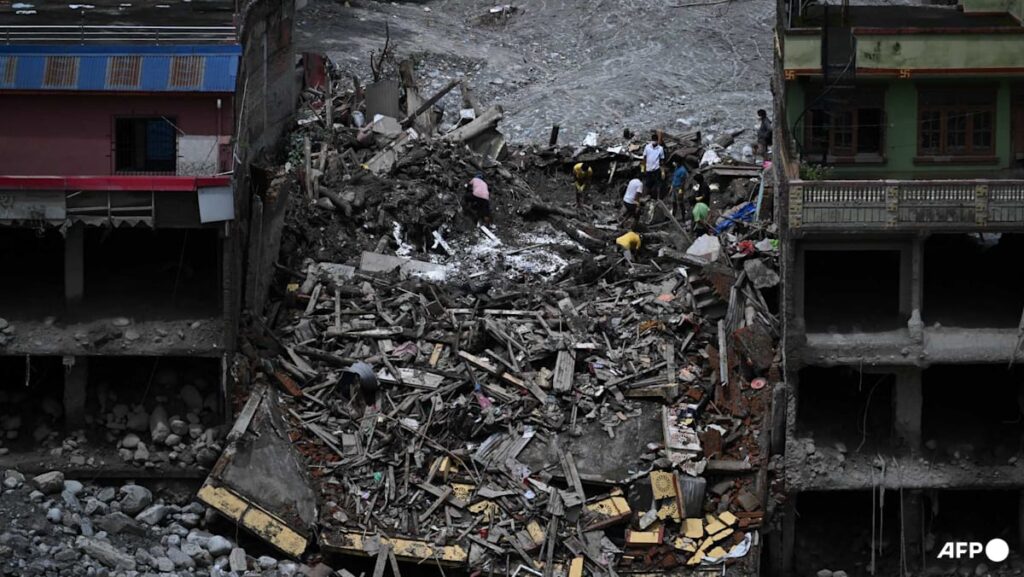
Floods tore through mountain districts, destroying roads, bridges and hydropower dams.
Communities near the epicentre remain cut off, with the UN working alongside Nepal’s government to get emergency supplies into devastated areas.
“Access has been very, very, very difficult,” Pieters Yahia said, noting that UN agencies had delivered water and and sanitation kits, as well as food and medicine.
“Those are the most essential, particularly for the people who are in the epicentre.”
Foreign Minister Shisir Khanal, in a briefing to diplomats in Kathmandu on Thursday, called it a “Himalayan tsunami”.
“I can say from first-hand observation that the reality on the ground is far more severe than images can convey,” he said. “This is not an ordinary flood”.
Foreign ministry spokesman Lok Bahadur Poudel Chhetri said Nepal needed specialised international assistance, including heavy-lift drones and temporary bridges, as well as body bags and DNA testing kits to help identify the dead.
He said Nepal also needed a mobile air traffic control system and broadband seismometers to monitor ground vibrations.
More than 21,000 Nepali security personnel are working on search, rescue and relief operations.
Nepali rescuers, aided by experts from India, China and South Korea, continue searching for survivors feared trapped inside hydropower tunnels, but teams have repeatedly hit dead ends, and no one has been confirmed alive.
The energy ministry said a committee will be set up to coordinate with rescuers and provide necessary assistance to the families of missing hydropower workers.
At a relief camp in Nepal’s Nuwakot district, an AFP journalist saw flood survivors waiting for their names to be called before collecting bags of rice, instant noodles, cooking oil and biscuits.
Pieters Yahia said the UN was discussing with the government “how to use helicopters and cargo drones to be able to deliver aid”.