


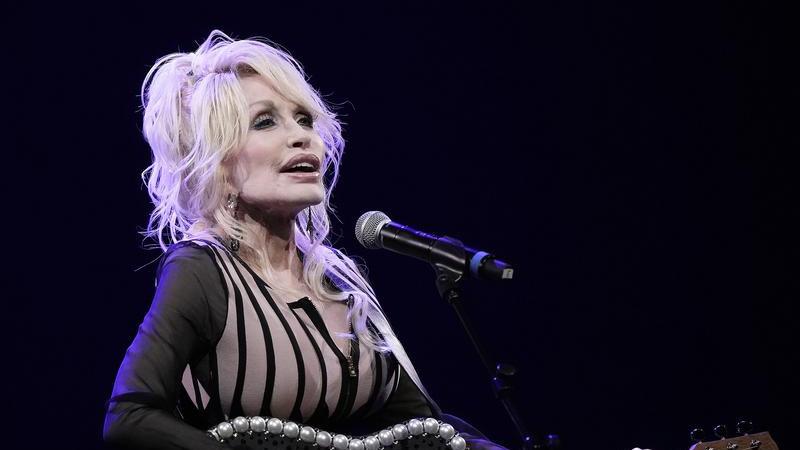
Dolly Parton, the country music icon whose soaring vibrato vocals, poignant songwriting and sparkling costumes defined her rise from a log cabin in the Tennessee mountains to the height of stardom and acclaim, has died. She was 80.
Parton died peacefully Tuesday in Nashville, Tennessee, her publicist said in a statement.
Known for her curves, massive blonde wigs and skin-tight outfits that served her self-deprecating wit, she was among the most beloved personalities in music and beyond — the rare celebrity whose appeal transcended generations, geography and politics.
She wrote hundreds of songs, including such favorites as “Jolene,” “Coat of Many Colors” and “I Will Always Love You,” which totaled more than 100 million worldwide sales and more than 1 billion online streams. Parton was a generous philanthropist and successful businesswoman whose projects included a theme park in the Smoky Mountain foothills near her birthplace.
Her career was influenced by her upbringing as one of 12 children born into what she called a “dirt poor” Tennessee family. She started her education nonprofit, Imagination Library, to send free books to needy children because her father quit school to work on the farm and struggled to learn to read.
Her first musical performances were in church, where her grandfather was a preacher. At 13, she appeared on the Grand Ole Opry in Nashville, where Johnny Cash introduced her as “a little girl here from up in East Tennessee.”
With a suitcase of songs, she followed her uncle, Bill Owens, also a songwriter, to Nashville after graduating high school.
‘The Porter Wagoner Show’
Her partnership with Porter Wagoner and his syndicated TV show kicked off her career. Their first duet, “The Last Thing On My Mind,” was released in 1967, the year she started her publishing company.
Their duets were often radio hits, but her solo singles didn’t chart as highly at first. With Wagoner as co-producer, she adjusted her country warble to a more polished pop-leaning style.
Her first No. 1 solo single was “Joshua.” She reached the top 5 with the ballad “Coat of Many Colors,” about her mother sewing together scraps to make a coat Parton wore “so proudly” even as her peers mocked it.
In 1973, she had the hit that made her career — “Jolene,” a country music standard with its churning rhythm and Parton’s repetition of the title as she pleads for the woman not to steal her man.
A pop crossover star
“Jolene” was followed by the 1974 hit, “I Will Always Love You,” an ode to Wagoner that helped her win the Country Music Association’s female vocalist of the year back to back in 1975 and 1976. She famously turned down Elvis Presley, who wanted to record it, because she would not share publishing rights.
Decades later, Whitney Houston’s version became a smash for the 1992 soundtrack of her film, “The Bodyguard.” Houston won a Grammy for her performance in 1994, presented to her by Parton.
Down home charm
For millions, she was simply “Dolly,” a mixture of Southern charm, humor and glamour. She was also considered a feminist role model for holding the reins of her career, writing her own songs, owning her content and controlling her finances in an entertainment world dominated by men.
Parton was open to making fun of herself; when she hosted Saturday Night Live in 1989 she told the writers her only restrictions were she wouldn’t curse and wouldn’t make fun of Jesus. She’d regularly joke about her breasts or her dumb blonde appearance, but with a wink that she was the one controlling the laughs. In the memoir “My Life So Far,” her friend Jane Fonda remembered Parton’s way with a wisecrack, “usually high raunch,” and a laugh that was “somewhere between a girl’s giggle, an explosive shriek, and a cascade of little bells.”
She married Carl Dean, an asphalt paving contractor, in the mid-1960s and they were together until his death in 2025 at the age of 82. Though rarely seen in public, he was an influence on her career: She said she wrote “Jolene” about a flirty bank teller who seemed to take an interest in Dean.
‘9 to 5’ to Hollywood and Broadway
In her first major film role, Parton played alongside Fonda and Lily Tomlin in the hit comedy “9 to 5.” Critic Roger Ebert called her a “natural-born movie star” and the title song, written by Parton, earned her two Grammy Awards and was a pop crossover hit. Starring roles in “The Best Little Whorehouse In Texas” and “Steel Magnolias” followed.
“I never thought of myself as a movie star,” she told The Associated Press’ Bob Thomas in 1979. “I knew I’d be a star, but as a singer or as a writer of songs or books or poetry. I wanted to be a famous performer and wear flashy clothes, but singing in movies was not one of my ambitions. My family lived in the mountains and we didn’t see movies.”


Her love affair with TV and film continued for decades, with appearances alongside Miley Cyrus on “Hannah Montana” and adaptations of her music for Christmas specials, films and streaming series.
The stage adaptation “9 to 5: The Musical” debuted in 2009, and “DOLLY: A True Original Musical” was set to open in December 2026.
United States of Dolly
Parton’s appeal spanned social and political divides. But she was strict in not voicing her own political beliefs, often turning aside questions about presidents, candidates, policies and other controversies.
“I don’t do politics,” Parton told Jad Abumrad on his hit podcast “Dolly Parton’s America.” “I have too many fans on both sides of the fence. Of course, I have my opinion about everything, but I learned years ago to keep your mouth shut about things.”
When the Rock & Roll Hall of Fame Foundation sent out a ballot with her name on it, though she said she felt she hadn’t earned it, the voters answered with a “Hello, Dolly.” Parton showed up to the induction ceremony, performed and then put out a rock album.