


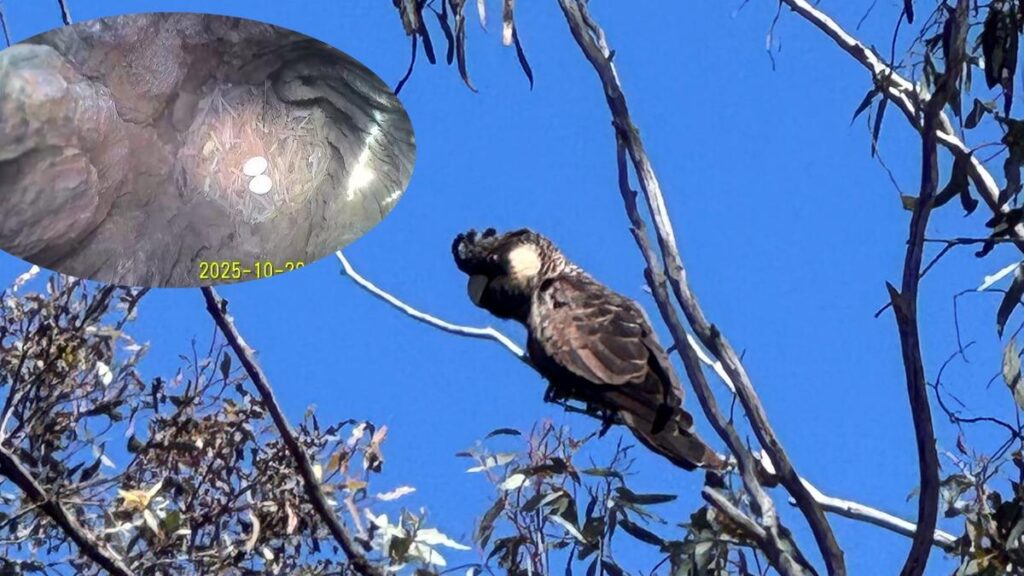
An endangered and rare cockatoo species has been discovered breeding at Dryandra Woodland National Park.
Eight active Carnaby’s black cockatoo breeding hollows were unearthed, including a sighting of a female incubating her eggs, during bushfire investigations at Dryandra in spring 2025 after a lightning strike sparked a small fire there earlier that year.
The combined efforts of the Department of Biodiversity, Conservation and Attractions, 5 Rivers NRM and BirdLife Australia confirmed the critical findings between September and November 2025.
These large black-feathered and white-tailed cockatoos are only found in WA’s south-west.


Sadly, the rare species is classified as endangered as numbers have been declining since the 1950s, largely because of the loss of feeding habitats.
Conservation operations officer Mel Taylor said the discovery was “super important because we can’t conserve what we don’t know is there”.
“We know that Carnaby’s do use the area, but we didn’t know they use it as a breeding habitat, so now we know that all these hollows potentially could be of use,” she said.
“It’s important to then make sure when a fire does happen, or a prescribed burn, that those trees are identified and protected, because we need those old trees in the landscape.”
She said the revelation meant there was a new area to investigate when tracking the Carnaby’s population.
“It’s really exciting because it gives us that extra bit of knowledge that Carnaby’s might be doing a bit better in our area,” Ms Taylor said.
“We can go out and look at the young, see if they’re fledging, if they’re leaving the hollow, so we can assess if the population is growing or declining. If we do find there’s a decline we can investigate those areas for what might be the threat.
“It gives us a new environment to investigate the overall health of the habitat, and more targeted areas that if we are finding the threat, we can go ‘OK, we need to focus here’.
“Or if there’s a big event happening, like another drought, we can target areas for investigation to put in extra work to help (Carnaby’s) continue persisting in the landscape.”
Ms Taylor advised residents living near Dryandra to keep big potentially hollow bearing trees on their property and provide a water source during summer, especially if they saw Carnaby’s black cockatoos nearby.


