



Dutch natural gas futures steadied after the kneejerk reaction that saw European natural gas prices plunge to a two-month low at the start of the week. The preliminary peace framework between the US and Iran have eased the market’s anxiety over energy disruptions.
However, it may take some time for normalcy to return fully. Besides, European countries will be keen on refilling their storage reserves. Based on these mixed factors, market volatility is expected in the short term.
Natural gas prices to remain above pre-conflict levels
Natural gas prices in Europe plunged to April levels at the start of the week in response to the US-Iran MoU and subsequent easing of the global woes on energy disruptions. However, Europe’s natural gas prices remain significantly higher compared to the pre-conflict period. More specifically, it is about 10% higher than during a similar period in the past year. It is also close to 30% higher than prior to the US-Iran war in late February.
On the one hand, the US-Iran preliminary peace agreement has eased the market woes over persistent energy disruptions. The closure of the all-important Strait of Hormuz cut off about 20% of the global LNG supply as Qatar could not export the product to Europe and Asia. As the buyers sort alternative shipments from Australia and the US. At the peak of the US-Iran war, European natural gas prices surged to a level last recorded in January 2023.
While the peace framework has shifted the market sentiment, it may take some time for full normalcy to return to the natural gas market. To begin with, clearing the trapped tankers and smoothening out the approvals may take some time. This also includes the multiple empty LNG tankers lying idle in Asia and which should be headed to the world’s leading LNG plant in Qatar, the Ras Laffan Industrial City. Besides, the liquefaction process involves cooling natural gas to around -162 degrees celsius at a slow pace.
Based on these factors, volatility is set to shape the natural gas market in the short term. Investors will continue to eye the US-Iran peace framework as they wait for it to be finalized and ratified.
Additionally, Europe’s natural gas demand is set to remain elevated as countries strive to replenish their reserves. Disruptions along the Strait of Hormuz and the subsequent surge in prices made it difficult for the nations to maintain robust storage levels, which were already below normal at the start of the year.
European natural gas price technical analysis

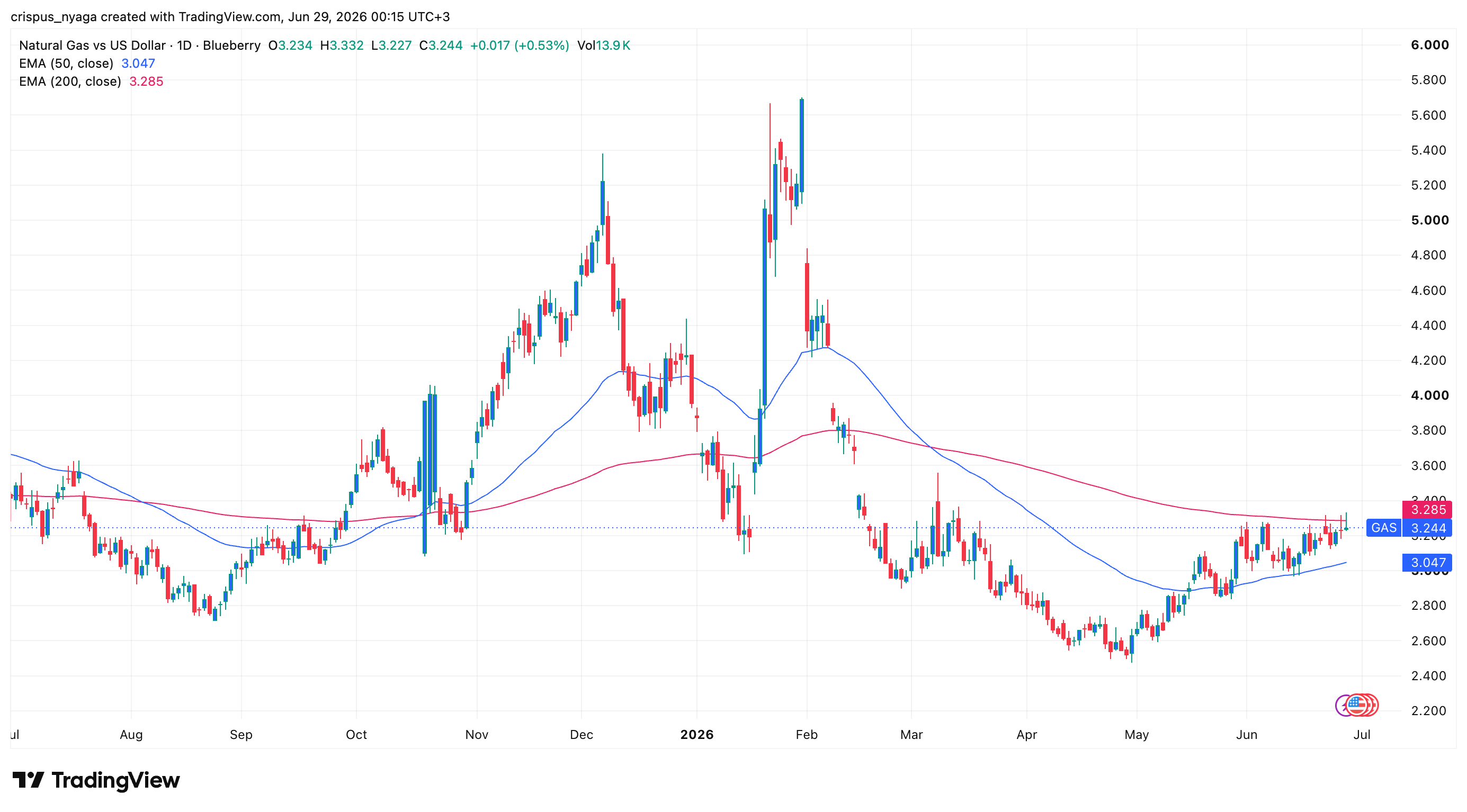
Natural gas price chart | Source: TradingView
European natural gas prices steadied on early Tuesday after the plunge recorded at the start of the week. In the previous session, the benchmark Dutch TTF natural gas futures dropped to the lowest level in close to two months in response to the preliminary peace framework between the US and the Islamic Republic of Iran. It has since found support around Monday’s intraday low.
A look at its daily chart signals volatility in the short term, even as the bears remain in control. To start with, it is trading below the short-term 25-day EMA and the medium-term 50-day EMA. At the same time, its RSI of 36 points to subtle gains.
In the near term, it will likely find support at $41.15 with the resistance at $44.50 yielding range-bound trading. Amid the volatility, further gains may be curbed at $45.90. On the flip side, further losses would activate the lower level of $40 while invalidating this thesis
The post European natural gas price analysis: Here’s what lies beyond the US-Iran MoU appeared first on Invezz