


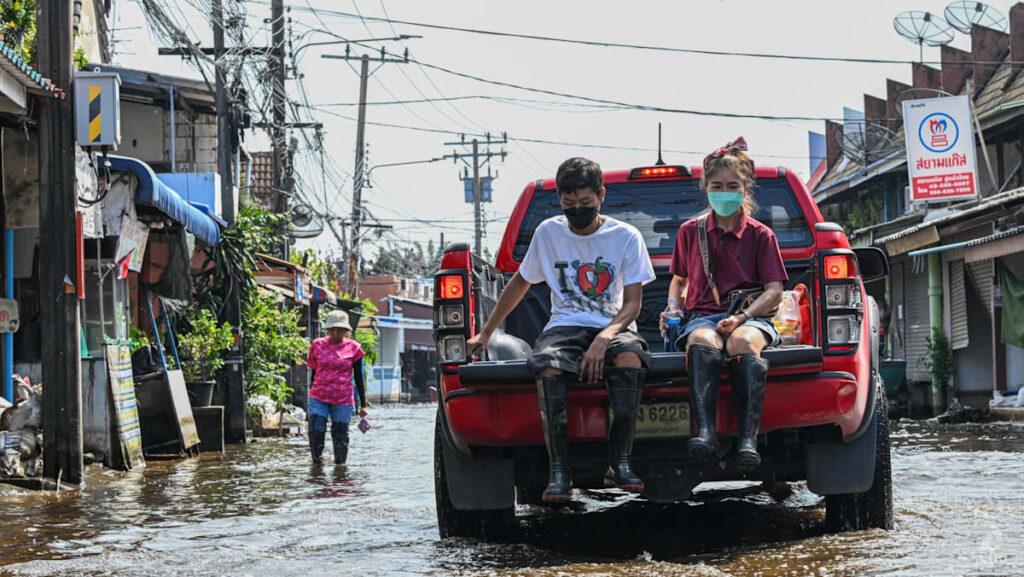
NOT DESIGNED TO COPE
For centuries, Bangkok has expanded across land where water naturally gathers and passes through.
Sitting low in the Chao Phraya basin and close to the Gulf of Thailand, the capital must now engineer the movement of water through a landscape dramatically altered by urban development.
Landscape architect Kotchakorn Voraakhom said Bangkok has shifted from a water-based to land-based city over the past half century, losing about half of its estimated 3,000 canals and its “porous capacity”, while becoming heavily dependent on pumps and concrete drainage.
“We still rely on a very outdated way of thinking of how to live with water,” said Kotchakorn, the chief executive officer of Porous City Network, a social enterprise that looks to increase urban resilience in Southeast Asia
Climate change is raising the stakes too, from rising seas at the city’s edge to heavier storms and increasingly volatile rainfall.
The consequences reach far beyond flooded homes and streets. Millions of lives, major centres of economic activity and the infrastructure and ecosystems that sustain them are increasingly exposed.
Preliminary estimates have put the economic losses from Thailand’s late-September floods in the tens of billions of baht, with Bangkok bearing a disproportionate share. One Rangsit University assessment estimated economic losses of 25.3 billion baht (US$780 million) nationwide over just four days.
Urban expansion in and around the capital has filled natural flood-retention areas and drainage routes with roads, buildings and industrial development, said Nuanchan Singkran, associate professor at the Faculty of Environment and Resource Studies at Mahidol University.
“At the same time, Bangkok’s infrastructure was not designed to cope effectively with flooding on this scale,” she said.
Nuchanart said several factors kept the water from draining quickly: overwhelmed drains, high canal levels, local bottlenecks, low-lying terrain and continued rainfall.
Using a simplified calculation, Nuchanart estimated that Bangkok’s reported pumping capacity alone would theoretically need three to four days to remove the runoff generated by 300mm of rain.
Bangkok’s Metropolitan Authority said pumping stations and floodgates were operating at full capacity throughout the emergency period, although major canals remained high because they were receiving water from surrounding districts.
But many drainage systems and canals are known to be obstructed with rubbish or other materials, reducing their effectiveness, Nuanchan said.
In Lat Krabang, local residents complained that clogged drains, construction debris and inadequate pumping were factors prolonging flooding in their area, well beyond that time scale.
“Instead of leaving us to deal with flooding on our own, the government should fix the problem,” Wandee said. “They should also make sure construction sites don’t allow sand and debris to wash into the drains. Otherwise, this will just keep happening again and again.”
They also said flood warnings came only after water was already rushing in.