


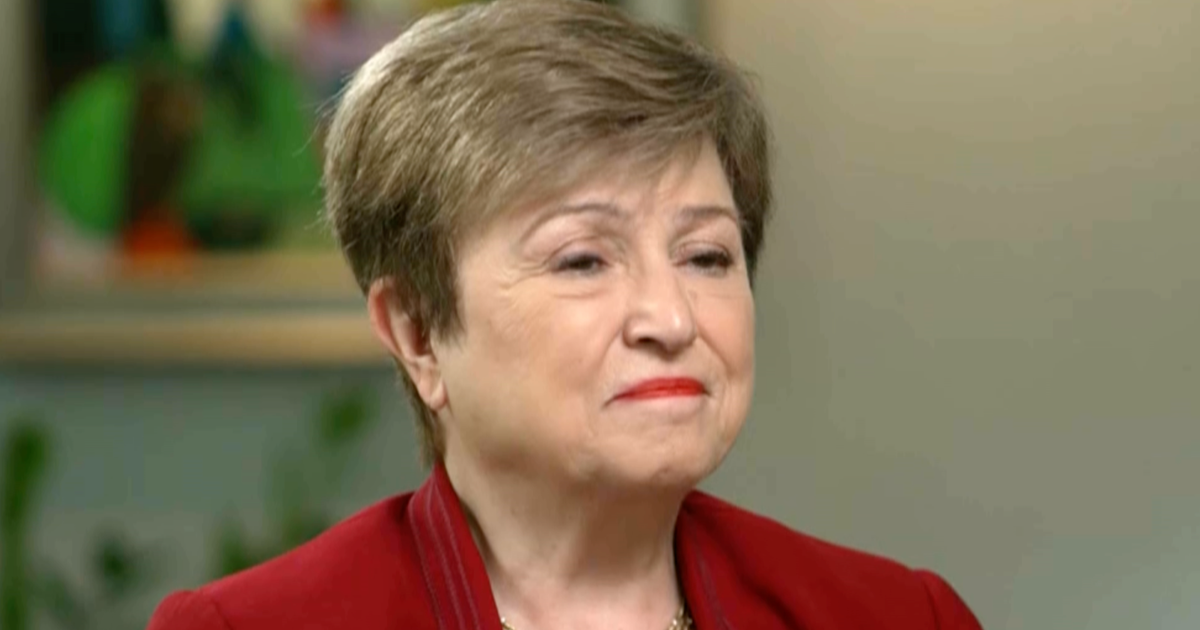
The following is the full transcript of an interview with Kristalina Georgieva, managing director of the International Monetary Fund, that aired on “Face the Nation with Margaret Brennan” on April 12, 2026.
MARGARET BRENNAN: Director, thank you so much for making time for us. We’re in an incredible moment right now. How do you calculate the economic shock from this Mideast war?
INTERNATIONAL MONETARY FUND MANAGING DIRECTOR GEORGIEVA: We look at the size of the impact and the duration of impact. And what I can tell you is that this shock is large. Thirteen percent of oil, 20% of gas that would have flown in the world is now stuck for five weeks and counting. It is global. Everybody uses energy. Everybody feels the pinch of prices going up. And it is asymmetric. It affects different countries differently. If you are in the vicinity of the conflict, it’s a big hit on you. If you are an oil importer, it is a big hit on you. If you have no reserves to protect yourself, you are in a very tough situation. We are running scenarios depending on the duration of the war. Now we have hopes for peace that would improve the conditions for everybody, but we are also looking at impact on infrastructure. A lot has been damaged, and it would take time to bring back to full operation.
MARGARET BRENNAN: So let’s pull that apart a little bit. It appears like Asia bore a lot of the economic impact here. South Korea, they’ve got a big computer chip industry. They have called on their citizens to conserve energy. India, they’re rationing energy. The Philippines had a national energy emergency. The Australian gas stations are running out of fuel. It seems like there’s a large part of the planet that’s really in pain.
MANAGING DIRECTOR GEORGIEVA: Oh yes, people are hurting. They’re hurting because of sheer lack of quantities. If you are in the Philippines, you’re queuing the same way people were queuing here in the ’70s to fill your tank. They are hurting because they may be in need of helium, for semiconductors or for MRIs. And now–
MARGARET BRENNAN: And that comes out of Qatar. Out of the Middle East.
MANAGING DIRECTOR GEORGIEVA: That comes out of Qatar, and now it is cut to size. They may be hurting because of fertilizers. Now is the planting season. If you are not getting fertilizers or not getting them at a reasonable price, we may see spike in food prices coming. They’re hurting because of remittances. Just think, how many people live in the Gulf, work in the Gulf, send money home to places like India and Bangladesh, and this money is not coming. They’re hurting because of transportation. I’ll tell you, my heart goes for Sri Lanka, a country that is coming out of a big shock, they were now affected because a third of flights to Sri Lanka go through the Gulf. Now, tourism is going to be- to be hammered. So for many, many reasons, countries are affected. And when you look at the size of the impact, it depends on how much your- your reliance on imports is, but it also depends on what is your fiscal position. Do you have capacity to absorb the shocks? Yes, who has this capacity? Poor, vulnerable countries, whether they’re in Asia or in Sub-Saharan Africa, they’re being hammered dramatically, and when we discuss our response, we will zero in on these highly vulnerable countries.
MARGARET BRENNAN: So the United States. Here Americans, they’re still spending, they’re still driving, but they have seen inflation go up, prices at the gas pump.
MANAGING DIRECTOR GEORGIEVA: Right, I mean, the U.S. is in the category of countries that are somewhat less impacted, because U.S. is energy exporter. But as I said, everybody feels the pinch of prices going up. Why? This is a negative supply shocks. You have less energy, but the demand is still the same. What happens? Prices go up, and here in the United States, people have not quite yet seen inflation going down to target. We were projecting this to happen by early ’27. Now that may be somewhat delayed. And what does it mean? It means that people experience a tax on their income. Who is most affected? Of course, low income, part of the population.
MARGARET BRENNAN: Right. Well, at- at one point, oil prices surged nearly 50% because of this war in Iran, and you called it the largest disruption to global energy markets in modern history, as increases, as you said, to fertilizer, to other prices that are going to push up food. Do you see this impact stretching through 2026 even if we get a cease fire that sticks?
MANAGING DIRECTOR GEORGIEVA: So the impact is baked in, because already the tankers that should have arrived in Asia have not arrived, right? So we already have that impact. But then on top of it, we have the infrastructure impact. Seventy-two energy facilities have been hit, one-third of them severe damage. You take the gas field in Qatar, it would take three to five years to reach its full capacity. That has significance. And then we have other infrastructure impacts, like refineries. If they don’t receive oil on a regular schedule, they have to shut down. When they shut down, to restart, that is with delay. So yes, we are going to see some drag of this crisis over the year. But if we have peace, of course, conditions are likely to improve faster. Above all, because confidence is going to benefit from the knowledge that there is a resolution of the fighting. Before- something that- that is very, very important to recognize. The world economy has been incredibly resilient. We have been hit by one shock and another and another. We were actually projecting a small upgrade for growth in 2026 had it not been for this war. Now we are going to have a downgrade, and the size of this downgrade will depend on these two things, duration and speed with which everything can come back to the same level of production that we had before.
MARGARET BRENNAN: Well, but just to put a fine point on it, when you’re- when people look at the effort to get even a ceasefire or some kind of peace deal, if they think, well, if this works, my prices are going to go back to where they were on February 27, the day before this war began. You’re saying no–
MANAGING DIRECTOR GEORGIEVA: Not right away. It will take time.
MARGARET BRENNAN: It’s going to take- it is going to take awhile in 2026.
MANAGING DIRECTOR GEORGIEVA: It will take- it will take some time, yes, and it will take more time for locations that are experiencing higher degree of disruption. And that’s why we need to remember the asymmetry of this shock. And spare a thought for these destinations where it would be still a matter of scarcity of supplies for some time.
MARGARET BRENNAN: And we’re hearing from European airlines issues with access to jet fuel. You’re talking about Asia there. People are going to see their airline ticket prices elevated. They’re going to experience this for some time.
KRISTALINA GEORGIEVA: Yes, the one good thing that we need to remember is that whenever we have an energy shock, we improve. Every energy shock in the past would lead to two things: more energy efficiency and more diversification of energy supplies.
MARGARET BRENNAN: More green energy.
MANAGING DIRECTOR GEORGIEVA: More green energy. We- we- we can show how that goes up. You get the shock, and then say, wait a minute, what can I do to reduce the impact? That would come. The problem is it would take a year and year and a half, two years. In meanwhile, people and businesses will be hurting.
MARGARET BRENNAN: So what is the IMF doing right now to soften the blow of this crisis for those who are hardest hit?
MANAGING DIRECTOR GEORGIEVA: Well, the first thing we do is to give good advice to countries. The- at a moment like this, everybody rushes to take action, and sometimes it’s good, and sometimes not so good. Don’t impose restrictions on your trade with petrol products. Why? Because if we make the situation worse, prices would go up even more. We are telling countries, if you are to be helping people and businesses, do it in a targeted manner, do it carefully, because the world has a problem with fiscal space. All these shocks have led us to borrow more, and it has increased the cost of this borrowing on budgets. So if you are to help, help the most vulnerable, target your support, and do it on a temporary basis.
MARGARET BRENNAN: So we have seen so many shocks, as you said, two major military actions in Iran. You’ve got the war in Ukraine still going on. You have the trade war, all of this still just coming out of COVID. Have you been surprised that we are not in a global recession, and the United States is not headed for recession?
MANAGING DIRECTOR GEORGIEVA: We were not so surprised for one reason. What we have seen over these last shocks is that the world is building resilience to it, and the resilience is a product of three things. Number one, across the world, governments have pulled out of managing the economy, managing companies, and let the private sector do the job. Private sector is more agile, more adaptable. So when we are hit, the response is faster and more efficient. Two, we have seen over the last decades many countries, emerging market economies, taking actions to strengthen their fundamentals. Independent central banks, fiscal councils, that leads to good policies that protect countries, especially at the time of a shock. And number three, innovation. Look at the technological transformation–
MARGARET BRENNAN: Yes.
MANAGING DIRECTOR GEORGIEVA: –that is taking place in the world. It’s incredible. So all these two things have buffered our world against recession. Now, we are not immune against recession, Margaret, so we still have to be careful, to follow good policies and to keep our institutions in good health, to protect us.
MARGARET BRENNAN: Well, the world’s two largest economies are set for a meeting next month, mid May, President Trump and President Xi. Do you think that that trade war is cooling off? How concerned are you?
MANAGING DIRECTOR GEORGIEVA: It is very good that the two largest economies found a way to reduce trade frictions. We see it in the performance of both and when they do well, there are positive spillovers for the rest of the world. So in this sense, we very much encourage discussions that lead to reducing the trade tensions between these two large economies, but also they set up a good example for the rest of the world, a trade war has no winners.
MARGARET BRENNAN: Did you- do you think that- that global economists really overestimated the negative impact of the Trump tariffs?
MANAGING DIRECTOR GEORGIEVA: Ah, very good question. So the Fund, when the tariffs came, was among the very few institutions that were not- not projecting recession. We did project some slow down in growth. We did see some slow down in growth–
MARGARET BRENNAN: So it’d be some- somewhat disruptive?
MANAGING DIRECTOR GEORGIEVA: We thought it would be somewhat disruptive. It was somewhat disruptive. But then what happened was an adjustment. Adjustment in the United States, with agreements that have reduced the pressure that tariffs would put here and on the rest of the world, and we saw the rest of the world saying, okay, let’s see how we can trade more with each other. Massive increase in trade agreements, more attention to regional trade, if you look at the place like–
MARGARET BRENNAN: You’re saying turning away from the U.S.?
MANAGING DIRECTOR GEORGIEVA: Well, the U.S. is saying we want to- to have an economy that is mostly based on investing at home, having manufacturing at home. That’s a choice that the country is making. Other countries are looking into their economic future. Small, open economies, they have no choice. They have to find ways to trade with each other, because otherwise it will be very costly for their people. So the developments are relatively calming in a sense that we see trade like water. You put an obstacle, it goes around it.
MARGARET BRENNAN: Well, it’s interesting, because when we were speaking recently to the head of the European Central Bank, Christine Lagarde, who used to run the IMF. She told us the attraction of the dollar has eroded. She said you need geopolitical credibility, rule of law, strong institutions and a strong military, and the volatility fueled by the Trump administration, she said it hasn’t been helpful. Would you agree with that? You see an erosion in the trust and confidence in the American dollar?
MANAGING DIRECTOR GEORGIEVA: What we see is that the huge amount of transactions are indoors. We see assets indoors. We actually see the rest of the world rushing to the United States to invest here. Why? Because of the high productivity growth and the strength of the U.S. economy. At the same time, the world is more multi-polar, there are more centers of economic significance. And as a result, naturally, we see some shift towards diversification of reserves that countries are holding. And I believe that given the depth of the U.S. capital markets, given the strength of the U.S. economy, the attractiveness of the U.S. economy, 75% of financial assets are here. That means that the role of the dollar is and remains quite significant.
MARGARET BRENNAN: Because we’ve seen like the Wall Street Journal, for example, talk about Iran charging tolls for, you know, boats that go through the Strait of Hormuz, they’re charging cryptocurrency, or the Chinese currency to avoid our sanctions.
MANAGING DIRECTOR GEORGIEVA: Of course. Of course, we are going to see, in a world that has multiple centers of gravity, we are going to see different choices. When we have the evolution, or actually the revolution of digital money, of course, there would be shift in that direction. The question is, how big is the size? And does it mean that somehow we would wake up tomorrow, you and I, and we say, oh, what happened? You know, our savings are in dollars. Should we worry about that? Don’t worry.
MARGARET BRENNAN: I want to come back to technology, because you raised it, and I want you to clear up that point. You’ve said, with the growth of AI, artificial intelligence, in advanced economies in particular, it looks like a tsunami about to hit the labor market. That’s a scary thing for a lot of people to digest. How disruptive is this going to be to our way of life?
MANAGING DIRECTOR GEORGIEVA: And digest we must because AI is happening. I’m telling my staff at the fund, AI or die. It is transforming the way we all work. It is very significant. And frankly, I don’t think that we are ready. When we look at the impact of AI on labor markets, what do we find? We find that already, one in 10 jobs here in the United States requires new skills, and it pays more. When it pays more, what do people do with the money? They go out and spend in restaurants, in gyms. That increases demand for low skilled labor. But the middle, the jobs that are routinely starter jobs for young people, this middle is shrinking fast.
MARGARET BRENNAN: The new college graduates. They’re having problems.
[CROSS TALK]
MANAGING DIRECTOR GEORGIEVA: The new college graduates. So when we crank the numbers, the total employment actually went slightly up, but because of low skilled jobs. So, are young people dreaming to be baristas? I don’t think so. How can we prepare young people to be entrepreneurs, to be agile to changes in the labor market? How can we change the mindset, including in our education system, for a world of constant learn- learning and permanent change? That requires attention. And here is my big worry, what I see in the world today is attention deficit disorder. We cannot halt on a topic long enough, and AI is this topic, unless we concentrate on understanding labor market impact, how we need to change education, how we need to change the business environment, I think we would find ourselves with winners, big time, and many, many losers. The ability of AI to increase inequality, to open up this accordion of opportunities widely is very significant, both within countries and across countries. So we better focus.
MARGARET BRENNAN: Get ready. Well, CBS has learned that there was an urgent meeting held by the Treasury Secretary and the Fed chair just a few days ago with Wall Street leaders to discuss specifically AI and this new model from Anthropic. There’s deep concern. Are you concerned? Why are they scared?
MANAGING DIRECTOR GEORGIEVA: Well, because we get into cybersecurity, and the risks have been growing exponentially. Yes, we are concerned. We are very keen to see more attention to the guardrails that are necessary to protect financial stability in a world of AI, and I am–
MARGARET BRENNAN: Those don’t really exist right now.
MANAGING DIRECTOR GEORGIEVA: I’m- I’m- we don’t have the ability to – us as a world – to protect the international monetary system against massive cyber risks. We have to work on that. We have a responsibility at the Fund. We are actually working with our members to bring that common understanding of what the risks are, how they can be managed, because time is not our friend on this one.
MARGARET BRENNAN: No, but you need institutions like the Fed and the central banks to figure out–
MANAGING DIRECTOR GEORGIEVA:Yes. Yes.
MARGARET BRENNAN: –How to manage the risk of cyber attacks – hacking, as people would know it?
MANAGING DIRECTOR GEORGIEVA: We do– we do need the key institutions for financial stability – and of course, major central banks are among those – we need them to be very attentive. And we also need them to work together. Because yes, this is an issue that has been addressed here in the United States, but it is an issue that easily can present itself in other parts of the world, and that is why we need people to cooperate.
MARGARET BRENNAN: To cooperate. Well, the president of this country continues to question the value of multilateral institutions. The IMF is one of those created out of the ashes of World War Two. Do you think that the global financial order does need to be rebooted a little bit? Because you’re talking about a small portion of it, but is there truth to that idea that we need to really reboot these systems, these international institutions, to meet the moment?
MANAGING DIRECTOR GEORGIEVA: The world is changing very rapidly, and change is unstoppable. Therefore, institutions like the IMF, we have to lean forward, and we need to take the responsibility to be at par with this change. What does it mean for us? It means to identify key risks and opportunities for the world economy and then bring our membership to work on those. Let me make a simple point. Yes, we need to upgrade the international monetary system. While we do that, we also have to protect the assets we have. So what is our asset proposition? We are the only institution that takes the pulse of each and every economy on this planet – big, small, rich, poor – and then presents a picture of what is happening in the world for everybody to see. And we are the only institution that can rescue countries in trouble. We can come up with large financial support on a dime. And we have done it. We will continue to do it. In a world of more frequent shocks, we need an anchor of stability, and this is what the fund is. When it was created, the world was a calmer place. Now it is not–
MARGARET BRENNAN: You think the world was a calmer place back when this was created?
MANAGING DIRECTOR GEORGIEVA: Well, when it was created, remember, people traveled on ships to come to the annual meeting–
MARGARET BRENNAN: The speed of change, okay.
MANAGING DIRECTOR GEORGIEVA: Now we are in a much, much more rapidly changing world, and in this world, you need even more to have an anchor, an institution that protects you, and, of course, an institution that works with others, not on its own, to deliver that stability in a sea of constant change. I very often, Margaret, I very often feel like a captain on a ship in rough waters. And rough waters we will have.
MARGARET BRENNAN: Quickly on that – the war in Europe and Ukraine. The IMF has helped Ukraine quite a lot. You’re the second largest foreign donor behind the United States. Kyiv is having some problems, though, getting their own domestic political order under control. What can you do to help them? Because they are about to run out of money.
MANAGING DIRECTOR GEORGIEVA: Let me start recognizing that they have done a lot. This is a country, fifth year in a war, that collects in tax revenues, 34 percent to GDP. Just imagine how very few countries collect even half of this–
MARGARET BRENNAN: In the middle of a war.
MANAGING DIRECTOR GEORGIEVA: –and they are not in a war. So we- we are standing with Ukraine because they have proven to be a responsible partner. So they earn the financial support they get. When I look into this year, it is a very critical year. Hopefully peace negotiations would bring a positive outcome. With or without that outcome, the country- the country would continue to need international support. And for this reason, we have a new program for Ukraine. We are working with Ukraine so they can continue on this path of reforms that gives them the credibility to earn massive financial support from the rest of the world, especially from Europe. I can tell you that I was there in the midst of very cold winter, minus zero degree Fahrenheit, and the country is functional. People get up, they go to work in a freezing weather. They show determination to keep their society strong. They deserve to be- to be supported by the rest of us.
MARGARET BRENNAN: Director, there’s so many more hot spots to talk to you about, but I have to leave it there for today. Thank you.
MANAGING DIRECTOR GEORGIEVA: Thank you.

