


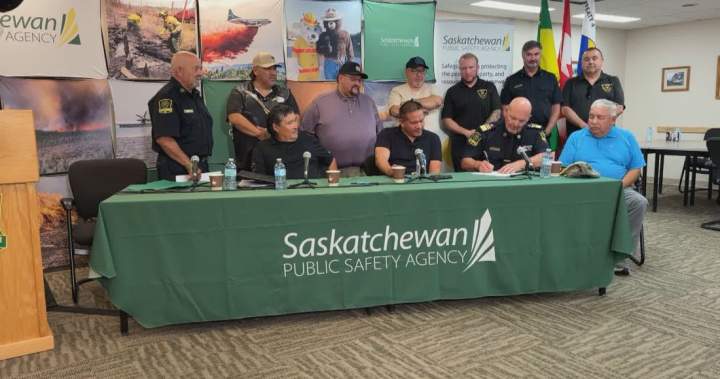
Wildfire management in Saskatchewan will be informed by First Nations perspectives, as outlined in a memorandum of understanding (MOU) a provincial agency entered into Tuesday with northern Indigenous governments.


The Saskatchewan Public Safety Agency (SPSA) signed an agreement with the Prince Albert Grand Council (PAGC) and Meadow Lake Tribal Council (MLTC) at the Provincial Response Centre near Prince Albert.
The province said discussions on wildfire responses, as well as prevention, mitigation and recovery, will now include leadership and knowledge from both First Nations councils.
“First Nations are an integral partner in effectively responding to the challenging threat of wildfires in our province,” Michael Weger, the minister responsible for the SPSA, said in a news release.
The agreement will see regular engagement among the stakeholders before, during and after wildfire season, the province said.
PAGC Grand Chief Brian Hardlotte said the councils have “generations of knowledge about the forests, the water, and the weather, and the fire,” speaking with reporters at Tuesday’s signing ceremony.
“That knowledge is to be at the table before an emergency, not when the smoke is already in the air, and that’s why this agreement matters,” he added.
“For Prince Albert Grand Council, being at the table is important, [because] what happens at the table is what really counts. We want the knowledge coming from our communities to help shape wildfire planning and that’s why it’s very important to work with our elders.”
MLTC Chief Jeremy Norman said the document will allow First Nations to use their personal experiences of being impacted by fires to inform and strengthen the SPSA’s wildfire preparedness, communications and resilience.


Get breaking National news
Get breaking Canada news delivered to your inbox as it happens so you won’t miss a trending story.
Last summer, Canoe Lake Cree Nation, a MLTC member, was among the communities forced to evacuate as wildfires raged.
“We had a rough one last year. Many of our communities were out for a long period of time. It was probably one of the worst fire seasons that we’ve had in a long time. And it’s costly, it’s very costly, not only financially but for our communities to be out for over a month,” Norman said.
The chief said he is glad the province is looking at how it can respond better, and earlier, to wildfires with the use of Indigenous knowledge.
Marlo Pritchard, the president and fire commissioner of the SPSA, said First Nations leadership must be included in wildfire-related decision making.
“Effective wildfire management depends on strong relationships, open communication and shared responsibility,” he said. “Communities across northern Saskatchewan have lived with the realities of wildfire for generations, and bring invaluable knowledge about the land, the forest and the measures needed to keep the people safe.”
Knowledge shared by the First Nations councils will inform the SPSA’s wildfire response provincewide, Pritchard continued.
The Saskatchewan government news release said this agreement “represents an important step toward a more coordinated approach to wildfire management and stronger relationships among First Nations, provincial and federal partners.”
Federal departments, including Indigenous Services Canada and the Canadian Forest Service, will also be included in relevant conversations.
The various bodies will hold regular conversations regarding priorities and recommendations in strengthening wildfire management in Saskatchewan, its release added.
Hardlotte said Ottawa’s inclusion will strengthen wildfire responses.
“At the end of the day, wildfire doesn’t care whose jurisdiction it’s in. When a fire threatens a First Nation, our people want to know there’s a plan,” the grand chief of the PAGC said, adding that establishing relationships with the province and Ottawa ahead of the next fire season is essential.
© 2026 Global News, a division of Corus Entertainment Inc.