


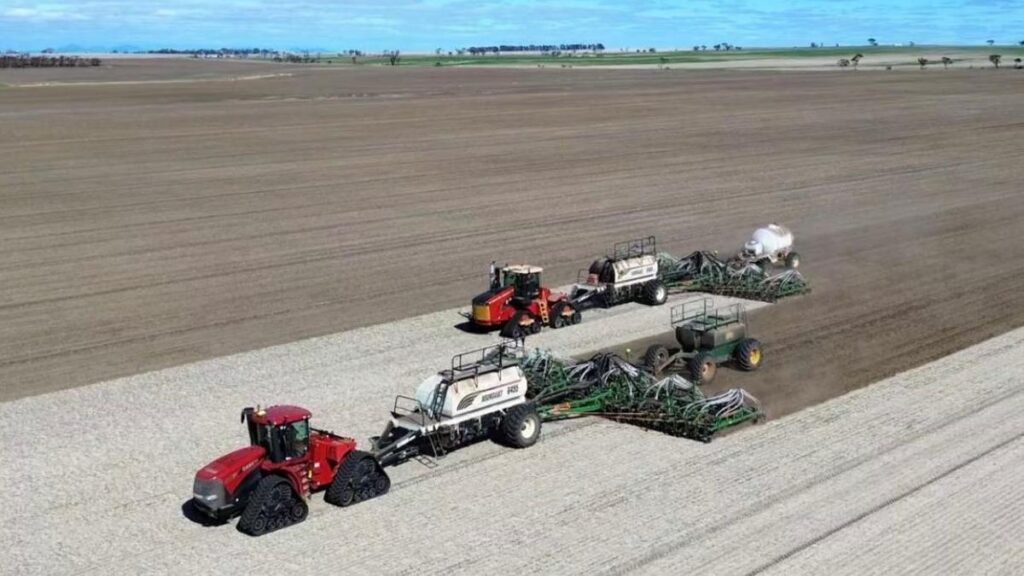
More than 50 per cent of WA’s canola has been sown, with sentiment rising among grain growers thanks to the season’s early start.
The Grain Industry of WA’s latest crop report, released on Friday, says the State’s growing area of cropped land currently sits at about 9.38 million hectares.
Crop report author Michael Lamond said the decrease in wheat planting in the past decade had been replaced by an uptake in barley and canola — a trend continuing this year as barley becames more profitable for its yield benefit.
The total area planted for wheat sits around 3.73 million hectares, with the highest amount planted in the Kwinana Port Zone at 2 million hectares.
“All cropping zones in WA will have a reduction in wheat planted relative to the 2025 cropping season, which is likely to end up being about a 14 per cent reduction in total wheat area,” Mr Lamond said.


Mindarabin grower Kelvin Hams is hopeful of a decent season after an encouraging start, but is holding out for more rain after receiving 30mm after ex-tropical cyclone Narelle and a further 11mm in the last two weeks.
Not deviating from last year’s program by much, Mr Hams started putting down wheat, barley, lupins, oats, and beans across 9700ha around April 9.
“We’re still seeding into moisture but are looking for more for things to keep going good,” he said.
“We’re probably about 50 per cent of the way through our program at the moment — we’re just chipping away at it.”
Crops sown in the earliest part of Mr Hams’ program — beans, lupins, and canola — have already begun to germinate.
“We’re actually probably seeding into better conditions than what we have for the last two years here,” he said. “It’s great news but we definitely need more rain.”
Mr Lamond said the emergence of canola depended on which side of rain growers were at the time of sowing.
The Kwinana Port Zone has the largest amount of land planted for canola so far at one million hectares, with the overall total for WA sitting at 2.28 million hectares so far.
“Canola sown prior to rainfall events is very good, and canola sown after rainfall events in late March and early April, which suffered patchy emergence, has now evened up,” Mr Lamond said.


“Cereal emergence is mostly very good across the State.”
He said the current winter crop would mark the earliest start and finish since 2022’s “very high-yielding year”, and provided a welcome boost to confidence across the grain industry since the start of conflict in the Middle East.
“Even though input costs are high, they have not blown out as much as was initially predicted prior to the start of seeding,” Mr Lamond said.
“The early sowing opportunity for canola has driven renewed confidence as it is the most profitable crop grown in WA, particularly when it emerges before mid-May, which will the case for most crops this year.”
However, crops sown early were at risk at the end of the season as they were more prone to frost, he said.
“Most growers are continuing to capitalise on existing moisture knowing that if they dodge frost events, a longer growing season will likely lead to higher yields which are needed to turn a profit,” Mr Lamond said.
“The risk is worth it.”