


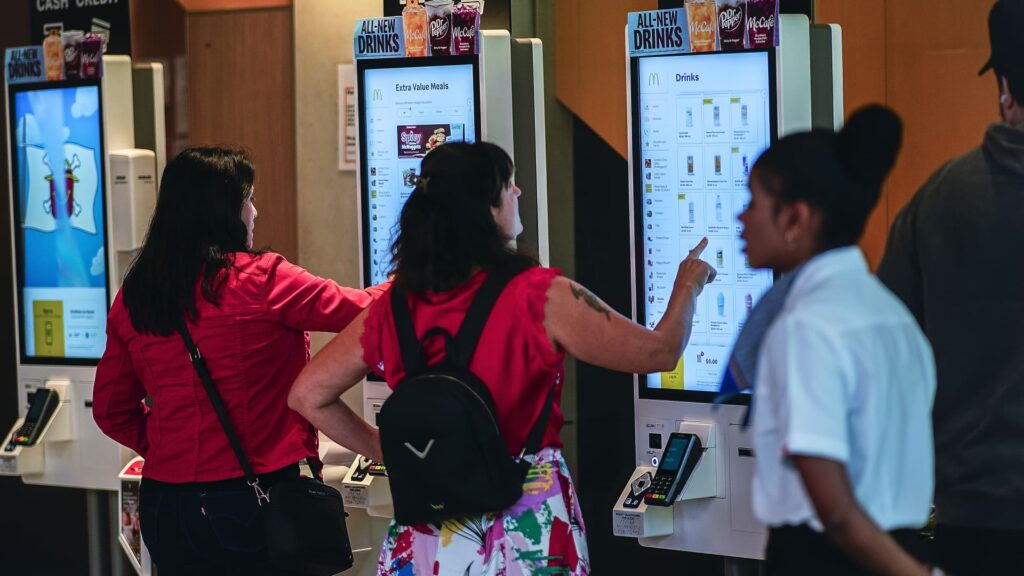
People pick up their menu inside the McDonald’s restaurant in Times Square, Manhattan, on Sept. 29, 2026, in New York City.
KHemaz | GVN | Getty Images
Fast-food giants and supermarkets are rolling out a range of AI tools that could affect the prices shoppers pay, but experts warn the spread of data-driven tools could make personalized pricing easier to deploy.
Just this week, a federal antitrust lawsuit filed against McDonald’s alleged the fast food giant uses an AI-powered “pricing engine” to set menu prices across U.S. locations and overcharge customers for Big Macs and fries.
McDonald’s has denied that it’s using AI to determine what individual customers are willing to pay and said it provides its franchisees with “tools, resources, research and recommendations to help them make informed decisions.”
Even so, food businesses globally are increasingly digitizing operations with AI. Earlier this year, American grocery chain Kroger said it’s using an AI platform called FlashFood to mark down perishables nearing the end of their shelf life and marketing them to shoppers via an app.
Meanwhile, electronic shelf labels (ESLs), which display the price of items in store on digital screens, are becoming increasingly popular at supermarkets like Kroger, Amazon Fresh, Walmart, and Whole Foods.


The technology is also gaining traction among U.K. supermarkets such as Tesco, Morrisons, and Asda. More recently, global financial platform Revolut trialed facial recognition checkout in select coffee shops, allowing customers to pay with just a glance.
CNBC reached out to Amazon Fresh, Whole Foods, Tesco, Morrisons, Asda and Revolut for comment on the use of AI but didn’t immediately hear back.
As AI use becomes normalized among retailers, experts warn that this could lead to more dynamic pricing, which refers to frequent, rapid real-time changes in prices that could dramatically affect shoppers’ experiences.
“Dynamic pricing means changing prices in response to changing market conditions, such as demand, timing, capacity or competitors’ prices,” Miroslava Marinova, a senior lecturer of commercial law at the University of East London, told CNBC. “It is not new. Airlines, hotels, and ride-hailing services have used it for years.”
Bank of England economists Clare Lombardelli and Rupal Patel said in April that more sophisticated technology is leading to prices changing more frequently and also becoming more individualized, which could see more firms charging “as close to the maximum price a consumer is willing to pay for a good or service,” which they defined as “perfect price discrimination.”
These conditions could make it harder for statisticians to “measure and interpret” month-to-month inflation data, as the consumer price index is based on a representative sample of prices for shoppers.
“That works well when prices mostly move slowly and uniformly. But when prices shift continually – and differently for each shopper – the idea of a ‘representative’ price becomes strained,” the BOE economists added.
AI collects more consumer data
While dynamic pricing has been in play for a long time, the BOE economists and Marinova noted that AI tools such as ESLs and facial recognition checkout are changing the amount of information that companies can collect on consumers, from transaction histories to browsing behavior, location, and purchasing patterns.
On Wednesday, U.K. supermarket chain Sainsbury’s released “SmartLists,” an AI feature that helps customers create shopping lists and find products just by uploading pictures of what they need or by typing out meal ideas.
“This is also why the traditional distinction between dynamic and personalised pricing is becoming less clear in practice,” Marinova explained. “Dynamic pricing responds primarily to market conditions, whereas personalised pricing uses information about the consumer to estimate willingness to pay.”
As companies use both pricing systems, it raises questions around whether customer information is being used to determine the prices consumers see.
“As retailers combine market-level information with increasingly detailed consumer data, the boundary between dynamic and personalised pricing becomes thinner,” Marinova added.
Walmart and Kroger have publicly insisted in recent years that they do not use dynamic or surge pricing to set individualized prices for customers, but have instead used tools to streamline operations.
Several U.S. states are moving to curb data-driven pricing. New York requires most businesses using customers’ personal data to set prices to disclose it clearly. Maryland has restricted food retailers and delivery services from using personalised, data-driven pricing to charge higher prices for certain food, while New Jersey and Connecticut have enacted measures targeting “surveillance pricing.”
Consumer choice compromised
Dynamic and personalized pricing are not automatically bad for shoppers, Marinova said, explaining that it can discount items for some consumers, making some products and services more accessible.
However, the risk of individualized pricing is that consumers are no longer aware of whether the price they’re getting reflects general market conditions or if it’s been influenced by information about their own behavior.
“That makes it much harder to compare prices and to know whether another consumer is being offered a different price for the same product,” she said. “If consumers cannot understand why they received a particular price, cannot compare it with prices offered to others, and cannot effectively switch to another supplier, the normal disciplining effect of consumer choice becomes weaker.”
The BOE economists added that an additional challenge is that personalized pricing “splinters the consumer experience,” which means households will face increasingly different inflation rates.
“And when prices differ for the same thing, inflation becomes even more personalised – and aggregate measures may no longer reflect households’ experience,” they said.