


Jose Flores was driving with his family to see “Toy Story 5” on Wednesday in Caracas, Venezuela, when a loud earthquake alert went off on his wife’s Google Android phone. Six seconds later, he felt the earth starting to shake.
Venezuela does not have a national early warning system of its own, but people with Android phones received alerts from Google’s Earthquake Alerts system, which can pull data from more than two billion phones equipped with built-in accelerometers. The same sensor that detects rotation on the screen can also sense vibrations from seismic waves.
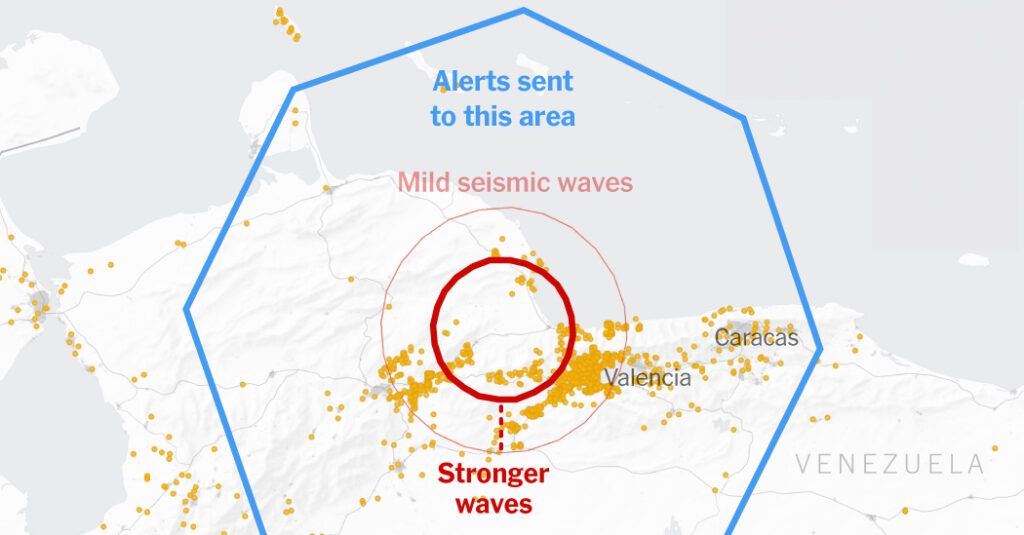
Three seconds after the quake started underground
Seismic waves reached the surface and were picked up by phones.
Google said the system, which is available in nearly 100 countries, sent warnings that reached 11.4 million people on Wednesday, giving users seconds or up to two minutes notice before back-to-back powerful earthquakes struck.
Several countries, including Japan, Mexico, Canada and the United States, have government-operated early warning systems. These largely rely on widespread regional networks of underground sensors that detect earthquakes and can send alerts to most phones — iPhone or Android — via government alert settings that are often enabled by default.
When earthquakes hit, they send out two types of waves that travel at different speeds. The fast-moving and milder primary waves, or P-waves, travel at four miles per second and are less likely to cause destruction. The slower and stronger secondary waves, or S-waves, travel at about half that speed and produce shaking.
When P-waves start radiating from the epicenter, Android phones sense the vibrations, start collecting data and send it back to Google servers for processing. The servers use information from many phones to figure out if an earthquake is happening. The phones have to be stationary — on a tabletop or in a bag on the floor, for example, and not in the pocket of someone walking around — in order to sense an earthquake.
The system quickly estimates the earthquake’s location and magnitude and then pushes alerts to phones. All Android phones in the affected region receive the alerts.
Nine seconds after the quake started underground
The system had crunched enough data from phones to identify an earthquake and send out the first alerts.
The epicenters of the quakes in Venezuela were beneath highly populated areas. Within three seconds, phones sensed the P-waves of the first quake, said Marc Stogaitis, a principal engineer at Google who works on the early warning system. Six seconds later, the system identified an earthquake and sent out the first alerts.
The system is continuously receiving and processing data, Mr. Stogaitis said. As an earthquake develops, the system often tweaks the magnitude, time, location and alert area. Google’s system sensed the increasing magnitude of the Venezuela earthquakes, and “the alert region grew as the earthquake grew,” Mr. Stogaitis said. Several seconds after the first quake, a second, stronger earthquake hit, and more alerts were sent.
“As the seismic waves from both events overlapped with each other, the system treated it as a single large event alerting those experiencing shaking from both events,” he said.
Distance matters. The farther people are from the epicenter, the more likely they are to get an early warning alert, giving them more time to act before the shaking starts. It’s more challenging to get timely warnings to people near the epicenter; those alerts usually arrive when the shaking has already started.
15 seconds after the quake started underground
The system continued to collect data from phones and sent alerts to a broader area that included Caracas.
Google sends out alerts for earthquakes of magnitude 4.5 and above, which are considered powerful enough to cause some damage. People receive different types of alerts depending on the estimated magnitude where they are. One blares a loud sound and uses urgent messaging to tell people to take immediate action in areas with potentially extreme shaking, another beeps to tell people to be ready, and a third cautions people to be aware in areas where lighter shaking could occur.
21 seconds after the quake started underground
Alerts eventually reached millions of phones across a large area.
The two quakes in Venezuela were powerful — the first had a magnitude of 7.2 and the second had a magnitude of 7.5. The second earthquake was the most powerful to strike the country since 1900. Google said its full spectrum of alerts was sent out. Almost 1.4 million of its most severe warnings, which the company calls “Take Action” alerts, went to people in areas where the intensity of the shaking was strongest.
An estimated 70 percent of all smartphones globally run on Google’s operating system, Android. The earthquake detection system works wherever people are using the phones, even in countries without other alert systems, according to a paper published in 2025. Google started sending out alerts for earthquakes detected by Android phones in 2021, initially in New Zealand, Greece, Turkey, the Philippines and central Asia. It had expanded to 98 countries by 2023.
It’s too early to tell if these early warnings saved lives on Wednesday. But several seconds can provide enough time for people to take action to protect themselves. Most countries recommend that people “drop, cover and hold on” before the shaking starts.
Mr. Flores and his family, who got the alert while driving in Caracas, were initially confused, even after the shaking started. It was the first time they had received such an alert.
“We thought the road was really bumpy, which is normal in Venezuela,” he said. “Then we saw the streetlights dancing, and we realized this was really serious.”
Now that he knows about the alerts, Mr. Flores said, he feels he will be better prepared to act if he receives one in the future. “It’s very helpful to get the alert, as it seems like it almost predicted the earthquake,” he said.