


Zcash’s Orchard implementation has increased interest in how users move between different privacy-focused assets, including swaps between Zcash and Monero. For those not familiar with Orchard, this is Zcash’s third-generation shielded pool, which is built to replace older privacy systems with stronger efficiency and more modern cryptography.
It uses the Halo 2 proving system, Pallas-based keys, and unified addresses. All of these make private transactions and address handling simpler and more flexible than Sapling.
Orchard is created to hide sender, recipient, and amount for shielded ZEC transfers while keeping the protocol auditable at the network level.
Privacy coins are facing increased regulatory scrutiny and exchange delistings, so many crypto traders are rotating between assets like BTC to XMR, ETH to XMR, ZEC to XMR, or XMR to ZEC depending on exchange listings, wallet support, regulatory developments, privacy preferences, and ecosystem changes.
The ZEC to XMR pair is at the intersection of two very different privacy philosophies. And it can be done in just one step using GhostSwap.
Zcash vs. Monero: What’s the Difference?
Both Zcash and Monero are privacy-focused cryptos, yet they use fundamentally different approaches to protecting user privacy.
Zcash: Optional Privacy
Zcash offers privacy through zk-SNARKs, shielded addresses, and zero-knowledge proofs. The key characteristic is that privacy is optional; Zcash supports both transparent transactions and shielded transactions, and users choose which they use.
This flexibility has trade-offs. Researchers have repeatedly noted that anonymity depends partly on adoption of shielded transactions. Users can accidentally transact transparently, and privacy depends on usage patterns. Historical research has found shielded adoption lower than ideal for maximum anonymity.
However, Zcash also offers advantages: very advanced cryptography, relatively small transaction sizes, selective disclosure capabilities, and regulatory flexibility due to the transparent option.
Monero: Privacy by Default
Monero takes the opposite strategy. Privacy is not optional. Every transaction uses ring signatures, stealth addresses, and RingCT by default. There’s no “transparent mode”; every transaction is private automatically.
This mandatory privacy provides benefits: strong fungibility, no need to think about address types, shielding funds, or privacy settings. Monero supporters often argue that every XMR is effectively identical, whereas coins on transparent chains may carry transaction history.
However, Monero’s mandatory privacy comes with trade-offs: larger transaction sizes, more limited exchange support, and more regulatory scrutiny globally.
How to Swap ZEC to XMR Using GhostSwap
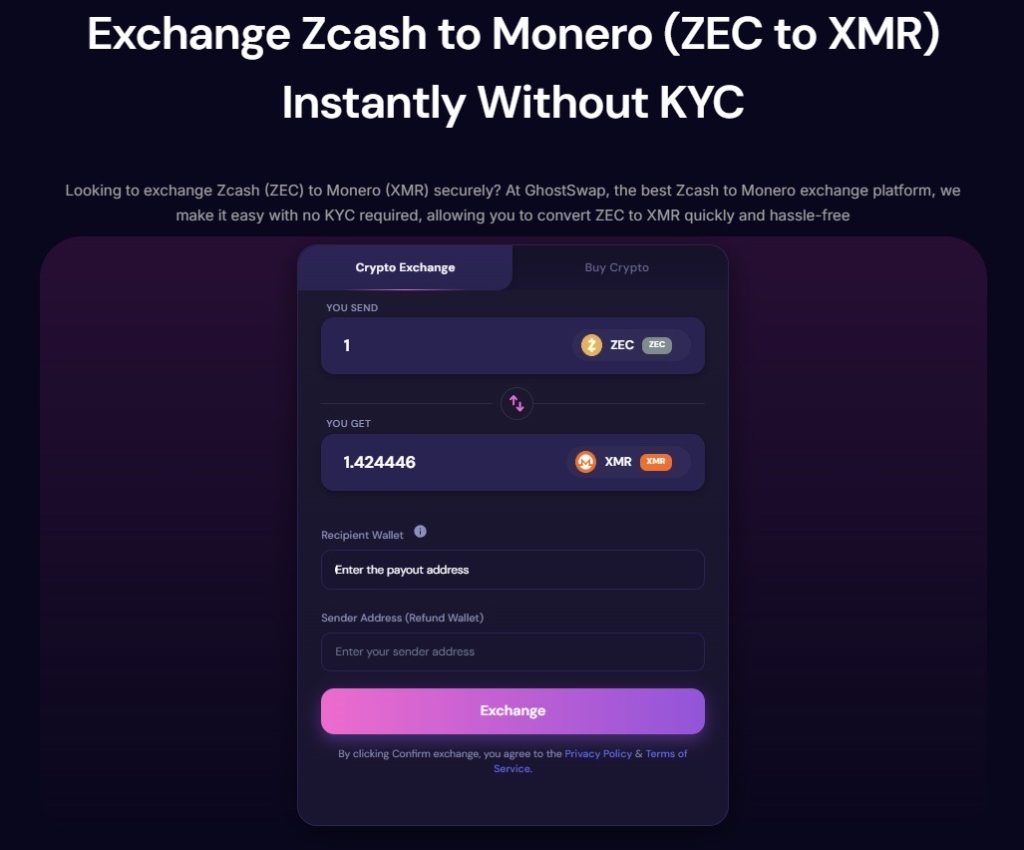
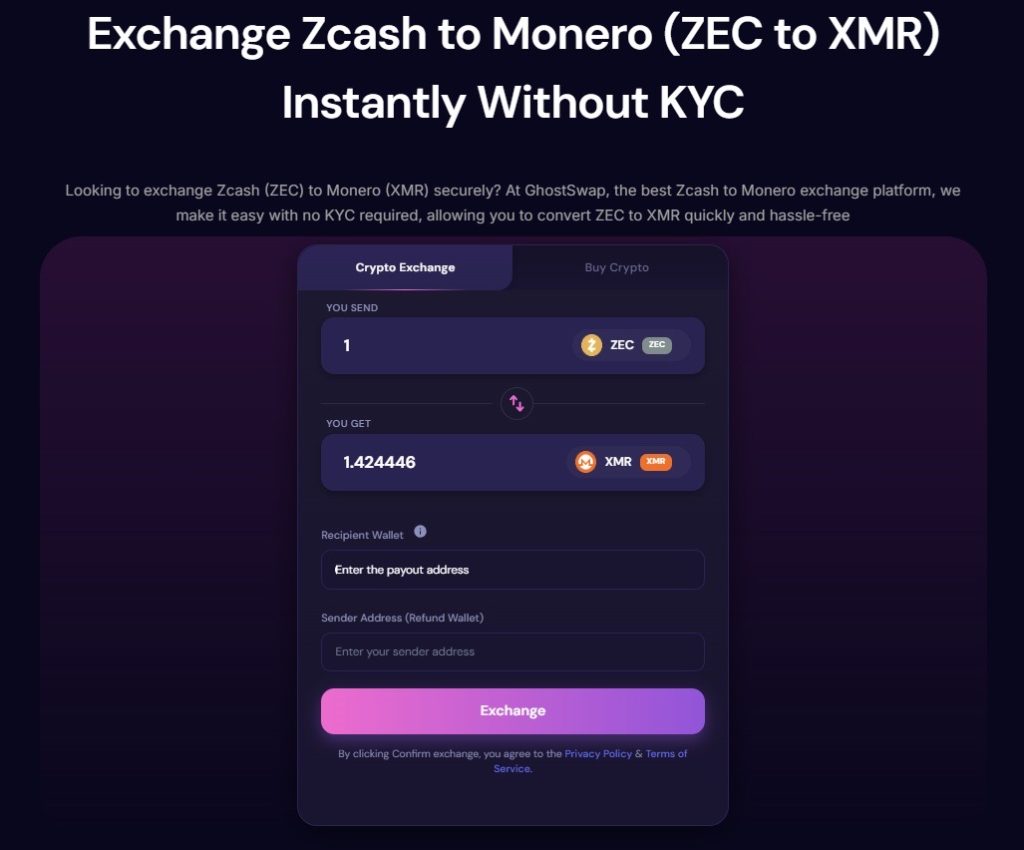
GhostSwap makes sure you can swap Zcash to Monero extremely easily. The platform supports both Zcash (ZEC) and Monero (XMR) as primary assets, and the ZEC to XMR page follows the same workflow as GhostSwap’s other pair pages.
Core user flow:
- Select ZEC as the asset being sent
- Select XMR as the asset being received
- Enter a Monero wallet address (the destination for your XMR)
- Optionally enter a refund address (recommended)
- Send ZEC to a temporary deposit address
- Receive XMR after confirmations

The platform markets this as:
- No account creation
- No email
- No KYC for standard swaps
- Non-custodial swap process
- Cross-chain conversion
- Typically completed in minutes depending on network conditions
The swap requires only an XMR destination address and a recommended refund address. No name, email, phone number, or identity documents are requested during the normal flow.
GhostSwap states most privacy-coin swaps finish within roughly 5–30 minutes overall as this depends on source-chain confirmations and congestion.
The user sends funds from their wallet, funds go to a temporary swap address, conversion occurs, and the output asset is sent to the user’s destination wallet.
GhostSwap’s Fees, Timing, and What to Expect
GhostSwap charges a flat 2% fee built into the quoted exchange rate. Users see this fee upfront as part of the exchange rate and the final receive amount. Standard blockchain network fees (Zcash and Monero transaction fees) are extra and come from the user’s wallet.
It’s important to understand that a ZEC to XMR swap is not instant. Completion depends on:
- Zcash confirmations (network conditions)
- Swap processing by GhostSwap’s engine
- Monero confirmations (the XMR network)
Once the Zcash network confirms the deposit, GhostSwap’s backend automatically executes the swap across its liquidity sources and sends the Monero directly to the provided destination address.
Is GhostSwap Legit
GhostSwap is a non-custodial swap platform that has processed over $750 million in swaps for approximately 1.5 million users. The company is registered as a Delaware LLC and operates as an anonymous crypto exchange prioritizing user privacy and simplicity.
Signs of legitimacy:
- Public website and extensive documentation
- Transparent swap process with upfront fees
- Published API with clear documentation
- Functional Telegram bot
- Operational history spanning years
- User-facing support channels
GhostSwap never takes long-term custody of user funds. Each swap uses a temporary deposit address, and funds are routed directly to the user’s destination wallet. No pooled account is ever held on GhostSwap, avoiding many hacking risks associated with centralized exchanges.
Even though GhostSwap advertises no account and no KYC for standard swaps, users should still read the terms because compliance screening may occur through underlying partners. The platform explicitly works with licensed crypto processing partners to handle AML/sanctions screening. If a swap is flagged (e.g., for high value or hitting a blacklist), GhostSwap reserves the right to block, reject, or refund it.
Important points:
- No-KYC ≠ No Compliance: GhostSwap advertises no account and no KYC for standard swaps. However, users should still read the terms because compliance screening may occur through underlying partners.
- Monero Doesn’t Erase History: A common misconception: swapping ZEC into XMR does not magically erase the history of the ZEC transaction. The ZEC side still exists on the Zcash blockchain. The Monero side simply enters a different privacy model after conversion.
- Network Confirmation Times Matter: A ZEC to XMR swap is not instant. Completion depends on Zcash confirmations, swap processing, and Monero confirmations.
The final conclusion
Swapping Zcash to Monero has become pretty relevant as the privacy-coin landscape evolves. Whether you prefer Zcash’s optional privacy model with its advanced cryptography and regulatory flexibility, or Monero’s mandatory privacy with strong fungibility and simplicity, GhostSwap provides a non-custodial, no-KYC bridge between the two ecosystems.
The platform’s support for both ZEC and XMR, combined with its public API, Telegram bot, and transparent 2% fee structure, makes it a practical option for users looking to rotate between privacy assets without creating exchange accounts or submitting to KYC processes.
Frequently Asked Question
Does GhostSwap require KYC to swap ZEC to XMR?
No. GhostSwap does not require identity documents, name, address, or phone number for standard swaps. Compliance checks are handled behind the scenes by partners and may occasionally flag transactions.
How long does a ZEC to XMR swap take on GhostSwap?
Most privacy-coin swaps complete within 5–30 minutes, depending on Zcash confirmation times, network congestion, and Monero confirmations.
What is the fee for swapping ZEC to XMR?
GhostSwap charges a flat 2% fee built into the quoted exchange rate. Users also pay standard blockchain network fees (Zcash and Monero transaction fees).
Is GhostSwap custodial or non-custodial?
Non-custodial. GhostSwap never takes long-term custody of user funds. Each swap uses a temporary deposit address, and funds are routed directly to the user’s destination wallet.
Does GhostSwap support Zcash and Monero?
Yes. GhostSwap supports both Zcash (ZEC) and Monero (XMR) as primary assets, with pairs like ZEC to XMR and XMR to ZEC available.
The post How to Swap Zcash to Monero With No KYC, in One Step appeared first on Cryptonews.