


At 9.15am — two minutes after Maharjan’s wife, Hira Shova Maharjan, had tried and failed to reach him — officials gave the final order to 3A: “Evacuate!”
Sah, who worked in the power house’s control room, sped from floor to floor, warning colleagues individually, he later told rescuers.
Outside the tunnels, evacuating workers tried to run away from the flood, but were not fast enough. Officials pointed to footage showing a group of roughly 30 workers swept away by a wave many times their height.
Rescuers later identified an escape ladder which, had workers known of it, could have saved as many as two-thirds of those inside, said Dahal.
But they “didn’t know where to go”, he said.
Of the tunnel’s four access routes, engineering drawings seen by Reuters showed one ran more than 180m to the underground powerhouse — but rescuers believed it was fully flooded, offering no hope of survivors.
Neupane instead turned his attention to a shorter cable-duct tunnel that sloped upward and was less exposed to the floodwaters. It was there that Maharjan and Sah had taken shelter, just 160m from the exit — “at the corner, at the edge of the tunnel,” as Maharjan would later describe it to his wife.
FEAR OF THE WORST
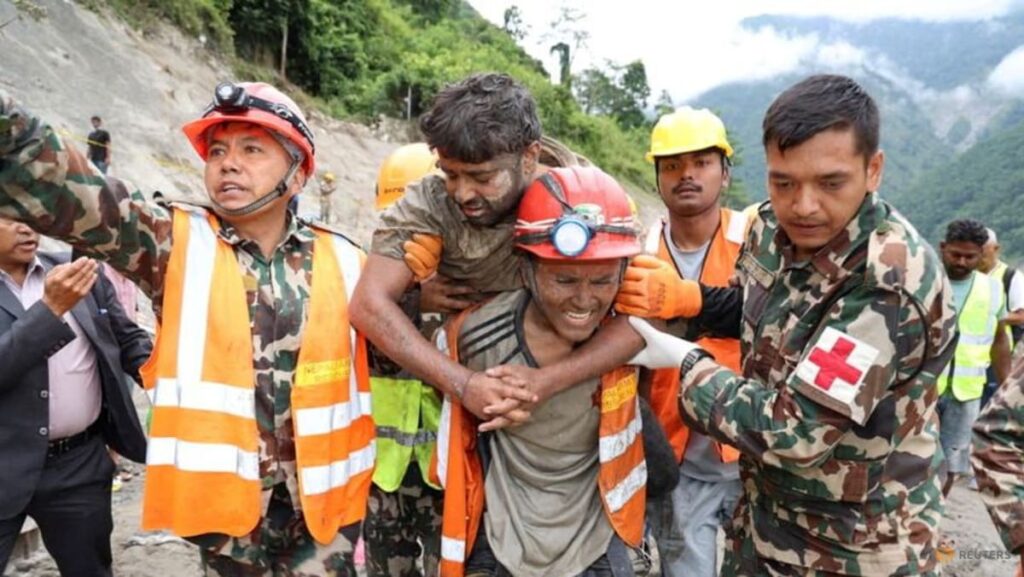
For the next nine days, the air pocket that had saved their lives became their prison. Sah said he recited Hindu prayers to keep his courage. Maharjan sipped the same muddy water he slept in to stay alive, his wife said.
When Hira Shova first heard about the flood, she assumed the powerhouse would be safe.
She tried calling her husband, colleagues, anyone who might know something. No one answered.
When officials later showed her photographs of where the site entrance once stood — now a bare riverbank — she told herself, “he couldn’t possibly be alive”.
“Deep down in my heart, a terrible hopelessness was setting in,” she recalled, but to her sons, 15 and 10, she kept up a brave front.