


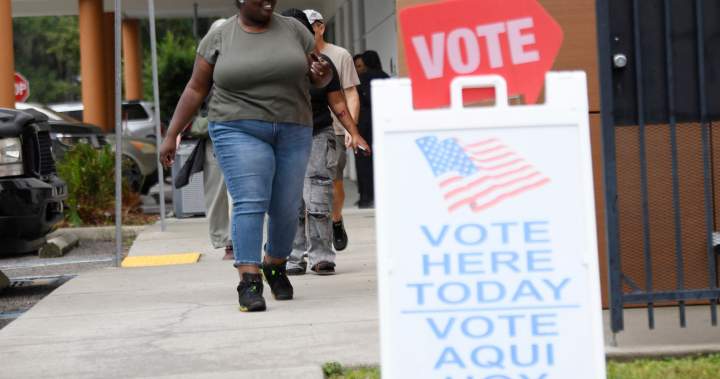
Americans will head to the polls on Tuesday for the midterms, with U.S. President Donald Trump’s war in Iran and trade war with Canada looming large in the election cycle.


Many of the 33 out of 100 U.S. Senate seats are being fiercely contested between Democrats and Trump’s Republican Party.
The trade war with Canada has occupied a large part of the narrative this election cycle in the seven border states electing senators on Tuesday.
The Wolverine State is seeing a heated election campaign between Democratic nominee Abdul El-Sayed and Republican Mike Rogers.
El-Sayed, a Muslim, has been the subject of several Islamophobic and racists attacks, including from Trump who called the Democrat a “jihadist” and said he should have to use a metal detector to enter the U.S. Senate.
On his part, El-Sayed has kept a focus on affordability and the high price of gas from the Iran war. When asked about the attacks against his name and faith, El-Sayed turned the conversation towards the high cost of the trade war with Canada.
“My name is not the reason you can’t afford your gas or groceries or to go see a doctor. Their war in Iran is the reason why. Their insane tariffs on Canada is the reason why,” he told reporters last month.
“If you’re picking a fight with Canada, you’re the asshole,” he said.
Michigan and Ontario have deeply integrated auto and steel manufacturing supply chains, with Trump’s trade war causing economic pain on both sides of the border. Canada has become a sticking point in the Michigan Senate election, with even Rogers distancing himself from Trump’s trade policy.
“Canada is not our enemy,” Rogers said in a campaign ad, in which he called for an end to the trade war despite supporting it months earlier.
El-Sayed appears to have the lead, although polls diverge on how sizeable his lead is.
A Beacon Research and Shaw & Company poll conducted for Fox News in September found he had a slight one-point lead, and a Marist University poll found him ahead by a thin two-point margin.
However, more recent polls suggest he may have surged. A CNN/SSRS poll conducted between Oct. 20 and 27 giving him a seven-point lead, while the latest New York Times/Siena Poll released on Sunday put him ahead by 11 points.
The Democratic campaign in Michigan, though, has had its share of hiccups with Congresswoman Haley Stevens’s shock decision to endorse Rogers, who she once said was a “fraud” and a “rubber stamp” for Trump.
Stevens, who lost the Democratic primary to El-Sayed in August, broke with El-Sayed after asking him to disavow an ad from an outside group that was critical of American aid to Israel. El-Sayed said he had nothing to do with the ad.
Appearing at a campaign event with Rogers, Stevens said her endorsement was “about standing together against hate and the future of this state and this country.”


Get breaking National news
Get breaking Canada news delivered to your inbox as it happens so you won’t miss a trending story.
The Democratic establishment rallied around El-Sayed, with Senate majority leader Chuck Schumer calling Stevens’s move a “despicable betrayal.”
During the Senate candidates’ debate last month, Republican incumbent Susan Collins and her Democratic challenger Troy Jackson sparred in a heated exchange over Canada.
“I was successful in getting road salt removed from the tariff list,” Collins said, referring to Trump’s decision to exempt certain Canadian goods from his sweeping 50 per cent tariffs.
“What about everything else? We can’t eat road salt,” Jackson hit back, arguing that Trump’s tariffs have not only hit Maine’s lumber and fishing industries, but also put a dent in the tourism sector with visits from Canadians taking a nosedive.
Collins, who has been the senator from Maine since she was first elected in January 1997, has distanced herself from the Trump administration’s trade policies.
In a letter to U.S. Commerce Secretary Howard Lutnick in August, Collins warned that Trump’s trade war against Canada would mean “higher costs, risk, and uncertainty for Maine families, small and large businesses and our communities.”
Jackson appears to have a slight edge in the polls, with the latest New York Times/Sienna poll putting him six points ahead. The same poll in September had Collins ahead with three points in September.
The latest University of New Hampshire Poll said he was nine points ahead while the CNN/SSRS poll gave him a narrow four-point lead.
Collins, however, is known to be a bit of a political survivor who has proven the polls wrong before. In 2020, some polls had Collins trailing by as much as 12 points when she came back from behind to win the seat.
The race for traditionally ruby-red Alaska looks to be in contention this year.
Democrat Mary Peltola still leads Republican Dan Sullivan in the polls, but her lead in the New York Times/Sienna poll has narrowed from seven points in September to a single point in the latest poll released on Sunday.
The state’s Senate election is in Trump’s crosshairs after the New York Times reported a secret effort to stack the ballot to favour Peltola. It was reported that the Peltola campaign allegedly recruited another candidate called Dan J. Sullivan Jr., who has a similar name to the Republican nominee Dan S. Sullivan, to run to deliberately confuse voters.
In a post on Truth Social, Trump said this was “Voter Fraud at the Highest Level” and called for Peltola to be “removed from the Ballot and prosecuted.”
Alaska’s Republican Governor Mike Dunleavy ordered an inquiry into what he called “an organized effort to manipulate Alaska’s elections.”
There is no Democrat on the ballot for the Senate in Idaho, where the Democratic nominee withdrew in July. Instead, three-term Republican senator Jim Risch is facing independent candidate and U.S. Army veteran Todd Achilles, who has previously served as a Democrat in the Idaho House of Representatives.
Despite a spirited campaign that has focused on the anger around affordability and data centre development in the state, Achilles is trailing in the polls. Even a Nexus poll commissioned by his own campaign has him down six points, while a Republican-sponsored poll puts Risch ahead by 27 points.
Montana is seeing a three-horse race, with Republican Kurt Alme facing Democratic nominee Alani Bankhead and independent candidate Seth Bodnar.
While Bankhead won the primary, polls show she has been trailing in third place with Alme the favourite to win the race. This has prompted several prominent Democrats, including former Transport Secretary Pete Butteigeg to endorse Bodnar over the official party nominee.
New Hampshire and Minnesota
Democrat Chris Pappas, who became the first openly gay member to represent New Hampshire in 2018, is heavily favoured in the polls win the race for senate.
The most recent New York Times/Sienna poll had Pappas up by 12 points over Republican John Sununu, who has Trump’s endorsement, while the most recent UMass Lowell poll had him up by seven.
Polls are divided on how wide Democrat Peggy Flannigan’s lead is in Minnesota, with the New York Times/Sienna poll putting her ahead by 14 points.
On the other hand, a Mason-Dixon poll conducted for the Minnesota Star Tribune in October had Flannigan, the state’s Lt. Gov., leading Republican conservative commentator and Republican candidate Michele Tafoya by four points.