


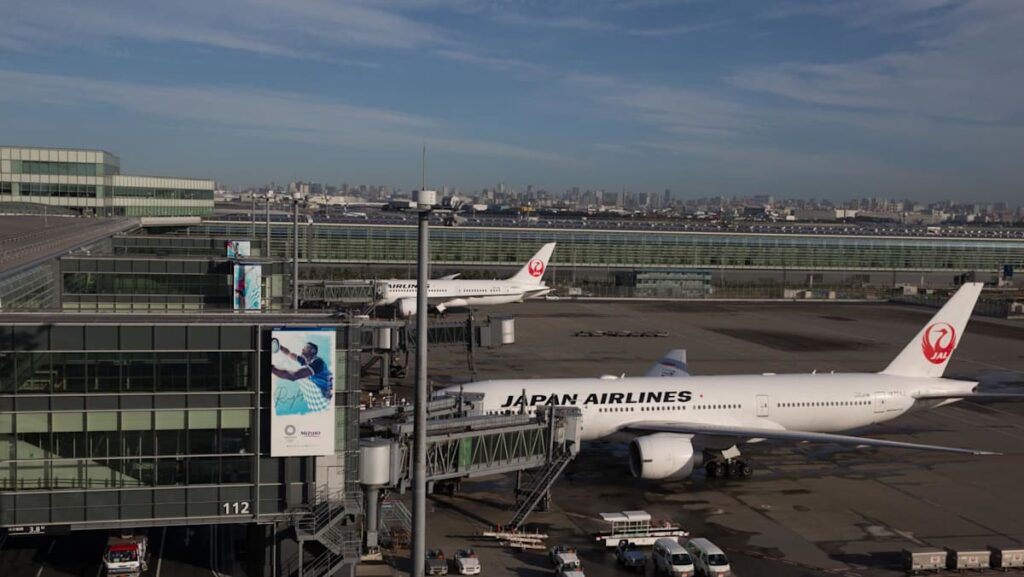
Humanoid robots will soon be involved in baggage loading and other ground handling operations at Tokyo’s Haneda Airport as part of a trial to reduce human workload and labour costs.
The trial, dubbed Japan’s first “demonstration experiment” for the use of humanoid robots at airports, will begin in May, according to a joint press release by Japan Airlines (JAL) and GMO AI & Robotics Trading on Monday (Apr 27).
Ground handling operations currently rely heavily on manual labour, with airport staff needing to operate various types of ground support equipment within limited spaces around aircraft, both companies noted.
“Conventional fixed automated facilities and single-function robots have had difficulty adapting flexibly to these existing infrastructures and complex operational workflows.”
The trial will therefore focus on humanoid robots that “possess a range of motion and adaptability comparable to humans”.
“Being human-shaped allows their introduction without significant modifications to existing airport facilities or aircraft structures,” JAL and GMO said.
In the future, the robots are expected to be used across a wide range of tasks, including baggage loading, cabin cleaning, and ground support equipment operations.
“By combining cutting-edge AI technology with the unique flexibility of humanoid forms, the project aims to realise a sustainable operational structure through labour savings and workload reduction.”
The trial is set to take place in phases until 2028.
It will start with visualising and analysing operations at airport sites to identify areas where humanoid robots can operate safely.
Repeated “operational verifications” simulating real airport environments will be conducted, with the goal of establishing a “sustainable operating model” and having humanoid robots support human workers, JAL and GMO said.
The companies added that the aviation industry is currently facing a “serious challenge” due to ground handling labour shortages, driven by factors such as an increase in inbound tourism and a falling working-age population.
Ground handling operations also require highly skilled personnel to maintain safety, particularly in tasks such as aircraft marshalling and baggage or cargo handling, which impose “significant physical burdens”.
Through the trial, the companies aim to create an environment where humanoid robots can “operate safely and effectively” in airport operations, support “sustainable development” in the aviation industry, and promote workplace transformation at airports.