


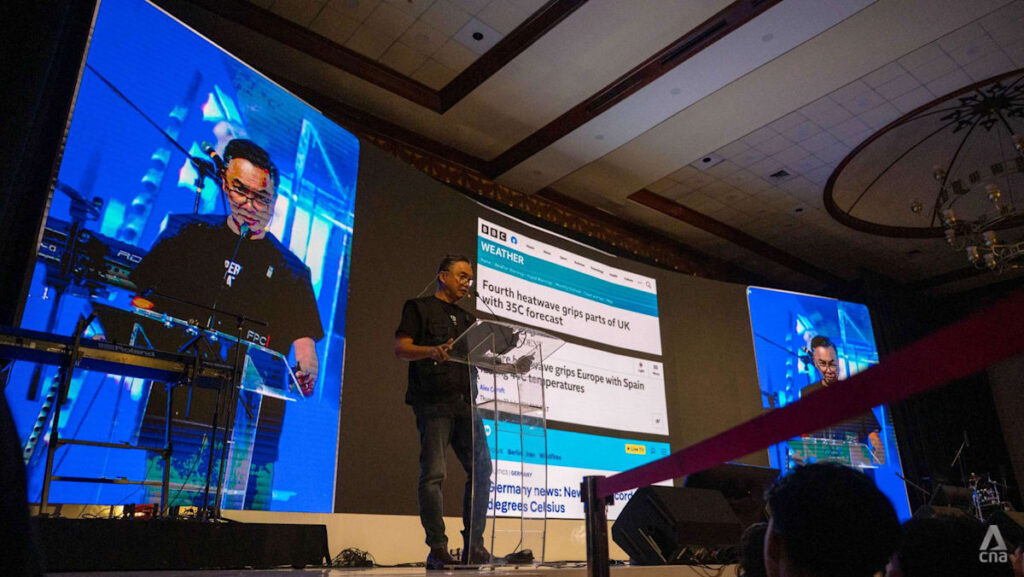
JAKARTA: Indonesia has been urged to seize the opportunity to emerge as a leader in global climate diplomacy, with geopolitical turmoil and mounting global economic pressures making the transition toward net-zero emissions no longer a long-term agenda that can be postponed.
Opening the Indonesia Net-Zero Summit (INZS) 2026 at Balai Kartini in Jakarta on Saturday (Aug. 1), Dino Patti Djalal, Chairman and Founder of the Foreign Policy Community of Indonesia (FPCI), said that climate change has become “the greatest blind spot in world affairs” today.
With wars unfolding in several regions, rapid advances in artificial intelligence, intensifying trade competition, and other global challenges, climate change has slipped down the list of international priorities.
“It has become something that is interesting, but no longer considered urgent,” he said.
Against this backdrop, Dino has urged the Indonesian government to play a more active role in climate diplomacy, including within the G20, whose member states account for nearly 80 percent of global greenhouse gas emissions.
Indonesia is a member of the G20, or Group of Twenty, an international forum that brings together the world’s major advanced and emerging economies to discuss and coordinate economic policy.
The other members include South Africa, the United States, Saudi Arabia, Argentina, Australia, Brazil, India, UK, Italy, Japan, Germany, Canada, South Korea, Mexico, France, Russia, China, Turkey, the African Union, and the European Union.
According to Dino, Indonesia should also speak candidly to the United States about the consequences of its withdrawal from the Paris Agreement, emphasising that the decision has harmed the international community including Indonesia.
As the US resumes promoting coal use, other countries in the world are forced to shoulder a greater emissions burden. “We hope they will listen,” he said.
Another concrete step Indonesia can take is to participate actively in COP31, which will be held in Antalya, Turkey, this November.
The Conference of the Parties (COP) is the supreme decision-making body of the UN Framework Convention on Climate Change. All states that are parties to the convention are represented at the COP.
“There was a time when Indonesia vigorously championed forestry issues because that was our comparative advantage. The world has no greater natural carbon sink than tropical forests. That gives us considerable leverage in building international cooperation,” Dino told CNA.
He added that biodiversity is another area in which Indonesia has a distinct advantage and can build international coalitions while encouraging other countries to strengthen their commitments.
“Biodiversity is one of Indonesia’s greatest assets. The international community is also willing to invest in biodiversity protection. In fact, there is already a global convention dedicated to conserving biodiversity,” Dino said.
“I spoke with the Minister of Environment today, and he agreed that biodiversity is the answer.”