


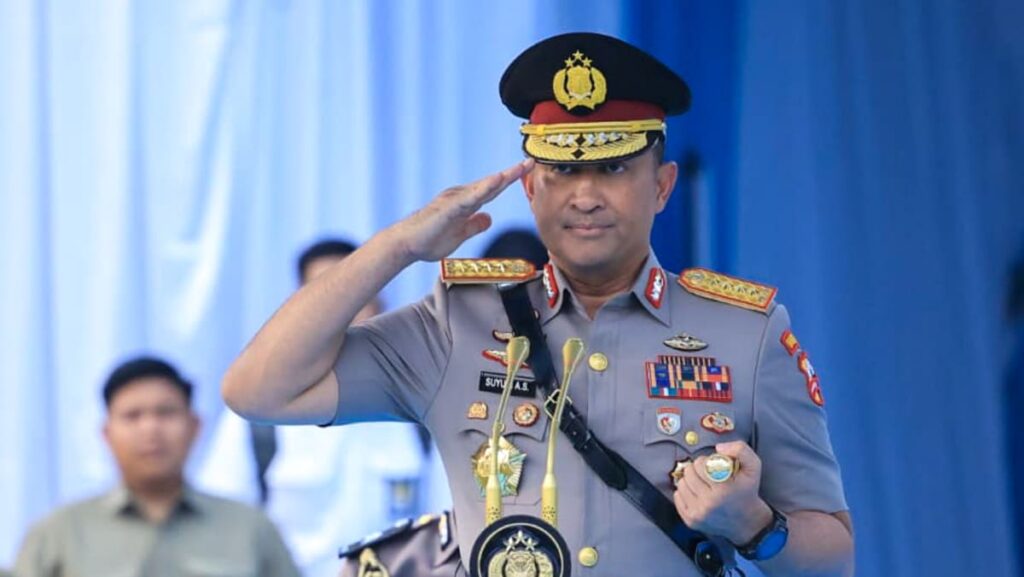
SWIFT CHANGES
The police overhaul that Suyudi ordered reached some of the most powerful positions in the national police hierarchy.
Asep Safrudin, formerly the police chief of the Riau Islands province, was appointed head of the national criminal investigation agency. His predecessor Syahardiantono has been reassigned to the presidential staff office.
Meanwhile, former Jakarta police chief Asep Edi Suheri has been appointed chief of the National Police’s General Supervision Inspectorate. He succeeds Wahyu Widada, who has been moved to serve as a high-ranking officer at the ministry of agrarian affairs and spatial planning.
Riau province police chief, Herry Heryawan, who has prior experience in criminal investigation, the police’s counterterrorism unit Densus 88, and regional command roles, was appointed to oversee public security and order. He replaces Karyoto, who will retire at the end of this month and who, like some Indonesians, goes by one name.
Dedy Kusuma Bakti, who previously held a senior intelligence and security role, was promoted to take the overall lead in those functions.
Former national police commissioner Poengky Indarti said these key appointments represented a natural progression for them given their relevant prior experience.
“The (police’s) professionalism will be strengthened, and this signals a positive trend for the enhancement of the national police’s performance,” she added.
The changes also extended well beyond national headquarters.
Nineteen of Indonesia’s provincial police chiefs were rotated on Oct 3, including commanders responsible for Jakarta and several of the country’s most populous provinces in Java, as well as resource-rich provinces in Sumatra and Sulawesi.
Suyudi also changed the leadership of Densus 88 by promoting its deputy chief, Tubagus Ami Prindani, to head the unit.
He appointed a new cybercrime director, Suhermanto, who had previously been assigned to the national narcotics agency.
In all, 70 senior and mid-ranking officers were promoted or given new appointments.
“He wants to make radical changes,” Bambang said, arguing that the speed could be intended to signal the necessity of reform. He described the overhaul as unusually fast and likened its scale to “bedol desa”, an Indonesian expression referring to moving an entire village.
He said one possible explanation was that Suyudi wanted both generational renewal and also to disrupt established structures within the police.
Head of non-governmental organisation (NGO) Indonesia Police Watch (IPW) Sugeng Teguh Santoso said the reshuffle was designed partly to remove centres of influence associated with Suyudi’s predecessor.
Suyudi has strong political backing to make such changes as he was President Prabowo’s sole pick to become the police chief.
“It appears the strategy is to completely overhaul the personnel at national police headquarters first, and only then consolidate the programmes,” Sugeng said.
“This is so the new police chief can control the institution under one command.”
But not all experts saw the speed as particularly significant.
Former national police commission commissioner Poengky said that while the turnaround appeared quick, early reshuffles by incoming police chiefs are not unusual.
Former police chief Tito Karnavian, who is now home affairs minister, moved 110 personnel nine days after becoming police chief in July 2016, she noted, while Idham Azis transferred 170 personnel seven days after taking office in November 2019.
“There is nothing strange or problematic with this reshuffle,” Poengky told CNA, describing such rotations as part of “regeneration, renewal and organisational strengthening”.
She also argued that several appointments matched officers with their expertise, citing Dedy’s appointment to lead intelligence and Herry’s move to the security maintenance agency following experience in criminal investigations, counterterrorism and regional policing.
“Essentially, professionalism is being strengthened,” she said.