


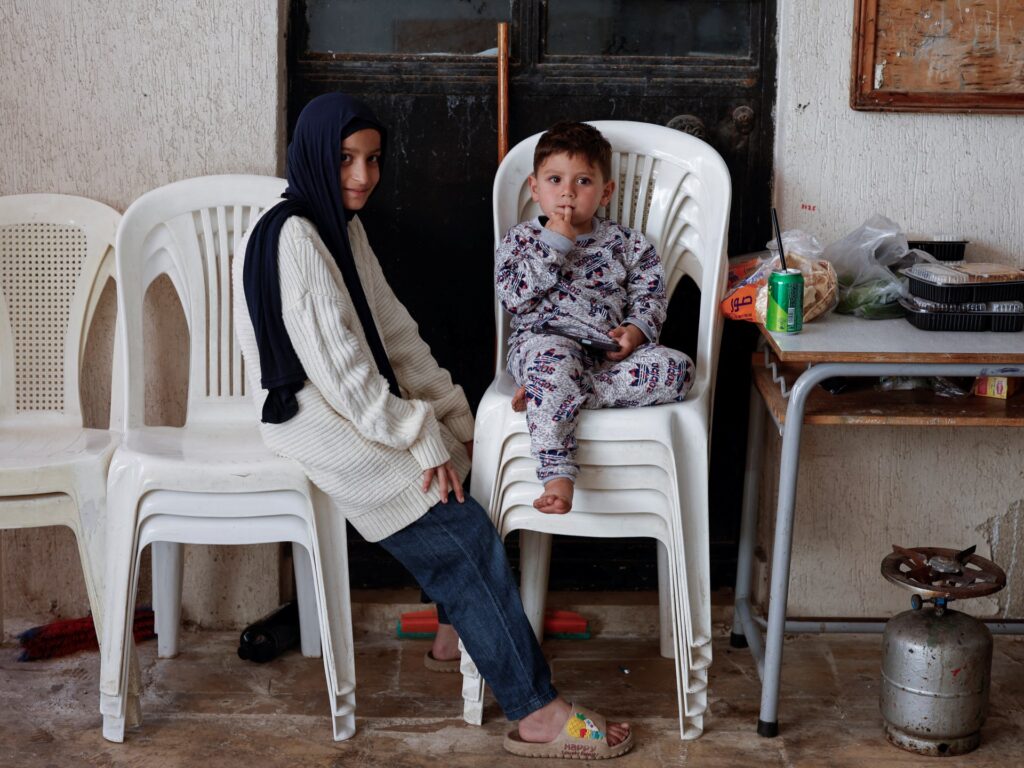
Froun, Lebanon – Abbas Makki is the principal of a school in the village of Froun, in southern Lebanon. He sits behind the desk in his office, preparing for the return of students to his school, which is also doubling as a centre for displaced people in the village.
Froun is littered with rubble from buildings destroyed by Israeli air strikes. Local officials say most of the village still has no state-provided water or electricity. This means that as the return to the school year approaches in Lebanon, many of the displaced are unable to return home.
Recommended Stories
list of 3 itemsend of list
“Our area has been devastated,” Makki said. He noted that the school reopened on the first day after a US-declared June truce was announced between Lebanon and Israel. And now, after the summer break, it will reopen again – but continue to provide shelter for those in need.
“We will reopen the school [for students], but will not abandon the displaced people,” Makki said.
Returned to rubble
Israel’s war on Lebanon intensified for the second time in two years in March. Two days after Israeli and US attacks killed Iran’s Supreme Leader Ayatollah Ali Khamenei, the Iranian-backed Lebanese group Hezbollah responded by attacking Israel for the first time in more than a year.
The Israeli response to those strikes was devastating. The Israeli military re-invaded southern Lebanon – after largely pulling out in early 2025 – and forced the displacement of more than one million Lebanese, mostly from southern Lebanon, the Bekaa Valley in the east, and Beirut’s southern suburbs.
In April, US-brokered direct negotiations between Israel and Lebanon began, despite Hezbollah’s preference for indirect talks. In late June, a framework agreement was reached between the two sides, including “pilot zones” where Israel would pull out its troops and the Lebanese Army would enter to disarm Hezbollah.
Froun, a town in the Bint Jbeil district about two hours’ drive south of Beirut, was one of three villages included in the pilot zone programme, despite local residents saying that Israel had never taken control of the town.
Still, shortly after the framework agreement was announced, locals who had fled the fighting in the area started returning to the town, only to find piles of concrete rubble where their homes once stood. Some, like Soujoud Ramadan, have taken to living at the local school.
Ramadan now runs a small market by the entrance to the school, where she sells snacks and basic household necessities. She said she opened the market here because the town centre and its surrounding areas had been destroyed, forcing residents who need to visit a shop to travel by car to villages with less destruction.
“We returned here after the ceasefire to a completely destroyed village,” she said. “But I hope Froun will return like it was and even better.”
Renewed displacement
The public school year is set to start on Tuesday, September 15 in Lebanon. A local official told Al Jazeera that the Lebanese government had also set that day as a goal for restoring water and electricity to Froun.
Since the establishment of the framework agreement, many Lebanese sheltering in schools have returned to their homes, or found other accommodation.
But Israel’s attacks on southern Lebanon in recent days have driven some back from their homes. On Monday, Israel killed 12 people in southern Lebanon, including two children, after it hit a residential building and a car in the Nabatieh region’s Kfar Reman. According to Lebanon’s Ministry of Health, 4,381 people in Lebanon have been killed by Israel since March 2.
Today, hundreds of thousands of people are still displaced in Lebanon.
“A school cannot function simultaneously as a proper shelter and a normal learning environment,” said Maysoun Chehab, the senior education programme specialist in the Beirut office of the United Nations Educational, Scientific and Cultural Organization (UNESCO). “Where schools continue to accommodate displaced families, reopening will inevitably be delayed or classroom capacity reduced. The solution cannot simply be to evacuate families; dignified and safe alternative accommodation must first be secured.”
On September 2, Lebanon’s Education Minister Rima Karami said that every student would have access to schools for the 2026-27 academic year, and said public schools would have in-person classes wherever possible.
But during a tour of southern Lebanon, Karami noted that no displaced person sheltering in a school would be removed “without an alternative being offered”.
In Srifa, a town near Froun, local media reported that displaced people had been moved from the town’s public school to a local private school. And in Bourj Qalaway, just to the south, Lebanon’s Council of the South has reportedly planned to install 17 prefabricated classrooms where the village’s school used to be before it was destroyed in Israel’s attacks.
In Froun, Makki said prefabricated houses would be provided for the displaced to allow students to go back to school.
“The important thing is that we will not mistreat the people nor will we stop classes,” he said.
Damage to infrastructure
Even with efforts from the government and locals to reopen schools, educational experts said the new school year would be a massive challenge after the widespread damage to southern Lebanon.
“Lebanon is not facing a normal school reopening; it is trying to protect education amid continued hostilities, displacement and extensive damage to schools,” Chehab told Al Jazeera.
She added that more than 340 schools have been damaged and 454 have been affected by conflict or displacement-related disruption.
“The immediate challenge is to rehabilitate schools and replace lost equipment, but the deeper challenge is to prevent a generation from paying the price of the conflict,” she said.
Students in Lebanon have had their school years disrupted for each of the last seven years, creating a lost generation of students.
“Education cannot wait for complete political or security stability,” Chehab said. “Every effort must be made now to return children to safe learning, support their teachers and restore a sense of normality and hope. Protecting education today means protecting Lebanon’s human capital, social cohesion and future.”