


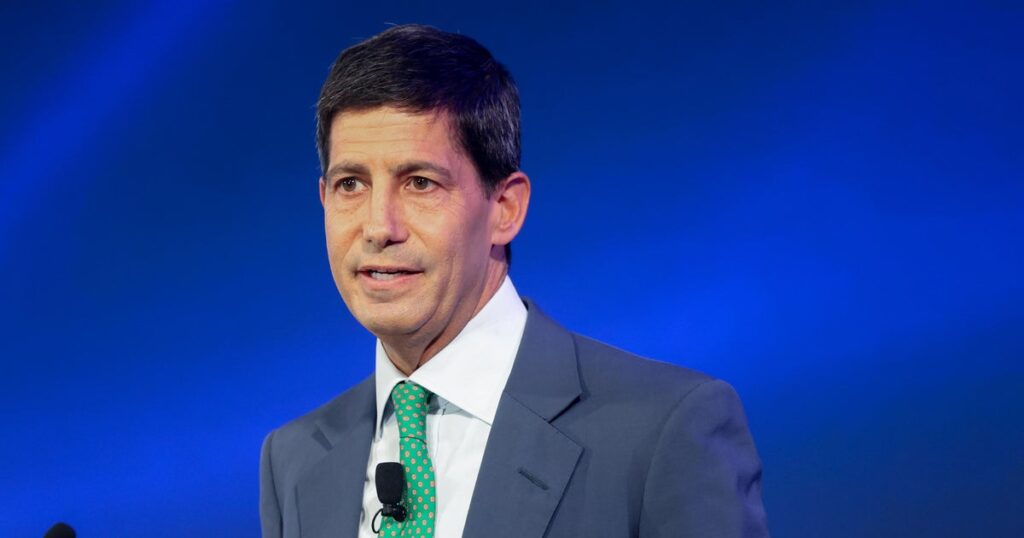
Kevin Warsh, President Trump’s nominee to replace Jerome Powell as chair of the Federal Reserve, is set to face questions regarding his views on inflation, interest rates and other economic issues at a Senate Banking Committee hearing on Tuesday.
A majority on the 24-member panel must vote in favor of Warsh’s nomination to advance it to the full Senate for a vote, with approval in the chamber also requiring a simple majority.
Warsh is widely expected to be confirmed to succeed Powell, whose term expires on May 15. One potential roadblock is Sen. Thom Tillis, a Republican from North Carolina who previously said he wouldn’t approve the nomination until the Department of Justice concludes an investigation into Powell.
In an interview with CNBC on Monday, National Economic Council Director Kevin Hassett expressed support for Warsh and said he expects the former Fed board governor to be confirmed.
David Wessel, director of the Brookings Institution’s Hutchins Center on Fiscal and Monetary Policy, told CBS News in an email that he expects Warsh to highlight his commitment to keeping prices stable while avoiding any explicit promises to adjust interest rates.
Here are key areas senators are likely to address during Warsh’s confirmation hearing, which is scheduled to start at 10 a.m. ET.
Interest rate cuts
Warsh was viewed as “hawkish” on inflation during his tenure as a Federal Reserve board governor from 2006 to 2011, generally prioritizing controlling inflation through tighter monetary policy. By contrast, “dovish” policymakers tend to favor keeping rates lower to boost economic growth.
More recently, however, Warsh has signaled support for lower rates, suggesting that AI could help keep prices down by accelerating economic productivity. In a November 2025 op-ed in the Wall Street Journal, he wrote that “AI will be a significant disinflationary force.”
Lawmakers are likely to press Warsh on whether he still favors easing borrowing costs amid a jump in inflation this year, as the Iran war drives up U.S. and global energy costs.
Tierney L. Cross / Bloomberg via Getty Images 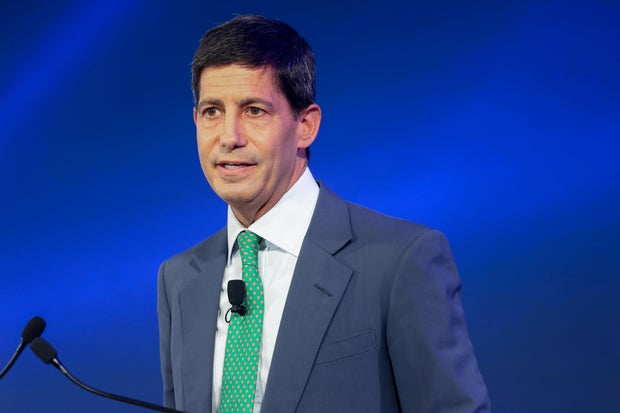

“Although Warsh has argued for lower rates, we do not view him as structurally dovish,” Deutsche Bank analysts said in a research note last week. “Instead, his views have tended to skew hawkish relative to others.”
President Trump has repeatedly called for the central bank to cut rates, something he’s likely to continue pushing for once the new Fed chair is sworn in. Asked last week on Fox Business whether he expects interest rates to decline, he said, “when Kevin gets in … interest rates should be much lower.”
The Fed’s benchmark interest rate is set by majority vote among the 12 members of the Federal Open Market Committee. That means Warsh won’t have unilateral power to set interest rates even if he wins confirmation. Meanwhile, with U.S. inflation rising last month to a 3.3% annual rate — the highest reading in nearly two years — Warsh could face resistance convincing other Fed officials to ease rates.
Fed balance sheet
Warsh is also likely to field questions at Tuesday’s hearing about his support for shrinking the Federal Reserve’s balance sheet, according to Wall Street analyst Adam Crisafulli of Vital Knowledge.
Warsh has previously argued that such a policy could help temper inflation and limit the amount of money circulating in the economy, opening the door to additional rate cuts, Deutsche Bank said in its report. Reducing the balance sheet often leads to higher interest rates, while expanding usually lowers borrowing costs.
A smaller Fed balance sheet also would provide a better lending environment for small businesses and consumers, Warsh wrote in his Wall Street Journal op-ed last fall.
Deutsche Bank analysts said in the report last week that Fed officials seem to be coalescing around the idea that reducing the balance sheet will be a slower process that requires more fundamental changes at the central bank. The focus at Tuesday’s hearing will be on “whether Warsh confirms this more gradual pathway to balance-sheet reduction,” the analysts wrote.
As of mid-April, the Fed’s balance sheet was $6.71 trillion, according to Trading Economics, up from $6.54 trillion in December. The balance sheet ballooned after the 2008-09 financial crisis, when the Fed bought trillions of dollars of government and mortgage-backed bonds in a move to lower interest rates and support economic growth.
Warsh’s wealth
Outside of his plans for the Fed, Warsh could face questions from Democratic senators over his personal wealth, Wessel told CBS News, adding that some lawmakers are “unhappy with the opaqueness of his financial disclosures.”
Warsh’s financial disclosures put his net worth at well over $100 million, far exceeding the wealth of previous Fed chairs. He is married to cosmetics heiress Jane Lauder, whose net worth Forbes estimates at $2.5 billion.
The regulatory filing, released last week, states that Warsh would stop working as an adviser for the private investment firm of billionaire Stanley Druckenmiller and divest some of his holdings if he is confirmed as Fed chair.