


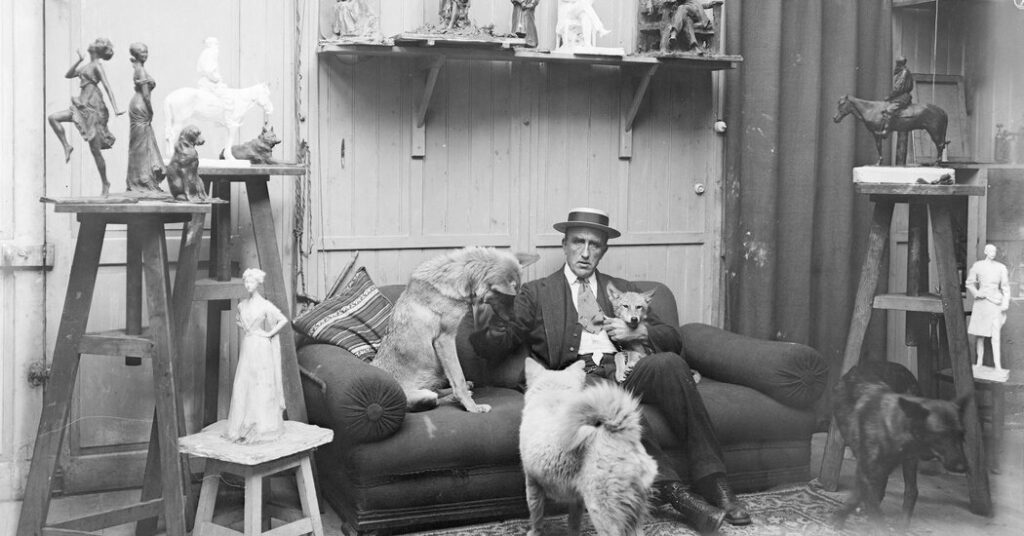
It’s likely that the name Paul Troubetzkoy won’t ring many bells with readers today. But a century ago, the sculptor was a globe-trotting portraitist feted by the rich to consolidate their wealth and fame, just as they seek out the photographers Tyler Mitchell or Annie Leibovitz today.
Italian by birth, a Russian prince by origin and a Parisian by adoption, Troubetzkoy also spent many years in the United States. From the late 1880s until his death in 1938, his spirited sculptures breathed life into the likenesses of the global A-listers of the time: Leo Tolstoy; Giacomo Puccini; the Rothschild, Vanderbilt and Rockefeller families; even early stars of American cinema like Mary Pickford and Douglas Fairbanks.
When Troubetzkoy exhibited at the famed Colnaghi gallery in London in 1931, the catalog included a preface by the Irish playwright George Bernard Shaw, a friend, who called him “the most astonishing sculptor of modern times.”
Later art avant-garde critics were less kind. Troubetzkoy had found his style — fluid, tactile modeling that captured movement — early on and stuck with it. In the long run, it was his steadfastness to a figurative ideal that dimmed his flame.
As other artists moved toward abstraction, critics “tended to overlook him,” said Omar Cucciniello, the curator of an exhibition running through June 28 at the Gallery of Modern Art in Milan. Titled “Paul Troubetzkoy: The Sculptor of the Belle Époque,” the show seeks to redress decades of relative neglect, bringing together dozens of works by what a wall text describes as “a naturally cosmopolitan artist.”
The Museums Special Section
The exhibition, which had a first run at the Musée d’Orsay in Paris last year, features loans from museums and private collections in Britain, France, Italy, Spain and the United States that reflect Troubetzkoy’s peripatetic existence.
A Russian prince by lineage and born in 1866 in Intra, a town on Lake Maggiore in northern Italy, Troubetzkoy trained briefly in Milan and moved in the city’s bohemian circles. During a walk-through of the show last week, Cucciniello said that Troubetzkoy’s noble origins “opened doors with Milan high society, specifically the more progressive circles” with more modern tastes.
Troubetzkoy rejected the traditional, historical subjects encouraged at art academies during that time. “He was interested in what he saw, in what he felt,” Cucciniello said. Troubetzkoy “had an incredible ability to observe things with a keen eye,” Cucciniello added. “He doesn’t have a sense of tedious, refined detail. Everything holds together, everything vibrates as a whole.”
Troubetzkoy was speaking during a visit to the United States, where he later settled from 1914 to 1920. Like other newspapers of the era, The Times chronicled his stay, enthralled by his pedigree and social connections, as well as his lifestyle: Troubetzkoy was a passionate vegetarian (a practice that he shared with his friends Shaw and Tolstoy), and he traveled with a pack of dogs — and sometimes a wolf — in tow.
In 1915, reporters were present and “cameras snapped like a battery of machine guns,” according to The Times, when Troubetzkoy spun his car around a racecourse, “circling the track — the wrong way,” in a qualifying round to race Harry Harkness, the president of the Speedway Corporation. He even made news even when he got a traffic ticket in Manhattan, with three Russian wolfhounds in the car, and was fined $8.
Troubetzkoy had numerous solo shows in various American cities, and each time “the local papers would publish something about him even before he arrived,” said Anne-Lise Desmas, a curator at the J. Paul Getty Museum in Los Angeles who worked on the Paris exhibition and the catalog. He was a natural self-promoter, she said: “He was a prince, and everyone was fascinated by that”; his Swedish wife, Elin Sundström, was chic and beautiful, and “they were not snobbish,” happily speaking to the press.
Many American museums have Troubetzkoys in their collections, because after the private collectors of his time died, their heirs often gave the works to the local museum, Desmas added.
His American stay ended with the inauguration of a monument to Gen. Harrison Gray Otis that Troubetzkoy sculpted in 1920, in MacArthur Park in Los Angeles. Today, the piece is diminished after copper thieves made off with one of the figures in 2024.
Although Troubetzkoy traveled the world, his heart never strayed far from Lake Maggiore, where he was raised with his two brothers in a villa overlooking the water. His family eventually sold the villa, which is now a condominium, but in 1912 Troubetzkoy bought another property on the lake in the nearby town of Suna. Troubetzkoy moved back permanently in 1932 and moved among the international aristocracy and the wealthy Milanese industrial class who flocked to Lake Maggiore at the time.
“He lived his first years and his last” on the lake, said Stefano Martinella, who works in the historical archives of the Museo del Paesaggio in Pallanza, next to Suna. The museum owns the world’s largest collection of Troubetzkoys, which the artist’s family donated to the museum after his death.
Pallanza’s lakefront is dotted with several works by Troubetzkoy, including a bust of the conductor Arturo Toscanini, who vacationed there. The museum lent 44 works from its collection of more 340 pieces for the Milan and Paris shows. The museum also has documentation of Troubetzkoy’s life, including a video that plays on a loop showing Troubetzkoy joking with Shaw as he sculpts the writer’s portrait.
The museum’s collection was mostly known to Troubetzkoy scholars, but Federica Rabai, the museum’s director, said she hoped that the artist’s refound fame would bring more visitors eager to explore his extraordinary life.
“He’s a character you never stop discovering,” Rabai said. “There’s always something new.”
Paul Troubetzkoy: The Sculptor of the Belle Époque
Through June 28 at the Gallery of Modern Art in Milan; gam-milano.com