


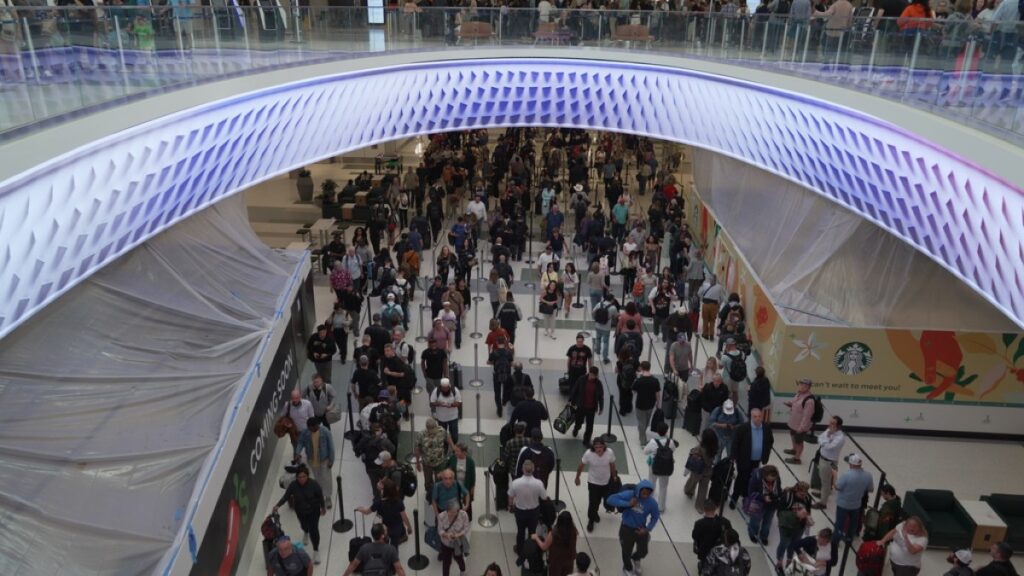
For more than a month, employees of the US Transportation Security Administration (TSA), tasked with screening the millions of people who pass through airports across the United States each day, have not been paid.
The result can be seen in videos that have spread across social media, showing frustrated travellers waiting in long lines at some of the country’s busiest airports, where hundreds of TSA employees have quit or declined to show up for work.
Recommended Stories
list of 3 itemsend of list
Hours-long delays have snarled airports, and morale among agency employees has suffered amid the lack of pay, the result of a partial government shutdown affecting the Department of Homeland Security (DHS), which oversees the TSA.
The administration of US President Donald Trump has deployed federal agents from US Immigration and Customs Enforcement (ICE) to airports across the country to fill gaps. That step that has drawn criticism given their lack of relevant training and a record of aggressive methods.
The delays also come at a time when the US-Israel war on Iran has resulted in additional complications when it comes to international travel, from cancelled or rerouted flights to heightened energy prices and concerns over security.
Taken together, analysts warn that the situation has created an image of systemic dysfunction and called into question the safety and reliability of the country’s air travel system.
“For years we’ve bragged about how the US has the best and safest aviation system in the world,” said William McGee, a researcher and consumer advocate at the American Economic Liberties Project.
“I’m not sure that’s something we get to say anymore.”
Exhausted workforce
More than 450 TSA workers have quit since the partial shutdown began on February 14, according to a CNN report citing Lauren Bis, acting assistant secretary for public affairs at DHS.
Call-out rates have also risen from an average of about two percent before the shutdown to around 10 percent last week. TSA did not respond to a request for updated figures.
Frustration among TSA employees has been compounded by the fact that many also went without pay during a previous government shutdown during contentious budget negotiations in October and November, the longest in history.
Everett Kelley, president of the American Federation of Government Employees (AFGE), a labour union that represents workers from numerous government agencies, including TSA, says the growing exhaustion is a natural response to the professional and financial instability workers experience.
“Across the country, TSA officers are once again being asked to report to work without a paycheck. They have families, mortgages and bills like everyone else,” Kelley said in a statement emailed to Al Jazeera.
Statistics on call-outs also don’t capture the full story, with some airports functioning normally while others experience chaotic delays and higher rates. Major airports in cities such as New York, Atlanta, and Houston have seen rates of nearly 30 percent or higher.
With conditions at each airport variable and hard to predict, McGee likens delays to a game of “Whac-A-Mole” that can occur at one location even as they ease at another.
“The bottom line is that, if you have to travel right now, you need to be getting to the airport very early,” he said.
Social media users have shared stories of showing up at the airport with ample time in advance and still missing their flights after waiting in line for several hours.
A spokesperson for the Port Authority of New York and New Jersey, which oversees operations at major airports such as John F Kennedy International and Newark International, told Al Jazeera in a statement that while the Port Authority does not rely on federal funds to operate, workers for federal agencies such as TSA still do.
“Over the last several days, we’ve begun to see that translate into long wait times at security checkpoints during certain periods depending on passenger volumes, TSA shift changes and staff breaks, and the number of TSA staff who come to work for each shift,” the statement says.


Political impasse
The situation is the result of a political stalemate over continued funding for DHS, which was set aside during the last shutdown for separate negotiations over immigration enforcement agencies such as ICE and US Customs and Border Protection (CBP). The impasse comes amid continued demands from activists and Democratic lawmakers to rein in immigration agencies, fuelled in part by the high-profile killing of US citizens such as Renee Good and Alex Pretti by federal agents during a crackdown in Minnesota in January.
Widespread public anger over aggressive methods and what rights groups say are routine civil liberties violations during the Trump administration’s mass deportation raids led to calls to rein in agencies and implement reforms.
But to pass a funding bill to reopen the government in November, both parties agreed to negotiate DHS funding at a later date. That impasse is behind the current partial shutdown, which began when funding lapsed on February 14.
Several bills put forward by Democrats to fund TSA while a larger deal on DHS is worked out have failed to pass, with both sides blaming the other for chaos at airports across the country.
“Democrats have offered to pay the salaries — fully fund, no conditions — for TSA,” Democratic Senator Sheldon Whitehouse said in a recent social media post. “It’s Republicans who keep blocking that.”
“Democrats are holding American travellers hostage and denying federal workers their paychecks for political leverage,” the White House social media account said in a post on Friday, sharing a video of long lines at an airport.
Media reports on Tuesday stated that the US Senate is moving to advance a bill that would fund much of DHS, including TSA, to address ongoing travel chaos, as an agreement focused on ICE reforms is worked out later.
McGee says that the situation has created a sense of general dysfunction.
“The US has launched a war against Iran, and because of that, there are heightened security concerns. That TSA is not being paid in that environment is kind of mind-boggling,” he said.
“On top of that, you have flight changes, logistical concerns, and rising energy costs,” he added. “It’s all a hot mess right now.”