


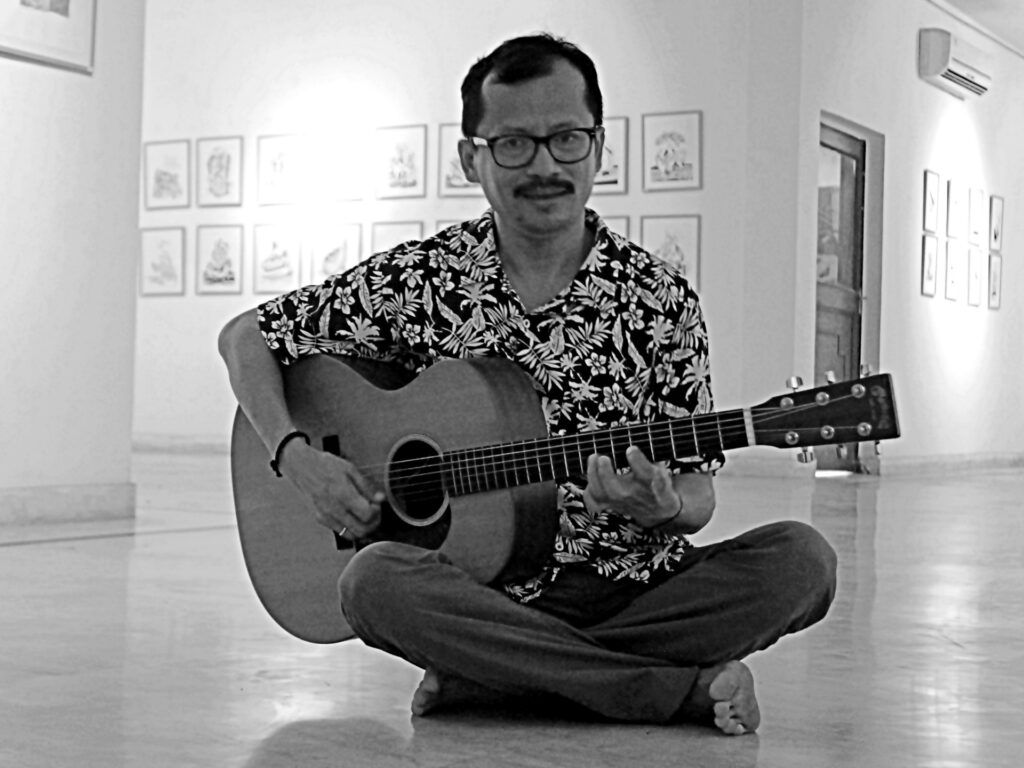
New Delhi, India — Late on Sunday night, Chongtham Vikram Singh was troubled by loud noises outside his home in the Indian capital, where he lived with his son and wife. He climbed down the stairs, but an argument ensued with nearly a dozen men, who chased him back to the third floor of his apartment.
The chase ended with 54-year-old Singh, a renowned guitarist from India’s northeastern state of Manipur, left unconscious on the stairs by the mob. Within hours, he had died from his wounds at a nearby hospital.
Singh’s killing has revived anxieties over entrenched racial discrimination and marginalisation that people from the northeastern states have long faced in the rest of India.
For his friends and fans, the tragedy comes as Manipur enters a fourth year of a deadly civil war that has displaced tens of thousands in the state.
“Vikram is an icon and legendary guitar player for us,” said Akhu Chingangbam, a popular Manipuri lyricist and singer. “That’s his heritage. He inspired generations to pick up guitar in the land where the arms and lives are so cheap.”
Singh’s tragic end, after teaching music for 20 years in the capital, is a reminder, Chingangbam said, that racism is a stark reality for thousands of domestic migrants from India’s northeast.
‘Best person you can come across’
In New Delhi, Singh gave private music classes and helped young musicians to gain a foothold. Back in Manipur, he was a rock star, the guitarist of a popular, socially conscious rock band – Eastern Dark.
The 54-year-old was among the region’s rock pioneers in the early 1980s.
The Eastern Dark band’s name is also a nod to the political marginalisation of people in northeastern states, including Manipur.
“We living in the east are living in this dark; in every aspect it’s dark socially, politically and anywhere you look. Our lifestyle and, geographically, every aspect of our life is dark,” Eastern Dark vocalist Heishnam Malemngangba Lokeshwar told a researcher in 2020.
Manipur has seen decades of armed rebellion, involving ethnic groups fighting Indian rule and, at times, each other.
Two decades back, Singh moved to New Delhi “to make something out of life”, said Chingangbam, Singh’s friend, “to expand the horizon and opportunities as a musician”.
Chingangbam remembers him as “the finest guitarist” he knew, but also as the person with the widest smile in the room, who would exchange stories during their jamming sessions. “He would always shake my body when he burst into a laugh,” Chingangbam said, recalling their days together in New Delhi. “Vikram was the best person you can come across in the world.”
Chingangbam also grew up listening to Singh’s music. When he was lined up to play at the music festival NH7 Weekender in 2016, Singh took him to a friend to get him a new acoustic guitar.
“But look at what it came down to — how he succumbed in Delhi,” Chingangbam told Al Jazeera. “It is a tragedy for people like us, who don’t feel safe anywhere. With war at home, we just don’t have a place where we feel secure, protected.”
The Delhi police have arrested eight accused, including a minor, on charges of murder, but have not commented on the motive behind the murder yet.
India’s ‘long history of racism’
Singh’s killing led to a wider outcry against years of marginalisation of people from the northeast in mainland India, where casual racism has become commonplace.
In 2014, the killing of Nido Taniam, a 19-year-old from India’s far northeastern state of Arunachal Pradesh, triggered by racial slurs over his appearance, led to protests in the capital. It also pushed the government, then led by the Congress party, which is now in opposition, to set up an independent committee to examine the larger concerns among the communities.
The committee found that about 86 percent of more than 200,000 northeastern migrants had experienced some form of racial discrimination in New Delhi, followed by metros including Mumbai, Hyderabad and Chennai.
The committee recommended an antiracism law, with non-bailable charges and investigation within 60 days, followed by fast-tracked trials. The new incoming government, led by Prime Minister Narendra Modi, did not adopt the suggestions.
The roots of the racism that people from northeast India face go back to colonial times, said Deepak Kumar, an assistant professor at the University of Hyderabad, with a focus on the northeastern states.
“It has a very long history. Under colonial rule, the British characterised the people from the northeastern regions as Mongoloid,” an offensive racial category to identify Indigenous communities in parts of Asia, he added.
“They developed policies that dealt with northeastern provinces differently than what was the idea of mainland India back then,” Kumar said.
In postcolonial India, with power centralised in New Delhi, several issues of regional identities and autonomy erupted. And with increased liberalisation of India’s economy and the migration of more people from northeastern India, the cultural differences became apparent and “created more conditions to complement existing racism”, Kumar told Al Jazeera.
Singh’s killing is headline racism, argued Kumar, but the rot lies in what he calls footnote racism. “They are charged extra to buy vegetables on the streets. People stare at them in a packed room. It is a daily reality,” he added.
‘Our legend’
Following Singh’s killing, India’s opposition leader Rahul Gandhi on Tuesday hit out at Modi and his close confidante, Home Minister Amit Shah, for “growing lawlessness, especially against people from the northeast”.
Gandhi wrote in a post on X: “After many such incidents, every Northeast family in Delhi is asking the same question today – are we safe here?”
Laishram Kangleinganba, the president of the Manipur Students’ Association Delhi, told Al Jazeera that despite the swift arrest of the accused men, the community is not hopeful of justice.
“The attack on him was vicious and unprovoked,” he said. “And I felt like: ‘Here we go again’. It has been decades of racial discrimination; all of us have worked for years to create awareness, but nothing changes.”
“This attack might happen to my friends or me one day — but it is happening to one person or another daily,” the 24-year-old said.
Kangleinganba said he had grown up listening to Singh’s music. “I don’t remember how I discovered Vikram. He was just around, always, since my childhood,” he said. “He was our first exposure to rock.”
Singh’s friend, Chingangbam, said these memories that the late guitarist left behind will ultimately define his legacy — not the violence that ended his life. “And we need to preserve his memory. He is our legend,” Chingangbam said.