


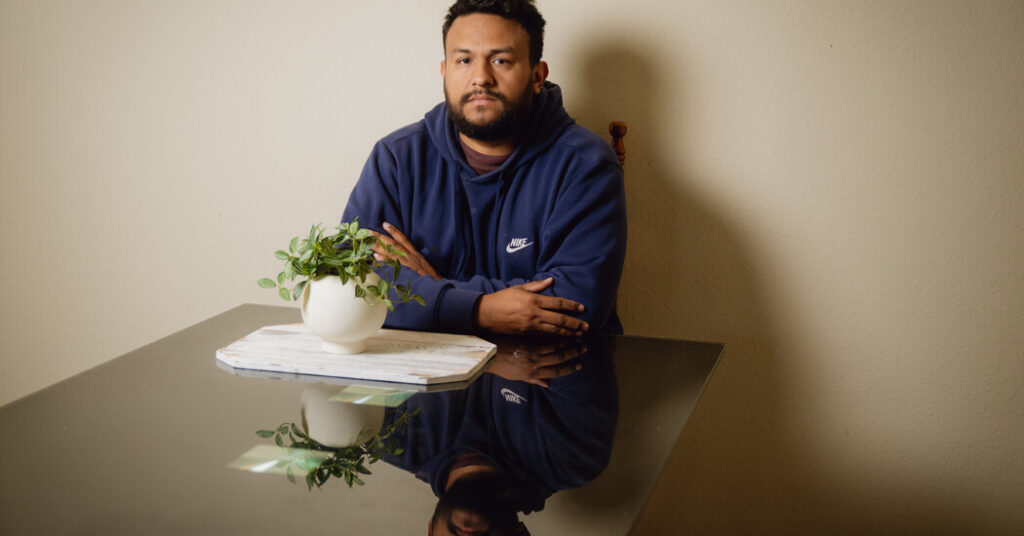
When Yoalbert González drove his mother to an immigration appointment in December, she was detained and, weeks later, deported to Venezuela, like many thousands of others from her country during President Trump’s second term.
Mr. González, 34, a delivery driver in Fort Worth who arrived at the U.S. border in 2021 seeking asylum, was terrified of the same fate and decided to leave the country voluntarily.
But he quickly found that leaving wasn’t as simple as booking a flight.
Many Venezuelans, including Mr. González, had their passports confiscated when entering the United States, under a longstanding federal policy to speed up deportation should they be denied asylum — leaving them unable to fly home.
Venezuelan officials require a valid passport or a government-issued travel permit for entry by airplane. This document is available only in Caracas, Venezuela’s capital, or in select consulates in Latin America, which have been overwhelmed by such requests.
This makes replacing a passport nearly impossible for many of the nearly 700,000 Venezuelans who have arrived in the United States since 2019. While the U.S. government recently restored diplomatic ties with Venezuela, the Venezuelan Embassy in Washington remains closed to the public and no Venezuelan consulates are open in the United States to issue travel documents.
The process for obtaining a travel permit can also be cumbersome and costly. A direct relative must request the document in person in Caracas and file with the authorities a travel itinerary and a letter detailing the applicant’s reasons for returning.
Some desperate Venezuelans have risked traveling on dangerously overcrowded boats to reach South America since they cannot travel by plane. Panamanian authorities say more than 20,000 people took boats through their waters in the year since Mr. Trump returned to office. The vast majority were Venezuelans.
One reason Venezuelans say they are leaving the United States voluntarily is their fear of being deported without their children — or spending long periods in detention if they are apprehended.
“I heard that a lot of people went to their appointments and were kept in custody. Then it happened to my mother. It was so frustrating, and I thought it might happen to me,” said Mr. González, who received authorization to live and work in the United States while his case for asylum was pending.
He was also granted Temporary Protected Status, or T.P.S., which has been given to nationals of designated countries experiencing upheaval or other adverse conditions. The Trump administration eliminated this protection for more than a half-million Venezuelans last year, a move that remains tied up in litigation, but has nevertheless ended the status for many.
The United States and Venezuela have developed a closer relationship following the capture of President Nicolás Maduro in January by U.S. forces. Now, as Washington restores diplomatic relations with Delcy Rodríguez, the acting leader in Venezuela, many Venezuelans hope that the travel bottleneck will be addressed.
According to Oliver Blanco, a Venezuelan diplomat, the country’s diplomatic mission to the United States is back under its control and officials will “gradually begin registering Venezuelans in the United States in order to identify their consular needs and resume consular services as soon as technical, operational and logistical conditions permit.”
In a statement, the State Department said the arrival of Venezuelan officials in Washington was a step toward restoring diplomatic and consular relations.
Critics say, however, that Washington and Caracas are not moving fast enough. The Venezuelan-American Caucus, a Miami-based advocacy group, said that the nascent diplomatic ties must move beyond “symbolic gestures” and that Venezuela must immediately restart basic consular services.
Adam Isacson, a border expert at the Washington Office on Latin America, a human rights group, said that the Trump administration, having launched an immigration crackdown, should be keen to facilitate travel for Venezuelans who want to return home.
“We know they’re beyond anxious to get Venezuelans to self-deport,” Mr. Isacson said about Trump administration officials, “so it’s surprising to me that they haven’t been able to push Chavismo to fix this,” he added, referencing the Socialist movement founded by the former Venezuelan president, Hugo Chávez, and to which much of the ruling party belongs, including the current president.
Since May of last year, U.S. authorities have offered to pay immigrants to “self-deport” through a government app, CBP Home. And while the Department of Homeland Security has said “thousands” have successfully completed the process, many Venezuelan applicants have reported difficulties.
Jennifer Ibañez Whitlock, senior policy counsel at the National Immigration Law Center, said the advocacy organization consistently heard that the app “was not working for Venezuelans,” as it required applicants to have a valid passport to complete the process.
At the same time, the Venezuelan government has launched a media campaign promoting the repatriation of some of the roughly eight million people who fled the country as part of one of the largest displacement crises in Latin America’s recent history.
Yelitza Pérez, a 29-year-old Venezuelan immigrant who arrived in the United States in 2022, said that she had applied for the CBP Home program in early February “but did not hear back.”
She obtained a travel document in March with her mother’s assistance in Caracas. But when she arrived at Miami International Airport, airline agents would not accept it, saying it was possible the travel document was fraudulent. Ms. Pérez was stranded at the airport with her two children.
Mr. Blanco, the Venezuelan diplomat, said the country’s authorities would “ensure the recognition and validity of travel documents” by coordinating with neighboring countries and airlines.
Miler Angulo, 32, who has an expired passport and lost her T.P.S. status in November, has seen her plans to return home repeatedly blocked. “It feels like having two walls closing up on me,” she said.
Ms. Angulo added that she had been so terrified of being detained that she has only left her New York City apartment to walk her dog and to commute to her job cleaning houses.
Mr. González, the delivery driver in Fort Worth, also obtained a travel permit through his uncle and bought a ticket to return this week. His wife and children reached Venezuela and are waiting for him.
He arrived at Miami International Airport on Wednesday afternoon for a 7:30 a.m. flight the next morning, but he wasn’t allowed to check in. The gate agent told him he had to arrive 24 hours early to verify his travel permit. He paid a fine and hoped he would be allowed to board another flight on Friday morning.
“This country opened its doors for us, but it also shut them down,” he said. “The only thing I wish for is to be with my family already.”
Annie Correal, Isayen Herrera and Tibisay Romero contributed reporting.