


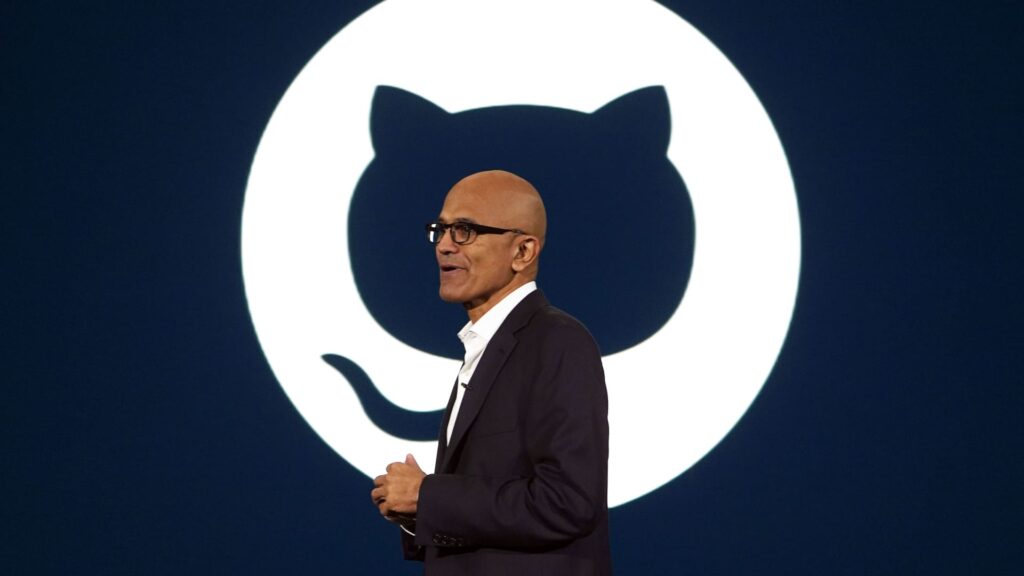
Microsoft CEO Satya Nadella speaks at a company event on artificial intelligence technologies in Jakarta, Indonesia, on April 30, 2024.
Dimas Ardian | Bloomberg | Getty Images
Microsoft had all the pieces to win in vibe coding, thanks to the near ubiquity of GitHub, which the company bought for $7.5 billion in 2018.
But repeated outages, executive turnover, and the soaring popularity of newer tools like Cursor and Anthropic’s Claude Code have eaten away at GitHub’s early advantage in generative artificial intelligence, creating another challenge for Microsoft CEO Satya Nadella as he attempts to straighten out his company’s AI story.
GitHub’s reliability challenges in recent months have affected companies as large as Cisco, and have been chronicled by influential names in software development. Mitchell Hashimoto, co-founder of HashiCorp, which IBM acquired last year, wrote in a blog post last month that GitHub “is no longer a place for serious work if it just blocks you out for hours per day, every day.”
Early Wednesday, GitHub said an employee’s device was compromised in a security incident. The attacker was able to obtain about 3,800 of GitHub’s own code libraries.
Some companies are seeking alternative tools that manage and deploy code. And there are options, whether it’s GitLab or offerings from Amazon and Atlassian. Jyoti Bansal, CEO of software delivery startup Harness, said his company has even explored launching a code storage feature.
“We are hearing real concerns from enterprise customers, and more of them are actively looking at alternatives,” said Bansal.
For Nadella, whose 12-year run at the helm of Microsoft is highlighted by a successful pivot to cloud computing, the AI era is proving to be more daunting. With the generative AI boom now well into its fourth year, Microsoft has struggled to carve out a clear lane despite playing a central role early on due to the company’s hefty investment in OpenAI and its vibrant cloud infrastructure business.
Microsoft, which widely promotes its Copilot technology, has lagged behind internet rivals in creating AI tools and services that resonate with users. That helps explain why its stock price is down 13% this year, trailing all of its megacap peers.


Microsoft vs. the Nasdaq this year
With GitHub, Microsoft’s flubs are more pronounced because the service gave the company a distinct homecourt advantage with coders. GitHub has six times more developers than when Microsoft bought the company eight years ago.
In the so-called devops market, GitHub is well ahead of GitLab, according to client spending data from startup Ramp, which issues corporate credit cards. And according to Stack Overflow’s 2025 developer survey, GitHub is the most popular tool for collaborative work management or code documentation.
The software repository market saw a surge in usage with the onset of AI-assisted coding, or vibe coding, as agentic AI allowed developers to ramp up their production. Nadella said in October that GitHub was “growing at the fastest rate in its history, adding a developer every second,” to a total of 180 million developers. Later in the year, GitHub started seeing faster growth in the creation of code libraries and the acceptance of code revisions.
On the latest earnings call in April, Nadella said, “When it comes to developers, GitHub itself is seeing unprecedented growth, driven by proliferation of agentic coding, and we are hard at work to scale and meet this demand.”
Too much downtime
But under the added pressure, GitHub’s infrastructure has sagged. Since March, GitHub has suffered over a dozen incidents lasting more than an hour, according to its status page.
“We have not met our own availability standards,” Vlad Fedorov, GitHub’s technology chief, wrote in a March blog post. At that time, 12.5% of GitHub traffic was going through a region of Microsoft Azure data centers in Iowa, with plans to serve 50% of traffic from Azure by July, he wrote.
Instead of relying strictly on Azure, GitHub has for years counted on dedicated data center infrastructure in northern Virginia. With the extra load, GitHub effectively ran out of space, said two people familiar with the issue who asked not to be named in order to discuss internal matters.
The Information previously reported on GitHub outages.
GitHub leaders have, on multiple occasions, considered moving heavily to Azure, which has data centers across continents, but those plans were shelved, said one of the sources. The other said GitHub has intended to move to Azure, but the migration has taken a very long time. Negotiations with Microsoft around capacity needs have delayed GitHub’s Azure adoption, the people said.
GitHub former CEO Thomas Dohmke speaks at the Collision conference in Toronto on June 27, 2023.
Chloe Ellingson | Bloomberg | Getty Images
Meanwhile, there’s been turmoil at the top. Thomas Dohmke announced his departure as CEO in August after about four years on the job. He’s yet to be replaced.
Some GitHub employees went to work for Julia Liuson, a 34-year Microsoft veteran who was running the developer division. Liuson announced her retirement in April.
Earlier this month, Microsoft Xbox chief Asha Sharma, who previously worked on GitHub as president of product for the CoreAI engineering group, said GitHub Vice Presidents Tim Allen and Jared Palmer were joining her division.
GitHub declined to comment.
To deal with the onslaught of usage, managers have even looked beyond Azure. Today the service counts on Amazon, Google, Microsoft and Oracle for cloud infrastructure, in addition to maintaining its own facilities.
“While we were already in progress of migrating out of our smaller custom data centers into public cloud, we started working on path to multi-cloud,” Fedorov wrote in an April blog post. He said GitHub’s top priority was availability and making sure its services are functioning properly.
There have been some embarrassing flubs.
Ryan Oksenhorn, co-founder of drone delivery startup Zipline, wrote in a post on X last month that his company was evaluating GitLab and Atlassian’s Bitbucket after GitHub accidentally undid code revisions, and subsequently provided instructions on recovering changes. Oksenhorn called it a “terrible, terrible bug,” noting that his company was “still cleaning up their mess” after GitHub failed to provide support.
GitHub’s own engineers, who can use GitHub Copilot as much as they want, don’t always fully review the code that AI agents propose, said one of the sources. Corporate policy prohibits employees from merging code without human review, said a third person, who also asked to remain unnamed in order to discuss internal matters.


Downtime isn’t the only problem.
“Right now people are tired of the instability, the product churn, the Copilot AI noise, the unclear leadership, and the feeling that the platform is no longer primarily designed for the community that made it valuable,” Armin Ronacher, creator of the open-source Flask software for building web applications, wrote on his blog. “Obviously, GitHub also finds itself in the midst of the agentic coding revolution and that causes enormous pressure on the folks over there. But the site has no leadership! It’s a miracle that things are going as well as they are.”
The outages have affected part of Cisco, which is communicating the problem to its customers, said DJ Sampath, a vice president at the company. Sampath said Cisco has “fail safes,” and runs enterprise versions of GitHub on its own servers.
GitLab CEO Bill Staples has been trying to capitalize on GitHub’s challenges.
“Tired of the pain yet? Come to GitLab and take back control of your destiny,” Staples wrote in a post on X. “I’ll even throw in the first year free for anyone switching from GitHub who signs a new three-year agreement.”
Without mentioning GitHub by name, Staples told employees in a memo that “platforms that weren’t built for machine scale are starting to break under it.”
Copilot features
For GitHub, it’s a particularly inopportune moment to be losing customers. Few markets are growing faster than AI-assisted coding.
OpenAI said in April that 4 million people were actively using its Codex coding agent, up from 3 million less than two weeks earlier. Anthropic’s Claude Code tool has shot up in popularity this year, a big reason why the company’s private market valuation recently climbed to $900 billion from $380 billion in February.
Cursor has continued to gain rapid usage, and forged a deal with SpaceX in April, giving Elon Musk’s company the right to acquire it for $60 billion. Cursor overtook GitHub Copilot in market share about a year ago and has kept the lead among customers that use Ramp, according to that company’s data.
A March survey of 636 software professionals from engineering analytics startup Jellyfish showed that GitHub Copilot was less widely used than Claude Code and Google’s Gemini Code Assist. That’s after Nadella said in January that GitHub Copilot had 4.7 million paid Copilot subscribers, up 75% from a year earlier.
GitHub was there first, having announced Copilot in 2021. Fedorov talks internally about the need for Copilot to regain leadership, one of the sources said. Executives push employees to match Cursor’s latest features, two people said.
“I think the overall impression is that they fell behind, because they’re one of the first movers, but then didn’t really enhance quite as quickly as some of the independents have done,” said Tom Murphy, an analyst with technology industry researcher Gartner.
Dohmke, GitHub’s most recent CEO, wrote in a post on X last month that the company hasn’t properly invested in AI, noting that more than 90% of employees “were assigned to the core product and primitives.”
“Making Copilot the scapegoat for the availability issues isn’t something previous or current leadership will agree with,” he wrote.
GitHub said in April that it was temporarily turning away requests for new individual GitHub Copilot plans, which start at $10 a month.
“As Copilot’s agentic capabilities have expanded rapidly, agents are doing more work, and more customers are hitting usage limits designed to maintain service reliability,” Microsoft Vice President Joe Binder said in a blog post. “Without further action, service quality degrades for everyone.”
GitHub wants to make Copilot’s economics more favorable. In June it will start charging based on how much people use it. GitHub provided a calculator to help customers figure out their new costs, and social media posts suggest the service is getting considerably more expensive. And that might lead some developers to abandon Copilot.
Jeremy Bray, a former senior software developer at FanDuel Sports Network, said he stopped paying for GitHub due to the price increase.
“I canceled my GitHub Pro account, so now I’ve just got the normal free account, which can’t do a whole lot,” Bray said.
WATCH: The catalyst for Microsoft’s stock will be continued AI growth, says BofA’s Tal Liani
