


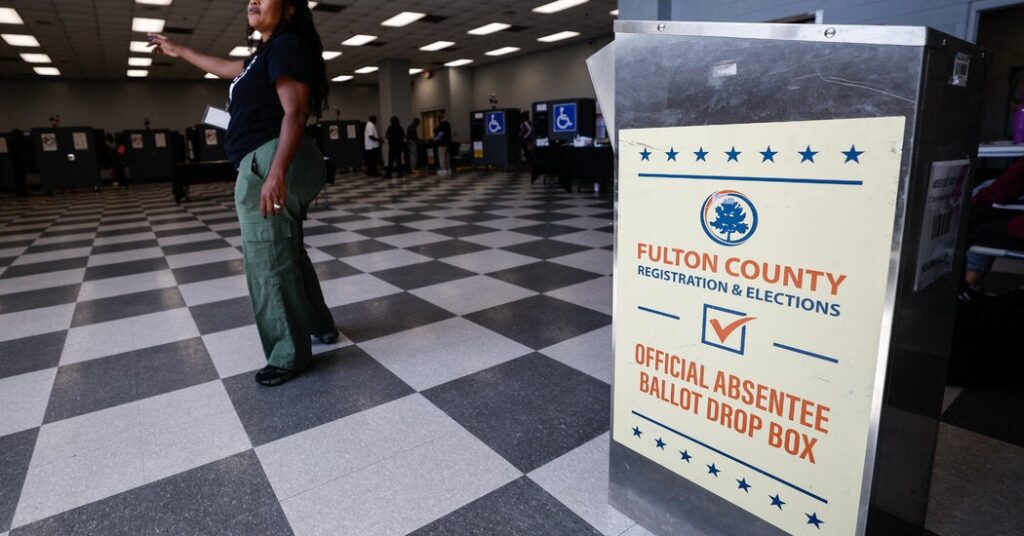
Election Day is Tuesday, but about 50 million ballots have already been cast, with early turnout outpacing the last midterm cycle in each of the major Senate battlegrounds.
In several key states, the share of registered Democrats has increased in the early vote, which includes mail-in ballots and early in-person voting. The overall picture offers few positives for Republicans, who saw strong early in-person turnout in 2024. And the surge provides indications that it could be a high-turnout election in the realm of 2018 and 2022, which set records for midterm turnout.
But millions of voters will cast their ballots on Election Day — in recent elections, around half of the votes nationally have come that day — and the impact of the early vote will be known only after polls close. That makes it difficult to pinpoint what those early votes say about each race.
While the early vote can’t reliably predict who is going to win, the numbers through Monday morning offer clues about which subgroups are turning out, and there are a few warning signs for Republicans.
Early turnout is up, with Democrats at an advantage.
In every Senate battleground that we are tracking, the number of early ballots cast has surpassed the total number of early ballots cast in 2022. That year trailed only 2018 for total turnout in a midterm election. (Midterms typically run well below presidential elections in total voters.) In Maine, South Carolina and Texas, early turnout this year is closer to what was seen for the 2024 presidential election.
Democrats have traditionally been more likely to vote before Election Day than Republicans, so their advantage in the early vote was to be expected. Still, in several states, the partisan makeup of the electorate is even more Democratic than it was in 2024. (In Georgia, where voters do not register with a political party, The Times estimates partisanship using party primary participation.)
The increased early turnout could be a sign that overall turnout will be much higher this year. But it is unreliable to project overall turnout by extrapolating from early vote totals. Such an inference would have vastly overestimated turnout in 2024, for instance, when the share of early in-person votes surged in many competitive states.
It is possible that the higher early-vote tallies are a matter of people who would have previously voted on Election Day deciding to vote early instead.
In the South, Black early turnout is up.
In Georgia, North Carolina and South Carolina — Southern states that went for Donald J. Trump in 2024 but are a focus of Democrats’ goal of flipping the Senate — Black voters make up a larger share of the advance vote than they did in recent cycles. (All three states record race on their voter files.)
Black voters in North Carolina made up 21 percent of early votes cast through Oct. 31, which was only a couple of percentage points higher than it was in 2022 and 2024. But with Black voters in these three states leaning so heavily Democratic — in 2024, Kamala Harris won between 87 and 90 percent of Black voters in each, according to Times Voter Trends — even small increases in their share of the electorate are significant.
The unanswerable question is whether a disproportionate number of Black voters chose to vote early this year rather than on Election Day, and whether Tuesday’s turnout will skew significantly toward white voters. In all three states, a majority of votes are typically cast during the early voting period, making the early vote in past years more representative than it was elsewhere.
Early voting gets younger as Election Day nears.
Older voters traditionally dominate the earliest ballots, as they tend to become politically engaged earlier in the cycle. That pattern is particularly pronounced during midterm elections, and this year is no exception.
For example, in Michigan, the median age of those who have voted so far is 67. That is roughly on par with 2022, when it was 65. (In 2024, it was 59.)
The final days and weeks of early voting, however, typically see a surge of young voters. Four weeks ago, about 11 percent of the ballots cast in Michigan came from those under the age of 45. In the past week, it was 30 percent.
Other states followed a similar trend. In general, mail ballots that are received later tend to lean Democratic. This could be relevant in states like Michigan, where in past elections, a batch of late-arriving mail ballots from Detroit grew the Democratic candidate’s vote share after Election Day.
Turnout in Texas surges in Hispanic counties.
The vast majority of Texans cast their ballots before Election Day, and early turnout in Texas this year has approached presidential levels, with ballots cast through Oct. 30 off by only 15 percent from the same point in 2024.
Given that the state is broadly seen as a tossup for the first time in decades, with a Senate race that has drawn hundreds of millions of dollars in spending, such high turnout is unsurprising. Still, the raw numbers are staggering. Nearly eight million Texans have cast their ballots thus far, rapidly approaching the total turnout of 2022 — including Election Day votes.
Turnout is highest in the most Hispanic counties. Of the eight counties running ahead of their 2024 totals, seven of them are more than 70 percent Hispanic. That could be good news for Democrats, with the most recent New York Times/Siena poll of Texas showing James Talarico, the Democratic candidate for Senate, leading among Hispanic voters by 38 percentage points.
But high turnout among this group is not always a good sign for Democrats. In 2020 and 2024, large South Texas counties with high Hispanic populations, like Hidalgo and Starr Counties, saw record-breaking turnout paired with massive Republican gains — and Mr. Trump flipped many of them two years ago.