


The state monarchy crisis is linked to a system unique to Negeri Sembilan, where the state ruler is elected by a council of four territorial chiefs (Undangs) rather than inheriting the throne through direct hereditary succession.
Under the system, Undangs hold the unique dual power to both elect and depose the ruler.
In an unprecedented move, the four Undangs had tried to topple Tuanku Muhriz on Apr 19, claiming misconduct by him.
The Undangs sought to replace him with Tunku Nadzaruddin Tuanku Ja’afar, the son of the previous ruler.
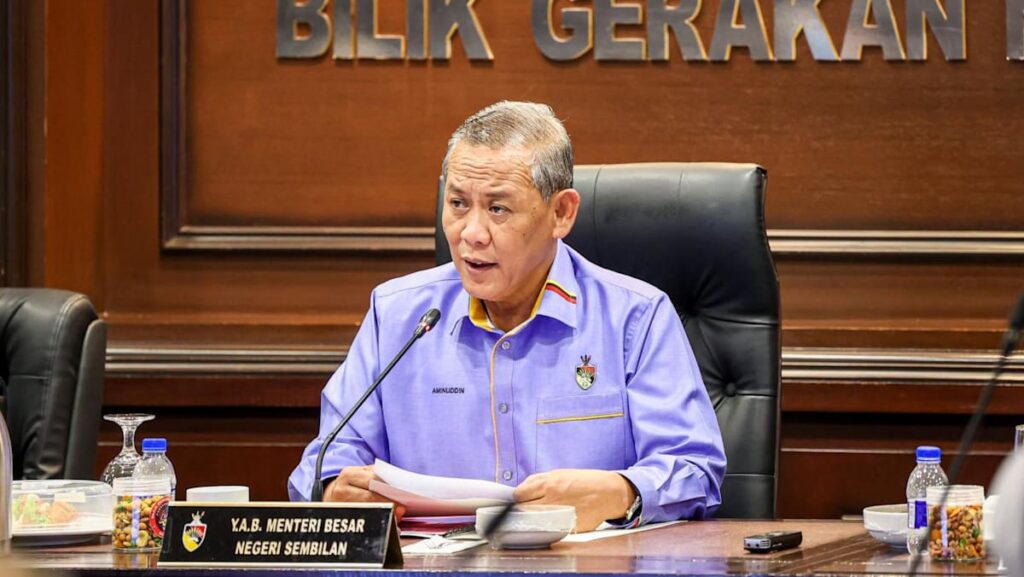
A day later, Aminuddin dismissed the Undangs’ attempt and declared the move invalid, claiming that one of the four Undangs had been removed from his position.
Referencing the royal tussle, the 14 UMNO assemblypersons then withdrew their support for Aminuddin, while emphasising that they respected customary institutions and the constitution and would not interfere in related matters.
Ahead of Thursday’s announcement, PH leaders and state assemblypersons from the coalition held an “emergency meeting” at Aminuddin’s official residence on Tuesday, local news outlets reported.
Addressing talks of a possible state assembly dissolution, Negeri Sembilan Democratic Action Party (DAP) secretary Cha Kee Chin said in a Facebook post later on Tuesday that the meeting was a “regular” one. The DAP is a component party of PH.
“It was a regular meeting, not a special meeting. It was called an emergency meeting because of the short notice after the dissolution of the Johor state assembly,” he said.
Johor Chief Minister Onn Hafiz Ghazi, in announcing the dissolution of his state assembly, said that the move made way for the “democratic process through the official determination of the Election Commission of Malaysia”.
In Johor’s last state election in 2022, BN won a two-third majority in the state assembly.
CNA earlier reported that BN was preparing for early state elections in Johor and Melaka, quoting sources from within UMNO.
Opposition coalition PN had previously said that they will contest all 56 seats in the Johor polls, setting the stage for a three-cornered fight with BN and PH.
In Johor’s last polls, PN contested all seats and won three.
Although BN is aligned with PH at the federal level, they are rivals at the state level in Johor and Melaka.
Observers have said that the Johor state assembly dissolution will likely spark a series of state polls in the coming months, not just in Negeri Sembilan, but also Melaka and Perlis.
On Wednesday, Perlis state ruler Tuanku Syed Sirajuddin Jamalullail said he wants Chief Minister Abu Bakar Hamzah to continue leading until the end of the 15th assembly, stressing that political stability would affect investors’ confidence in the state.
Tuanku Syed Sirajuddin called on state assemblymen to put the people’s interests over personal interests, expressing hope that Abu Bakar would be given space to lead till the end of his term.
“I would like to remind all the Honourable Members that this government is my government. Therefore, I hope that the chief minister will be given the space to continue leading … without any disruptions that will hinder all the plans,” he told the legislative assembly.
His comments come amid tensions between main PN component parties Parti Pribumi Bersatu Malaysia (Bersatu) and Parti Islam Se-Malaysia (PAS), after eight PN state assemblymen – five from Bersatu and three from PAS – withdrew support for former Perlis chief minister Shukri Ramlil in December last year, citing corruption in several large state projects.
Abu Bakar, who is from Bersatu, later succeeded Shukri in what was described as an effort conspired by Bersatu to oust PAS and install its own chief minister.
On May 23, Abu Bakar said he would dissolve the state assembly if six PAS assemblymen table a no confidence vote against him.
Meanwhile, Melaka’s state election is due by February 2027. Separately, the current term for the Sarawak legislative assembly ends in February 2027 and a state election must be called by April that year.