


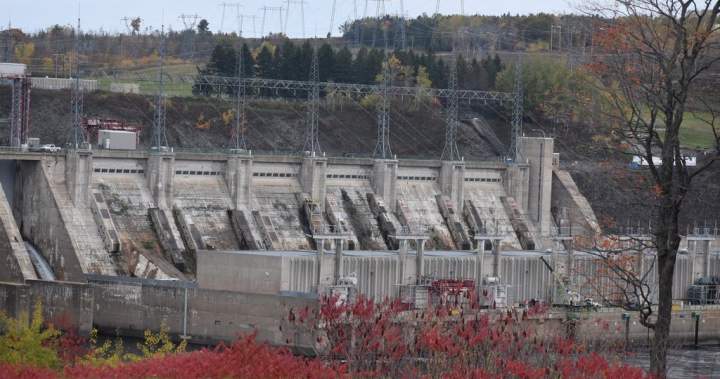
The federal government is spending nearly $270 million to help New Brunswick modernize a pair of energy facilities that officials say are key to Ottawa’s plan to double the capacity of Canada’s electrical grid by 2050.


The bulk of the money is a $219-million loan from the Canada Infrastructure Bank to extend the life of the province’s largest hydroelectric dam, located west of Fredericton on the Saint John River.
The province will also receive a $50-million grant to upgrade its Salisbury Terminal near Moncton, which officials say is key to managing the flow of electricity across the provincial grid.
Federal Energy Minister Tim Hodgson made the announcements Tuesday during a news conference in front of the massive Mactaquac Dam.
“New Brunswick is critical to this plan and so are today’s investments,” he said. “Together, these two projects will strengthen New Brunswick’s electricity system while creating jobs, attracting investment, supporting affordability, and lowering emissions.”
New Brunswick’s Crown-owned electric utility is preparing the 672-megawatt Mactaquac Generation Station for a multibillion-dollar overhaul aimed at extending its operational life to 2068.
The new funding will pay for technical studies, regulatory reviews, First Nations engagement and planning for the Mactaquac Life Achievement Project, according to Natural Resources Canada.


Get daily National news
Get daily Canada news delivered to your inbox so you’ll never miss the day’s top stories.
In 2016, NB Power agreed to a plan in 2016 to spend up to $3.6 billion to prolong the life of the dam, which would have otherwise been decommissioned by 2030 due to concrete swelling.
The new funding will support technical studies, regulatory reviews, First Nations engagement and planning for the Mactaquac Life Achievement Project, according to Natural Resources Canada.
On Tuesday, NB Power CEO Lori Clark said the total cost for the project is now expected to be close to $9 billion.
Hodgson would not commit the federal Liberal government to spending more on the dam, noting that electricity generation is within provincial jurisdiction.
However, he said the federal government will need to help provinces and territories keep costs low as they work to meet federal clean energy regulations that call for a net-zero electricity grid by 2050.
“In the budget coming up, you will see a number of initiatives we are working on to work … with provinces and territories to help them realize the growth that they need in an affordable way,” the minister told reporters.
“This is clearly an indication that we understand how important it is for our prosperity to grow our electricity generating capabilities and we understand that the federal government needs to do its part in helping to make that affordable.”
New Brunswick Premier Susan Holt said the Mactaquac Generating Station is important to the entire Maritime region.
In the event of a system-wide blackout, the dam can start generating electricity without relying on an external power supply, making the largest so-called “black-start” facility in the region.
“We often call it the battery of the Maritimes,” said Holt. “Having this kind of renewable energy that we can turn on and off is critical, not only to our province, but to our neighbours in Prince Edward Island and in Nova Scotia and beyond.” The dam supplies 30 per cent of the province’s renewable energy requirements and 20 per cent of its overall electricity demand, officials said.
The investments come as NB Power is looking for ways to fix ageing infrastructure without imposing massive rate hikes on its customers.
Since the 1980s, concrete portions of the the dam have been affected by a chemical process called alkali-aggregate reaction. The reaction causes concrete to swell and crack, requiring substantial repairs and maintenance.
Just last week, NB Power applied to the provincial regulator to raise rates by 17.4 per cent over the next three years as it plans to spend $4 billion on maintaining the provincial grid.
Some of that money will be used to transition the province’s only remaining coal-fired generating plant to a facility that burns wood pellets to generate electricity.
© 2026 The Canadian Press